Advertisements
Advertisements
Question
Write the mechanism of hydration of ethene to yield ethanol.
Advertisements
Solution 1
Step 1: Protonation of the alkene to form a carbocation by the electrophilic attack of H3O+.
\[\ce{H2O + H+ -> H3O+}\]

Step 2: Nucleophilic attack of water on carbocation.

Step 3: Deprotonation to form an alcohol.

Solution 2
The acid-catalysed hydration of ethene may be represented as:
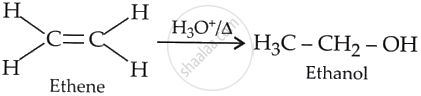
The mechanism followed by the above reaction may be depicted as:
Step 1: Generation of carbocation: Protonation of ethene yields a carbocation as,
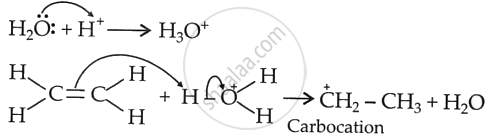
Step 2: Nucleophilic attack of water on carbocation: The carbocation polarises the lone pair electrons of O of water, and hydration takes place.

Step 3: Formation of product, regeneration of the proton:

APPEARS IN
RELATED QUESTIONS
Name the reagents used in the following reactions:

Name the reagents used in the following reactions:

Write the structures of the main products when acetone (CH3 − CO − CH3) reacts with the following reagents :
CH3MgBr and then H3O+
Show how will you synthesize 1-phenylethanol from a suitable alkene.
How is the following conversion carried out?
\[\ce{Propene -> Propan-2-ol}\]
Name the reagent used in the following reaction:
Butan-2-one to butan-2-ol.
Write the structures of A, B and C in the following reactions :
Primary alcohols are prepared by the reduction of carboxylic acids. Though lithium aluminium hydride is a strong reducing agent, it is not used in the reaction. This is so because:
Aldehydes are reduced to the corresponding alcohols by the addition of hydrogen in the presence of catalysts to form ____________.
Monochlorination of toluene in sunlight followed by hydrolysis by aq. \[\ce{NaOH}\] yields.
Alkenes convert into alcohols by ____________.
Acetone reacts with Grignard reagent to form:
Select the acid(s) which cannot be prepared by Grignard reagent.
The best reagent to convert pent 3 – en 2 – 01 into pent 3 – in – 2 – one is
Glycerol is used in the manufacture
An aldehyde isomeric with allyl alcohol gives phenyl hydrazone. Pick out a ketone that too gives a phenyl hydrazone containing the same percentage of nitrogen.
For distinction between \[\ce{CH3CHO}\] and \[\ce{C6H5CHO}\] the reagent used is ______.
How are the following conversions carried out?
\[\ce{Methyl magnesium bromide ->2-Methylpropan-2-ol}\]
