Advertisements
Advertisements
प्रश्न
Write the mechanism of hydration of ethene to yield ethanol.
Advertisements
उत्तर १
Step 1: Protonation of the alkene to form a carbocation by the electrophilic attack of H3O+.
\[\ce{H2O + H+ -> H3O+}\]

Step 2: Nucleophilic attack of water on carbocation.

Step 3: Deprotonation to form an alcohol.

उत्तर २
The acid-catalysed hydration of ethene may be represented as:
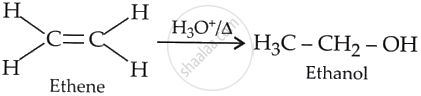
The mechanism followed by the above reaction may be depicted as:
Step 1: Generation of carbocation: Protonation of ethene yields a carbocation as,
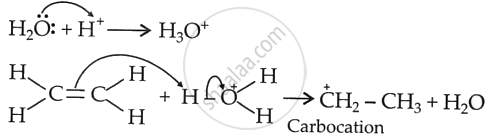
Step 2: Nucleophilic attack of water on carbocation: The carbocation polarises the lone pair electrons of O of water, and hydration takes place.

Step 3: Formation of product, regeneration of the proton:

APPEARS IN
संबंधित प्रश्न
Name the reagents used in the following reactions:

Write the main product(s) in each of the following reactions:

Write the structures of the main products when acetone (CH3 − CO − CH3) reacts with the following reagents :
CH3MgBr and then H3O+
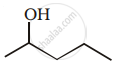
Show how you would synthesise the following alcohol from an appropriate alkene?
How will you convert: Phenol to 2, 4, 6 − trinitrophenol?
Aldehydes react with Grignard reagent to produce ____________.
Which of the following reacts with NaOH to give alcohol?
Select the acid(s) which cannot be prepared by Grignard reagent.
Most readily hydrolysed halide is:-
Glycerol is used in the manufacture
Glycerol as a trimester present in
Alkaline hydrolysis of an alkyl halide can be preferably carried out using ______.
The best reagent to convert pent - 3 - en - 2 - ol into pent - 3 - en - 2 one is ______.
To synthesise 1.0 mole of 2-methylpropan-2-ol from Ethylethanoate ______ equivalents of CH3MgBr reagent will be required. (Integer value)
An aldehyde isomeric with allyl alcohol gives phenyl hydrazone. Pick out a ketone that too gives a phenyl hydrazone containing the same percentage of nitrogen.
\[\ce{? ->[\Delta, CN-][EtOH, H2O]}\] Benzoin.
The reactant is obtained by dry distillation of the calcium salts of the following pairs:
Write the mechanism of acid dehydration of ethanol to yield ethene.
How are the following conversion carried out?
\[\ce{Methyl magnesium bromide -> 2-Methylpropan-2-ol}\]
