Advertisements
Advertisements
Question
Write down the significance of the following in the context of 'On to the Summit':
husiar.
Advertisements
Solution
- The word, 'husiar‘ means 'caution‘.
- The climb down from the summit was more difficult and dangerous than the climb up.
- There was a greater danger of slipping and falling into the Kangshung glacier below.
- Thus, even though climbing down took less time than climbing up, the author and Hillary had to be comparatively more cautious.
- With regard to this, the author notes that they needed 'husiar‘ while coming down.
APPEARS IN
RELATED QUESTIONS
In the following items, sentence A is complete, while sentence B is not. Complete sentence B, making it as similar as possible to sentence A. Write sentence B.
(A) It is probable that the ship will reach the shore.
(B) In all .................................................................................
In the following items, sentence A is complete, while sentence B is not. Complete sentence B, making it as similar as possible to sentence A. Write sentence B.
(A) When she heard the news of her daughter’s result, she was very happy.
(B) On ........................................................................................
What are the fears of the caged bird? Answer with examples from Maya Angelou’s poem.
But a caged BIRD stands on the grave of dreams
His shadow shouts on a nightmare scream
His wings are clipped and his feet are tied
So he opens his throat to sing.
Read the above lines and answer the question that follow.
What is the main conflict in this poem?
Which is the turning point in the poem?
What is the climax of Ray Bradbury’s “All Summer in a Day?”
Fill in the blank with an appropriate word:
The dog was hiding __________ the bed, barking at the stranger.
(A) If you are not ready to come with me, I will not go.
(B) Unless…………………………..
Read the following passage carefully and answer the questions that follow:
For some time Mother had greatly envied us our swimming, both in the daytime and at night, but as she pointed out when we suggested she join us, she was far too old for that sort of thing. Eventually, however, under constant pressure from us, Mother paid a visit into town and returned to the villa coyly bearing a mysterious parcel. Opening this she astonished us all by holding up an extraordinary shapeless garment of black cloth, covered from top to bottom with hundreds of frills and pleats and tucks.
‘Well, what do you think of it?’ Mother asked.
We stared at the odd garment and wondered what it was for.
‘What is it?’ asked Larry at length.
‘It’s a bathing-costume, of course,’ said Mother. “What on earth did you think it was?’ ‘It looks to me like a badly-skinned whale,’ said Larry, peering at it closely.
You can’t possibly wear that, Mother,’ said Margo, horrified, Shy, it looks as though it was made in nineteen-twenty.’
‘What are all those frills and things for?’ asked Larry with interest.
‘Decoration, of course,’ said Mother indignantly.
‘What a jolly idea! Don’t forget to shake the fish out of them when you come out of the water.’
‘Well, I like it, anyway,’ Mother said firmly, wrapping the monstrosity up again, ‘and I’m going to wear it.’
‘You’ll have to be careful you don’t get waterlogged, with all that cloth around you,’ said Leslie seriously.
‘Mother, it’s awful; you can’t wear it,’ said Margo. ‘Why on earth didn’t you get something more up to date?’
‘ When you get to my age, dear, you can’t go around in a two-piece bathing suit… you don’t have the figure for it.’
‘I’d love to know what sort of figure that was designed for,’ remarked Larry.
‘You really are hopeless, Mother,’ said Margo despairingly.
‘But I like it… and I’m not asking you to wear it,’ Mother pointed out angrily.
‘That’s right, you do what you want to do,’ agreed Larry; ‘don’t be put off. It’ll probably suit you very well if you can grow another three or four legs to go with it.’
Mother snorted indignantly and swept upstairs to try on her costume. Presently she called to us to come and see the effect, and we all trooped up to the bedroom. Roger the dog, was the first to enter, and on being greeted by this strange apparition clad in its voluminous black costume rippling with frills, he retreated hurriedly through the door, backward, barking ferociously. It was some time before we could persuade him that it really was Mother, and even then he kept giving her vaguely uncertain looks from the corner of his eye. However, in spite of all opposition, Mother stuck to her tent-like bathing- suit, and in the end we gave up.
In order to celebrate her first entry into the sea we decided to have a moonlight picnic down at the bay, and sent an invitation to Theodore, who was the only stranger that Mother would tolerate on such a great occasion. The day for the great immersion arrived, food and wine were prepared, the boat was cleaned out and filled with cushions and everything was ready when Theodore turned up.
One word answers or short phrases will be accepted.
- peering
- ferociously
- immersion
(b) Answer the following questions briefly in your own words.
- Why did mother not join the swimming in the beginning?
- Briefly describe her swimming costume.
- What did Larry think it was?
- Which sentence tells you that Margo thought it was old fashioned?
- What was Leslie’s concern?
- Why did mother think it was suitable?
(c)
(i) In not more than 60 words describe what happened after mother went upstairs to try on her costume.
(ii) Give a title to your summary in 3 (c) (i). Give a reason to justify your choice.
Fill in the blank with an appropriate word:
His teacher is very pleased ……… him.
In your opinion, does Boori Ma, the main protagonist of the story A Real Durwan, deserve the life that she meets at the end of the story? Give reasons for your answer.
Re-write the following sentence according to the instructions are given. Make other changes that may be necessary, but do not change the meaning of the sentence.
Has Alia written to you?
(Begin: Have you……….)
Re-write the following sentence according to the instructions are given. Make other changes that may be necessary, but do not change the meaning of the sentence.
The monsoon is the best season in our country.
(Rewrite using ‘good’)
Give an account of how Napoleon and his companions were unjust and cruel in their behavior towards the other animals.
Give reasons for the following.
The boy king changed his name from Tutankhaten to Tutankhamun.
(i) What do you understand by the terms `outsider art’ and `art brut’ or `raw art’?
(ii) Who was the “untutored genius who created a paradise” and what is the nature of his contribution to art?
The words ‘grip’, ‘dawn’. ‘usher’, ‘coin’, ‘passport’ have a literal as well as a figurative meaning. Write pairs of sentences using each word in the literal as well as figurative sense.
Try to write four lines of poetry or four sentences of prose with one of these as the starting point.
Which do you think are the most poetic lines? Why?
Distinguish between the following pairs of sentences.
He was visually impaired.
There are many instances of gentle humour in the story. Point out some of these and state how this contributes to the interest of the narration.
It is difficult to adjust to a fall from glory.
Write four to six lines of Free Verse on the topic ‘The road that leads to my college’. Express that it is the road to knowledge and bright future. You may begin like this: Every day I tread with the bag of books …
Use the phrase in a sentence of your own, after finding out its meaning.
blast off
We add ‘un-’ to make opposites. For example, true — untrue. Add ‘un’– to the word below to make its opposite. Then look up the meaning of the word you have formed in the dictionary.
answerable: ____________
What is beauty? Where can, in the poet’s opinion, beauty be seen, heard, and experienced?
Look at the sentences given below. Find out which one is correct. If the sentence is wrong give reasons.
List the reactions of the agricultural officer to the author’s inquiry about Kasbai rice seeds. One is done for you.
(a) He had not heard of Kasbai.
(b) ___________________________
(c) ___________________________
Match the following.
| Sr. No | A | B |
|
| 1. | Constitution | a. | It is the freedom to go where you want, do what you want, etc. |
| 2. | Liberty | b. | It is the state of being equal, especially in status, rights, or opportunities. |
| 3. | Equality | c. | It is a sense of common brotherhood. |
| 4. | Fraternity | d. | It is an aggregate of fundamental principles or established precedents that constitute the legal basis of a polity, organization, or other types of entity and commonly determine how that entity is to be governed. |
Complete the flow chart showing the events on the day of the assault.

The cherry tree is a narrative poem. Features that make it a narrative poem are given below. Justify them with proper examples.
It is a time-bound poem.
A brilliant student from your school has won a Mathematics Quiz at the National Level.
Frame questions to interview him/her when the school felicitates him/her. Follow the steps given below.
- Greetings
- Introduction of the interviewee and achievements.
- 2 or 3 questions about growing years.
- 4 to 6 questions about the achievements.
- 2 or 3 questions about future plans and prospects.
- Expression of thanks and good wishes.
Think of different ways of classifying them, for example, electric and non-electric, day-time sources and night-time sources
Place the given areas of questioning from the list in the appropriate columns.
- future plans
- inspiration
- overcoming hurdles/ struggle
- coach/ mentor/ guide/ teacher
- message for the youngsters
- family support
- alternate career choice
- first or maiden award/ achievement /success /setbacks
- a turning point in life/ success formula/technique.
| Section of the interview | Aspects to be covered | |
| 1. | Introduction | Welcoming/Greeting, Introduction of the guest/Occasion. |
| 2. | Opening questions | |
| 3. | Main body | |
| 4. | Concluding questions | |
| 5. | Summing up | Concluding the statement, Expressing gratitude. |
You can add your points.
Gather information on any one of the following by talking to your elders, family members, and from other sources in your mother tongue and write a short note on it in English.
Something that you use to decorate your home on special occasions.
Think and write in your own words.
Why did the traveller choose the road less travelled? What attribute of the traveller does it bring out?
‘..... and that’s how I realized that courage and hope can help me overcome any major mishap/problem in life.’ Write an episode/experience from your own life that leads to the above conclusion.
Answer the following question :
If an opinion contrary to your own makes you angry, what does it indicate?
Prepare and present a speech on ‘My Favourite Place’.
Use the following points.
- Name of the place
- Its special features
- The reason why you like it
Based on the reading of the poem, complete the web chart given below.
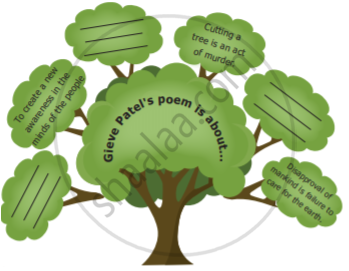
Select three words that best describe Mr. Scotti.
clever / unlucky / stupid / successful / miserable / happy.
The fly gives into flattery and becomes the spider’s prey. If you are asked to give a happy ending to the poem, how will you save the fly? Write in your own words.
Read the telephonic conversation between Malar and Selvi. Malar needs to leave a message for her father.
| Malar: | Hello, my name is Malar. Could I talk to Mr. Rao, please? I’m his colleague Mr. Vishvanath’s daughter. |
| Selvi: | I’m sorry, my father is out for his morning walk. Do you want to leave a message for him? |
| Malar: | Yes, please. My father had to leave for Madurai all of a sudden since my grandfather is ill. So he won’t be able to come to work for a few days. It would be really nice if your father could inform the office. |
| Selvi: | Don’t worry, I’ll leave the message for my father. |
| Malar: | Thanks a lot. |
| Selvi: | You’re welcome. |
|
This is the message that Selvi left for her father the previous day. Write a similar message based on her conversation with Malar. ______ (Date) 4.30 p.m. (Time) Dear Papa, I have my music class at 5.00 p.m. so I am leaving now. I’ve prepared tea and samosa and kept it in the kitchen. Please come and pick me up at 7 p.m. |
|
Message ______(Date) ______(Time) Dear Papa, _____________________________________________________________ |
Write the contraction for the following phrase.
has not - ______
Use the following clues to complete the following exercise.
| play | stop | buy | learn | see | meet | learn |
| be | eat | go | travel | start | read | visit |
Write three new things you have done in the last three years.
- I have started ______
- ____________
- ____________
Punctuate the following sentence.
she fed the baby washed the dishes put the lights off and went to sleep.
In the sentence below the capital letter, comma, full stop and question mark are missing. Put these in the correct place.
sita where are you looking
Write a few lines on Mithoo and his little dog named Shadow.
Which do you think would be more fun — travelling by aeroplane or sailing on a ship? Write why you think so.
Look at the following words. They are group names.
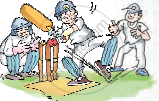
troop of soldiers
swarm of bees
team of players
litter of puppies
fleet of ships
library of books
Explain the following phrase selected from the story in your own word and work with a partner to make sentence using these phrase:
on approval
The photograph did not look like ______.
Respond to the following advertisements.
Classified Advertisement
| WANTED 100 part-time Graphic Artists Experienced in Photoshop and InDesignSalary negotiable. Apply to: MM Graphics, Triplicane, Chennai - 5 or Mail your Resume to [email protected] |
Block Advertisement
|
Female IELTS Teachers Required Postgraduates in English with a minimum of 3 years experience Must be bold and confident Good salary, transport and food allowance provided Apply to: ARV Institute of Languages 149B, Bose Road, Coimbatore Ph: 98400 xxxxx Email: [email protected] |
Read the given sentence and underline the no word.
There is nothing to do.
School examinations do not test intelligence. Express your views either for or against this statement
What might success mean to the following people? Think about it and write.
A politician
These two passages are examples of a short introduction to works of art - a short review. They cover the following points:
- The name of the creator
- The theme or subject matter
- Type of art
- Individual style
- Presentation techniques
- Its effect on viewers
- Message or interpretation
What points will you include if you had to review a book or film or a play? List the points.
Using the internet, find the following information about a place you wish to visit using the following points.
- Distance from your place
- Available modes of transport
- Accommodation facilities
- Historical facts
- Climate
- Famous sites
Discuss the challenges that people have to face due to disabilities.
Read the passage given below and answer the questions (i), (ii) and (iii) that follow.
| (1) | “Can I see the Manager?” I said, and added solemnly, “Alone.” I don't know why I said “Alone.” “Certainly,” said the accountant and fetched him. | |
| (2) | The Manager was a grave, calm man. I held my fifty-six dollars clutched in a crumpled ball in my pocket. “Are you the Manager?” I asked. God knows I did not doubt it. “Yes,” he said. “Can I see you …. alone?” I asked. |
5 |
| (3) | The Manager looked at me in some alarm. He felt that I had an awful secret to reveal. “Come in here,” he said, and led the way to a private room. He turned the key in the lock. “We are safe from interruption here,” he said; “Sit down.” We both sat down and looked at each other. I found no voice to speak. “You are one of Pinkerton’s men, I presume,” he said. |
10 |
| (4) |
He had gathered from my mysterious manner that I was a detective. I knew what he was thinking, and it made me worse. |
15
20
|
| (5) | The Manager got up and opened the door. He called to the accountant. “Mr. Montgomery,” he said unkindly loud, “this gentleman is opening an account, he will deposit fifty-six dollars. Good morning.” I rose. A big iron door stood open at the side of the room. “Good morning,” I said, and stepped into the safe. “Come out,” said the Manager coldly and showed me the other way. |
30 |
| (6) | I went up to the accountant’s wicket and poked the ball of money at him with a quick convulsive movement as if I were doing a conjuring trick. My face was ghastly pale. “Here,” I said, “deposit it.” The tone of the words seemed to mean, “Let us do this painful thing while the fit is on us.” He took the money and gave it to another clerk. |
35 |
| (7) | He made me write the sum on a slip and sign my name in a book. I no longer knew what I was doing. The bank swam before my eyes. “Is it deposited?” I asked in a hollow, vibrating voice. “It is,” said the accountant. “Then I want to draw a cheque.” My idea was to draw out six dollars of it for present use. Someone gave me a chequebook through a wicket and someone else began telling me how to write it out. The people in the bank had the impression that I was an invalid millionaire. I wrote something on the cheque and thrust it in at the clerk. He looked at it. |
40
45 |
| (8) | “What! Are you drawing it all out again?” he asked in surprise. Then I realised that I had written fifty-six instead of six. I was too far gone to reason now. I had a feeling that it was impossible to explain the thing. I had burned my boats. All the clerks had stopped writing to look at me. Reckless with misery, I made a plunge. “Yes, the whole thing.” “You withdraw all your money from the bank?” “Every cent of it.” “Are you not going to deposit anymore?” said the clerk, astonished. “Never.” |
50
55 |
| (9) | An idiot hope struck me that they might think something had insulted me while I was writing the cheque and that I had changed my mind. I made a wretched attempt to look like a man with a fearfully quick temper. | |
| (10) | The clerk prepared to pay the money. “How will you have it?” he said. This question came as a bolt from the blue. “What?” “How will you have it?” “Oh!”— I caught his meaning and answered without even trying to think— “in fifties.” He gave me a fifty-dollar bill. “And the six?” he asked dryly. “In sixes,” I said. He gave it to me and I rushed out. As the big door swung behind me. I caught the echo of a roar of laughter that went up to the ceiling of the bank. Since then, I bank no more. I keep my money in cash in my trousers pocket and my savings in silver dollars in a sock. |
60
65
70 |
| Adapted from: My Financial Career By Stephen Leacock |
||
-
- Find a single word from the passage that will exactly replace the underlined word or words in the following sentences. [3]
- The kind stranger went and got back the ball from where it had rolled into the bush.
- I took offence at the expression on his face that was clearly meant to insinuate I was a liar.
- The firm experienced a financial loss when the contract went to a contender who had just entered the business.
- For each of the words given below, choose the correct sentence that uses the same word unchanged in spelling, but with a different meaning from that which it carries in the passage. [3]
- alarm (line 8)
- The silence from the other end set off alarm bells in her head.
- The pallor of his skin alarmed those standing around.
- I set my alarm for six o’clock but slept through it.
- The sound of the approaching jets caused some alarm in the war room.
- wicket (line 44)
- The wicketkeeper was the true saviour of the day for that one match.
- The team wanted to bat while the wicket was still dry.
- The man at the window handed us our tickets through the wicket.
- The quick loss of wickets demoralised the team.
- reason (line 48)
- After the tragedy, his ability to reason is severely diminished.
- They reasoned they could get better seats if they arrived early.
- Recipients of funds were selected without rhyme or reason.
- We have every reason to celebrate.
- alarm (line 8)
- Find a single word from the passage that will exactly replace the underlined word or words in the following sentences. [3]
- Answer the following questions as briefly as possible in your own words.
- With reference to the passage, explain the meaning of the expression of the ‘I had burned my boats?’ [2]
- Cite any two instances of the behaviour of the bank employees that indicate the insignificance of a deposit of fifty-six dollars. [2]
- Why do you think the people in the bank thought of the narrator as an “invalid millionaire?” [2]
- Summarise why the narrator decided ‘to bank no more’ (paragraphs 6 to 10). You are required to write the summary in the form of a connected passage in about 100 words. Failure to keep within the word limit will be penalised. [8]
