Advertisements
Advertisements
Question
These two passages are examples of a short introduction to works of art - a short review. They cover the following points:
- The name of the creator
- The theme or subject matter
- Type of art
- Individual style
- Presentation techniques
- Its effect on viewers
- Message or interpretation
What points will you include if you had to review a book or film or a play? List the points.
Advertisements
Solution
- The theme of the book/film/play.
- The plot and the story.
- The characters in the book/film/play.
- Flow of language and style of narration.
- Authenticity of the book/film/play (story).
- The message conveyed in the book/film/play.
APPEARS IN
RELATED QUESTIONS
In the following items, sentence A is complete, while sentence B is not. Complete sentence B, making it as similar as possible to sentence A. Write sentence B.
(A) No other planet is as big as Jupiter.
(B) Jupiter ...............................................................................
Is there any significance of the logs of wood in the hands of the six people?
But a BIRD that stalks down his narrow cage
Can seldom see through his bars of rage
His wings are clipped and his feet are tied
So he opens his throat to sing.
Read the above lines and answer the question that follow.
Why does the caged bird sing?
What thoughts are uppermost in the soldier’s mind as he talks with the old man?
One day a millionaire went to a hotel in New York and________(ask) for the cheapest room they________(have)."What________(be) the price of the room?" he________(ask). The manager________(tell) him."Is that that the cheapest room you________(have)? I________(stay) by myself and only________(need) a small room." The manager said, "Why do you choose a poor room like that? Your son always_______(stay) in our most expensive room.""Yes," said the millionaire, "but his father________(be) a wealthy man; mine is not."
With close reference to the story ‘The Bet’ by Anton Chekhov, mention the clauses of the bet as laid down between the young lawyer and the old banker. Give an account of the events that follow the bet .
Give reasons for the following.
Carter had to chisel away the solidified resins to raise the king’s remains.
Make posters to highlight the importance of the Green Movement.
Within a few pages, the author has packed the important events in the lives of John Ipe and his wife. Discuss how conciseness and economy of expression can achieve an effective portrayal of entire lives.
Match the words and phrases with their meanings in the box below.
|
|
|
paragraph numbers |
|
1. |
homesick |
(3) |
|
2. |
practically |
(4) |
|
3. |
it pains me |
(7) |
|
4. |
appreciate |
(9) |
|
5. |
thoughtless |
(10) |
|
6. |
exercise |
(11) |
|
7. |
relief |
(13) |
|
8. |
ghastly |
(14) |
|
Almost |
it hurts me |
terrible |
|
test the strength of |
understanding the difficulties |
|
|
wanting to be home |
a welcome change |
not very caring |
Complete the web highlighting the feelings/emotions of Tenzing after reaching the summit.
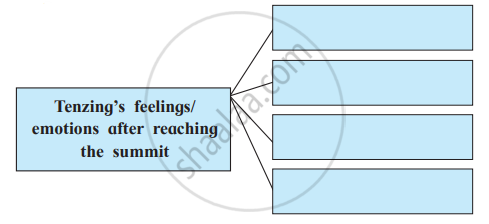
Discuss the following with your partner and complete the following sentence.
In a farmers’ market, we find _______________.
The writer goes in search of an invaluable indigenous variety of seeds. List three reasons for the importance of keeping records of our indigenous agricultural practices.
Write an appreciation of the poem considering the following points:
- About the poem, poet, and title.
- Theme/summary/gist of the poem.
- Poetic style/language, poetic devices used in the poem.
- Special features/novelties/focusing elements.
- Message/values/morals in the poem.
- Your opinion about the poem.
Make a paraphrase of the poem ‘Leisure’ in your own simple words. Write it down in your notebook.
Answer the following questions in a paragraph about 80 -100 words
It is said, “The choices made by one, shape one’s destiny”. Ponder on the thought and write a paragraph.
Nalan’s grandfather showed him an old treasure trunk. A road map was stuck on the trunk. It showed the spot where a key was hidden. Look at the road map and write five directions to reach the spot where the key is hidden. Discuss with your partner and compare your directions with those of your classmates.
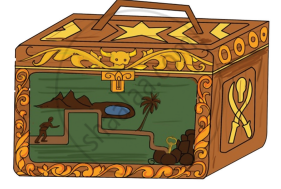
- ____________
- ____________
- ____________
- ____________
- ____________
Write a letter of enquiry for the following.
Write a letter to the head of the BSNL office enquiring regarding the internet broadband scheme launched recently.
Using the given informal letter as a model, write a letter about the topic given below.
Write a letter to your father asking permission to go on an educational tour.
Develop the following hints.
A wood cutter - cutting wood - dropped his axe in the pond - started weeping - an angel appeared - asked what the matter was - brought a golden axe - from the pond - wood cutter did not accept - brought a silver axe - not accepted - brought an iron axe - accepted - pleased with the honesty - offered all the axes to him.
Do you want to try to write your own paragraph now?
Write a paragraph on Palm tree.

- ______
- ______
- ______
- ______
- ______
Now complete the following, in the same way, using the words easy or strong.
Skipping is ______.
Jumping is ______ than skipping.
Walking is the ______ of all.
Some words have similar sound, but different meaning. Choose the correct word from the options and fill in the blank.
I have to leave at ______.
Why did the friends part ways?
Lack of adequate financial resources and sponsorships often affect sportspersons. How is this evident from Mary Kom’s life?
Aunt Jane seemed to think that there was a mistake in the wedding present she had given Jack. Why?
How did Jack manage to pay seven pounds eighty and eighty pence out of six pounds?
Write an e-mail to the Principal of a neighbouring school inviting their pupils to attend the classes if they so wish. Give all details of the classes to be held.
What was the blue bead?
Imagine someone has invited your family to a programme and you were the only person at home when the invitation was given orally.
Write a note (4-5 lines) to pass on the message to the other people in your family. Or, Write an imaginary conversation in which you pass on the message to your parents.
