Advertisements
Advertisements
Question
What does the word ‘cardboard’ denote in the poem? Why has this word been used?
Advertisements
Solution
In the poem, the word ‘cardboard’ stands for the frame that supports and borders the photograph. The photograph shows the poet’s mother as a twelve-year-old girl with two of her cousins, Betty and Dolly. The word ‘cardboard’ has been used to depict that the photograph is many years old. The use of cardboard as a photo frame was common in old times.
APPEARS IN
RELATED QUESTIONS
Attempt the following in 150-200 words.
Write a character sketch of Bishop Brooks as he appears in Helen Keller's − The Story of My Life.
Read the extract given below and answer the questions that follow:
Far far from gusty waves these children's faces.
Like rootless weeds, the hair torn round their pallor;
The tall girl with her weighed-down head.
(a) Who are these children?
(b) Which figure of speech has been used in the first two lines?
(c) Why is the tall girl's head weighed down?
(d) What does the word, 'pallor' mean?
Dolly Winthrop has a very noble nature. Comment.
Answer the following question in 200-250 words:
How did Kitty help Anne overcome her loneliness?
Comment on the influence of English – the language and the way of life – on Indian life as reflected in the story. What is the narrator's attitude to English?
This play, written in the 1950s, is a humorous and satirical depiction of the status of the mother in the family.
What are the issues it raises?
“I have done something; oh, God! I've done something real at last.” Why does Andrew say this? What does it mean?
What was the reason for the anxiety of Paul's mother as he grew older?
How, according to you, can peace and liberty be maintained in a state?
How does the poem capture the elusive nature of the peacock?
Why does the poet prefer to be a primitive Pagan rather than a member of civilised society?
Discuss the following in pairs or in small groups.
“Discipline and a questioning spirit can coexist in an individual.”
What are the unpleasant aspects of the human condition that the poet wants to escape from?
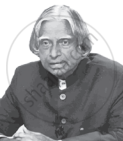
Name the world-famous personality who reached great heights despite of humble circumstances.
Make a list of the preparations made for an assault on Tiger Hill.
Individual guns ___________.
Find evidence from the lesson and write in your own words.
Indians respect the freedom of others.
There are different types of short stories. Use a dictionary/internet and find out what each of the following types refers to.
- fable:
- anecdote:
- fairy tale:
- parable:
- tragedy:
- humorous story:
- detective story:
- myth:
The poem expresses feelings of serenity. Pick out expressions from the above poem that express the same.
State the facts about the story.
- Main characters:
- Problem:
- Attempts made to solve it:
- Climax/Turning point:
- Problem solved:
- End:
Correct the following statement.
The last leaf was a real leaf that survived.
Say where . . . . . . .
______ do the cows and sheep stand?
Read the lesson and name the following.
A sack around the heart ______
Match the terms in ‘A’ with their explanation in ‘B’.
| 'A' | 'B' | ||
| (1) | tooth- extraction | (a) | a cut made for surgery |
| (2) | cardiac | (b) | having length, breadth, and depth |
| (3) | sedative | (c) | plastic surgery |
| (4) | tumor | (d) | related to the heart |
| (5) | incision | (e) | a control unit for a robotic surgery |
| (6) | a console | (f) | removing a decayed tooth |
| (7) | 3-D | (g) | a substance that makes a person sleep |
| (8) | Cushing clip | (h) | an extra growth in the body |
| (i) | a device to stop blood loss in neurosurgery |
Say WHY. . . . . .
Mother agreed to send Ramanujan to England.
Find one more example which shows that a beautiful appearance is not enough.
Read the passage and answer the following question:
What is seen on the obverse and reverse of the PVC medal?
Describe the following with the help of the story.
Thiruvalluvar
Correct the given sentence with justification.
The play is restricted to only a part of the woods.
There were some reasons why Theseus was initially against but later gave consent for the marriage of Helena with Lysander. Explain.
Have you seen a newborn young one of an animal?
Complete the following using your own idea:
His head was too big to ______.
The merchant ships brought spices and other treasures from India and other countries to Italy.
Write the following in short:
The events at the court.
Write a short note on the following:
The ‘four signs’ that Prince Siddharth beheld.
Read the following and observe the use of tenses.
‘Last week I witnessed a strange accident. Let me tell you about it. The signal flashes green. Vehicles start in the opposite direction. They move fast. Suddenly a speeding motorcyclist tries to cut across, from the wrong side. He is about to collide with a loaded truck. He applies the brakes. He falls and slides out with his bike from under the truck. He comes out unscathed on the other side.’
- When an event, which has occurred in the past, is narrated in the Present Tense to create a dramatic effect its Tense is called the ‘Dramatic Present Tense’.
- Now try to relate Jayant’s sci-fi story, in brief, in the dramatic past tense.
From the play, find all the words that are related to the following:
knowledge and learning
Add other related words you know to the list.
Often the brook speaks of itself as if it is human.
For example, 'I bicker down a valley.'
Find two other examples of the human activities of the brook.
Why did Marouckla’s stepmother hate her?
Name the following.
Did not let the passes go waste.
Read the word. Write the words that combine to make it.
snowwhite
List the insects, birds, trees and plants mentioned in the poem.
Read the data below and answer the following question.
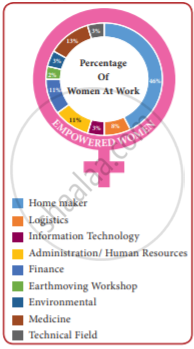
Choose the correct answer.
In which field of work is women’s involvement the second highest?
How should you speak with old people?
Identify the character/speaker.
I must find out why he's in such a hurry!
Why do we need trees? List four reasons that Grandfather gives.
Gulliver took the small creatures in his hand and crushed them.
A day in Mars is called ______.
Try your own.
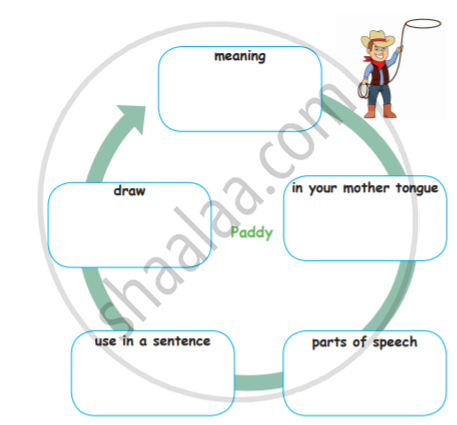
Match their hobbies.
 |
swimming |
 |
cycling |
 |
gardening |
They use ______ as bait.
Did she give up the fight?
Identify the character/speaker.
He set the fish free.
______ over heard her father’s talking on the phone about the robbery.
How did Mugund’s mother die?
A person who overcomes problems, will get ______ at the end.
Who was burning with curiosity?
Where did the naughty boy go?
Read the passage given below and make notes.
To match the best cities across the world, the Government of India initiated ‘smart cities’ to drive economic growth and improve the quality of life of people. The agenda under smart city promises to resolve urban sustainability problems. Urban forests provide a range of important ecosystem services that are critical for the sustainability of cities. Urban forestry, which is defined more as ‘Management of Trees’ contributes to the physiological, sociological and economic well-being of the society. Mangroves, lakes, grasslands, and forests in and around our cities, act as sponges that absorb the air and noise pollution and they present themselves as our cultural and recreational hotspots. However, these spots are rapidly being reclaimed and replaced in the name of development. Presence of urban green has shown to increase the economic value of the place.
Urban forests contribute to reduce the cost of building storm water drain systems for municipalities and neutralizing urban heat island effect. Plants not only provide shade but also help in regulating the micro-climate. They help regulate energy budgets, improve air quality, and curtail noise pollution. Trees, herbs, shrubs, and grasses arrest sedimentation and prevent other pollutants from entering our water systems. This will give a chance for our urban lakes and rivers to recover and help improve aquatic ecosystems. Biodiversity also gets a boost through the urban forestsand helps create corridors connecting the forest areas. High biodiversity areas can also help to build resilient ecosystems. Availability of forests within our urban areas gives an opportunity for children to connect to the natural environment and learn about native species.
How can we identify insecure websites?
Write compound word using the pictures.
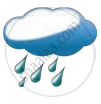 |
+ |  |
| ____________ | ||
