Advertisements
Advertisements
Question
Underline the verb and choose the correct option from the options.
Rahul finds Maths easy.
Options
Present tense
Past tense
Advertisements
Solution
Rahul finds Maths easy- Present tense.
APPEARS IN
RELATED QUESTIONS
Change the following sentence into simple sentence.
Einstein smiled and put his arm across my shoulder.
Let us begin by studying the relationship between the different verb forms and the time they denote.
Work individually
Indicate the tense and time of each of the highlighted verbs in the table below.
The first has been done as an example.
| Sentence | Tense | Time | |
| 1. | We are planning to go out for a picnic tomorrow. | Present | Future |
| 2. | India has made tremendous progress in the past few decades. |
||
| 3. | It has been raining since morning. | ||
| 4. | Could you please send your e-mail address as soon as possible? |
||
| 5. | The train must have reached Delhi by now. |
||
| 6. | It always rains in July here. | ||
| 7. | Cold wave intensifies further. (A news headline) |
||
| 8. | He was playing here a minute ago. | ||
| 9. | She won the Student of the Year award last year. |
||
| 10. | All incomplete forms will be rejected. |
Present Progressive
(Progressive = continuous)
Form

S +is/ am/ are +verb+ ing
S +is/ am/ are+ not+ verb+ ing.
Is/am/me+ S + verb+ing?
S + is/ am/ are +being+ Verb (past participle)
- Complete the following sentences by filling in the blanks with the present progressive form of the given verbs.
i. "You've put on weight, Cheryl."
"Yes. I.. .... (eat) a lot these days."
ii. "Hurry up! We ... (get) late for school."
"Justa second, please! I ... (come}."
iii. Temperatures ... (rise} all over the world.
iv. "You .... not ... (wear) this dirty shirt to office. Wait, I'll give you another."
v. "l...not ... (do) your homework-forget it. I still haven't forgotten how you
fought with me in the morning."
vi. The Prime Minister ... (leave) for Russia tomorrow on a 5 day state visit.
Vii "You ... (be) ver:yrude, Abhi."
viii. She ... always (make) excuses for coming late.
ix. Aabha ... (write) a novel these days.
- The table below shows different uses or meanings of the present progressive. Match the verbs in the above sentences with the uses or meanings they convey.
| a. Something pre-arranged or a fixed plan ............ b. Insistence............. c. Annoyance............ d. Repeated action............. e. Some development or change........... f. Emphatic refusal............. g. Something happening 'around now'.............. h. An action just starting.......... i. Temporary action not necessarily taking place at the moment of speaking............ |
*It is a little difficult to match the sentences with uses of present progressive
tense. Here are the answers:
a-vi, b-iv, c-vii, d-i, e-iii, f-v, g-ix, h-ii, i-viii.
Compare your answers with these and have a class discussion.
Complete the following sentences with the appropriate forms of the given verbs.
1. Every day I(go) to school in a bus but today I (go) by car because the bus operators are on strike.
2. "Baichung Bhutia (pass) the ball to Bannerjee; Bannerjee (take) a shot at the goal but it (be) way above the goal post. The Indians (attack) much more now ... "
3. I (think) you (make) a mistake by signing this contract.
4. The doctor (say) mother (respond) to the treatment well.
5. Farzana (be) not well. She (not come) to school today.
Study the following picture carefully and then write a paragraph to describe what is happening.
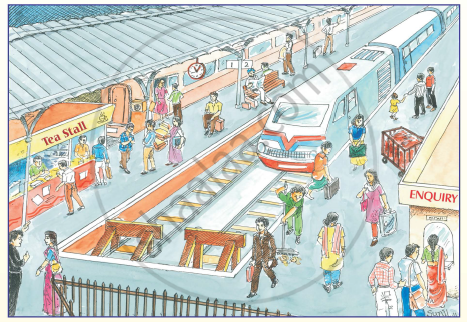
Simple Past Tense-Past Perfect Tense
Underline the main verbs in the sentences below. Then, rewrite the sentences in the correct order of events.
1) The people began to starve.
2) In 1925, a disease destroyed the crops in one village.
3) Later, the village people came to retrieve their children
4) The chief decided to send the children of the village to live in a settlement in the next valley.
5) However, they had married outside the village.
6) This caused a war between the two villages.
__________________
__________________
Now work with your partner and tick (✓) the sentence in which a different tense has been used. In pairs, discuss why this has been done.
Sentence No: 5 uses a different tense because ..................................................................................................................................................
..................................................................................................................................................
The present perfect is often used with the following time expressions:
until now for many years
so far over the last few years
lately in the past few months
not yet since20xx
recently
in recent years
Choose five of these time expressions and make sentences about interesting
items of news concerning yourself.
------------------------------------------
------------------------------------------
Now make groups of four, and tell (not read) each other your news.
What has been the situation of your village/town/city five to ten years ago and how has it changed since then? Write a short paragraph describing the changes in its size, population, traftlc, buildings, lifestyle etc. Which verb forms would you mainly use to describe the changes? (Hint: Simple Past and Present Perfect forms.)
Study the following sentences.
1) I didn't know Jim had migrated to the United States.
2) When we arrived at the theatre, the show had already begun.
3) The patient had died before the ambulance reached the hospital.
4) He had got married by the time he started working.
5) I couldn't open the locker because I had mislaid the keys.
6) Byom Bakshi felt that he had seen the man somewhere before.
As you can see, each of the above sentences describes two different actions, events or situations. Work with a partner and list them as shown in the example.
| A. Occurred First | B. Occurred Later |
| 1. Example: Jim had migrated to the United States. | 1. I did not know it. The speaker came to know the fact later.) |
| 2. | 2. |
| 3. | 3. |
| 4. | 4. |
| 5. | 5. |
| 6. | 6. |
What verb forms have been used in (A) and (B) respectively?
A. ....................................................................
B ....................................................................
What conclusion can you draw from your analysis?
...................................................................
...................................................................
Find the incorrect sentences and then rewrite them correctly. Put a tick mark (✓)against the sentences that you think are correct.
1) By 2005, the singer recorded ten albums.
2) When I got to the bank, it had closed.
3) Timothy, the tiger, had killed five calves yesterday.
4) When Rehman met Mini ten years later, she grew up into a young girl.
5) By the time we reached the airport, the flight had left.
6) We hardly went a kilometre or so when the car broke down.
Carefully study each of the following events or situations described in a set of three sentences/phrases. Then, write a short paragraph to describe each event/situation as shown in the example. Your paragraph should begin with the description of the second event in each case. Use the verb form had+ past participle to describe the earliest of the past events.
|
• Somebody burgled the office on Sunday night. • Our arrival at work on Monday morning . • Police informed |
We arrived at work on Monday and found that somebody had burgled the office the previous night. So, we immediately informed the police. |
|
• (I) Mayank went out with his family. (ii) I tried to phone him this morning. (iii) His servant answered. |
I tried to phone Mayank this morning but the servant ........................................... ........................................... |
|
• (i) Rohit returned from holiday.(ii) Jayanti met Rohit. |
Jayanti met Rohit, who ........................................... ........................................... |
|
• (I) All the arrangements were finalised for the seminar. (ii) The seminar participants arrived in Gangtok. (iii) Met the professors from the UK the same evening. |
The participants arrived in Gangtok. They found ........................................... ........................................... |
Tenses -Summary
Read the biodata of Sangeeta Rani Puri, India's swimming sensation. Then, complete the interview in the spaces provided. Do NOT add any extra information. Use appropriate tenses.
|
Natne : Sangeeta Rani Puri Status : Non-resident Indian Place of Birth : Trinidad Place of Residence : USA Parents : Raj Krishna Puri (Father) -fatnous immigration lawyer Moyna Margaret Puri (mother) - (from Trinidad) Achievements records : i) six new national records in five day (Junior National Swimming Meet, Vijaywada) |
Interviewer: Sangeeta, since you were in India for only a short while before
you flew to Atlanta, would you tell us a little about yourself?
Sangeeta : Well, I'm an Indian and I'm proud to be one.
I: Please tell us about your parents.
S: My father ____________________
_______________________ from Trinidad.
I: Have you taken part in any of the National Championships?
S: (Very excited) Yes,_________at Vijaywada.
I: How ______________________________________________ Senior Nationals?
S: I won seven events and __________
I: How do you rate your performance in the Altanta Olympics in 1996?
S: I ___________________________ in the 50 metres freestyle. It's true that I _____________in Atlanta. But _____________________
I: Haveyou ___________________ forthefuture?
S: I in the USA. And of course I ____________for as long as possible. Also I _______________________ in the olympics.
I: Thank you, Sangeeta. I wish you all the best.
S: Thankyouverymuch.
Working with the same partner, use the information given below and
discuss the reasons for choosing a particular verb form in F .1. Then match
the information in the bubbles below with the sentences, and put the
sentence number in the space provided, as shown in the example.
| 1. e.g. Something is expected to happen before a particular time in the future. (Sentence No 2) |
2.Statement of a universal truth or fact. ( ) |
|
3.Something is expected to ( ) |
4.Simple statement of future ( ) |
|
5.Sure to happen at a particular time in the future, as arrangements for it ( ) |
6.Statement of a planned event expected. ( } |
The Dauphin will give me all I need.
(Rewrite the sentence using the present perfect tense)
Use the correct tense form of the verb given in the bracket and rewrite the sentence.
She ________ that old fashion book of her mother a few months back.
Use the correct tense form of the verb given in the bracket and rewrite the sentence.
She ________ at her left shoulder for quite some time.
Use the correct tense form of the verb given in the bracket and rewrite the sentence.
One human should _______ this for another always.
Use the correct tense form of the verb given in the bracket and rewrite the sentence.
All this ________ destroyed in a few years.
Name the Tense of the Verb underlined to include Time (Past/Present/Future) and Aspect (Simple/Continuous/Perfect/Perfect Continuous).
It had made all the difference.
Name the Tense of the Verb underlined to include Time (Past/Present/Future) and Aspect (Simple/Continuous/Perfect/Perfect Continuous).
I have been facing death.
Change the Tense as instructed.
I got fired. (Future Perfect)
Change the Tense as instructed.
Life hits you in the head. (Present Perfect Continuous)
Change the Tense as instructed.
I started the company. (Present Continuous)
Spot the error and correct the following sentences.
- My grandparents laid down for an afternoon nap.
- A stranger were knocking at our door.
- My sister and I shares a study room.
- One of my friend, is leaving school.
- A flock of birds were flying overhead.
Rewrite the sentence as per the instruction given along with it.
The mother langur looked straight into my eyes.
(Rewrite the sentence in the Simple Present Tense)
Rewrite the sentence as per the instruction given along with it.
She surveyed the area for the vicious male langur.
(Rewrite the sentence in the Simple Future Tense)
Underline the verb and choose the correct option from the options.
Preeti even wrote about it.
Underline the verb and choose the correct option from the options.
Preeti was scornful.
Underline the verb and choose the correct option from the options.
They are sportsmen.
Read the following sentence carefully, underline the verb and find out the tense in the sentence.
The sun was now ascending the sky.
Read the following sentence carefully, underline the verb and find out the tense in the sentence.
Still they took no notice of him.
Read the following sentence carefully, underline the verb and find out the tense in the sentence.
She is standing on a little high hump on the plateau.
Read the following sentence carefully, underline the verb and find out the tense in the sentence.
He just felt dizzy.
Observe the following underlined phrases. Here ‘have /has’ are followed by the past participle form of the verb. This construction indicates the perfect present tense. Find more such sentences from the speech.
- We have made progress in the last couple of decades.
- We have prevented millions of child deaths.
- It has happened.
- ________________________
- ________________________
- ________________________
Rewrite the sentences in present perfect tense:
I had been working for Anil for almost a month.
