Advertisements
Advertisements
Question
Find the incorrect sentences and then rewrite them correctly. Put a tick mark (✓)against the sentences that you think are correct.
1) By 2005, the singer recorded ten albums.
2) When I got to the bank, it had closed.
3) Timothy, the tiger, had killed five calves yesterday.
4) When Rehman met Mini ten years later, she grew up into a young girl.
5) By the time we reached the airport, the flight had left.
6) We hardly went a kilometre or so when the car broke down.
Advertisements
Solution
- By 2005, the singer had recorded ten albums.
- When I got to the bank, it had closed.
- Timothy, the tiger, killed five calves yesterday.
- When Rehman met Mini ten years later, she had grown up into a young girl.
- By the time we reached the airport, the flight had left.
- We had hardly gone a kilometre or so when the car broke down.
APPEARS IN
RELATED QUESTIONS
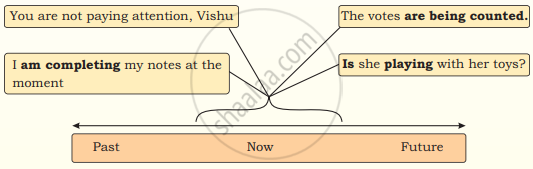
- S + is/am/are + verb + ing
- S + is/am/are + not + verb + ing.
- Is/am/are + S + verb + ing?
- S + is/am/are + being + Verb (past participle)
Verbs that are normally NOT used in the progressive form.
1. Which sentence in each of the following pairs is acceptable and
why?
1. a. I am respecting you.
b. I respect you.
2. a. My son loves to draw and paint.
b. My son is loving to draw and paint.
3. a. We are having two cars.
b. We have two cars.
4. a. I am thinking you are new to this place.
b. I think you are new to this place.
5. a. The cake smells good.
b. The cake is smelling good.
| Verbs referring to mental states (eg. know, think, believe etc) and to the use of the senses (eg. smell, taste etc) are never, or hardly ever, used in progressive forms. Some of these verbs are: believe prefer know suppose feel sound (dis)like love realise understand hear taste see hate recognise want see belong doubt imagme remember wish smell agree possess own owe involve include depend |
Can you explain the difference between?
1. a. l justcan'timaginehowyougotintosuchamess.
b. You're imagining things nothing will happen.
2. a. The coffee tastes bitter
b. Mother is tasting coffee to check ifit is too bitter.
3. a. My teacher admires my art work
b. She is admiring the latest painting I have made.
4. a. The doctor is feeling the patient's pulse.
b. The patient is feeling better.
Present Perfect vs. Simple Past
a. Explain the difference in the meaning of the following pairs of
sentences. You may like to use the given hints.
1. a. I have been a teacher for five years.
b. I was a teacher for five years.
(Hint: Is the speaker still a teacher?)
2. a. I always got good marks in English.
b. I have always got good marks in English.
(Hint: Is the speaker still studying?)
3. a. Geeta has never met her cousin.
b. Geeta never met her cousin.
(Hint: Is Geeta's cousin alive?)
4. a. I have never been to Timbuktu.
b. I never went to Timbuktu.
(Is the speaker talking about a particular journey or his travels so far?)
5. a. Jose has completed seven assignments today.
b. Jose completed seven assignments today.
(Hint: Is the day over? Has Jose more assignments to write?)
Complete the following sentences with the appropriate forms of the given verbs.
1. Every day I(go) to school in a bus but today I (go) by car because the bus operators are on strike.
2. "Baichung Bhutia (pass) the ball to Bannerjee; Bannerjee (take) a shot at the goal but it (be) way above the goal post. The Indians (attack) much more now ... "
3. I (think) you (make) a mistake by signing this contract.
4. The doctor (say) mother (respond) to the treatment well.
5. Farzana (be) not well. She (not come) to school today.
Look at the incomplete sentences below. Using the information provided, complete each sentence using a suitable tense. Follow the examples:
1947 until now India I has been (be) independent since 1947.
1947 India became (become) independent in 1947.
1. 1947 until now l There --------- (be) manywars.
2. 1991 There ------- (be) a war in the Persian Gulf.
3. 1953 -------- Edmund Hilary and Tensing first (climb) Everest.
4. 1953 until now Many people ________ (climb)Everest.
5. 1983 India --------- (win) the Prudential Cricket World Cup in England.
6. 1983 until now India -------- (win) many limited-overs cricket trophies.
Here is a letter Nikita wrote to her friend Susie who lives in Milan, Italy. What verb forms has she used in this letter? Bas she used a mix of verb forms? Is there any particular form that has been used more frequently?
Dear Susie
It's a beautiful Sunday morning. Rakesh is busy with some office work and the kids are playing in the park outside and I've time enough to write a quick letter to you.
So, how are you doing? How's your new novel coming along? I hear you're learning Bharatnatyam these days. Couldn't believe it when Sharon told me about it. Bhartnatyam in Milani Never knew there is an Indian Dance school in Italy. Interesting! By the way, who are you taking dance lessons from? I mean, who is your Guru? And why are you learning Bharatnatyam? Must you do everything that I do?
What happened to your plan to visit us this winter? Well, winter is round the corner. When are you coming? How long do you plan to stay? What places would you like to visit? Do let me know, will you? I'll make your itinerruy accordingly. Remember, this time when you come, you are not staying at any hotel as you did last time. You will stay with us. I have a room spare for you to stay as long as you wish. OK? As for the weather, I've already told you, winter is setting in. It's beginning to get cold, especially in the mornings and the evenings. The temperature is falling with each passing day and it's just the right kind of weather for some travel and adventure. Delhi is at its best in the early winter and it is waiting to welcome you with open arms. And how's your mom's health now? Is she keeping well? Is she getting physiotherapy done regularly? I continue to pray for her speedy recovery. I think I got to go now. The kids seem to have had a fight. I can hear the youngerone crying. These boys are giving me a difficult time! Catchyoulater. Bye
Yours
Nikita
Complete the following sentences correctly by using the simple past or
past perfect forms of the given verbs.
1) We ____ already (reach) home when Irlan __ (say) that he (forget) his books at school.
2) Wendy (wake up) late, then she ____ (miss) her school bus, so by the time she (reach) school, it already (start).
3) I ___ (visit) my town again ten years after I _____ (leave) it and ___ (find) thatit completely (change).
4) When Feroze and Mehr (meet) for the first time, they ___ _ (not like) each other but now they are married.
Working with the same partner, use the information given below and
discuss the reasons for choosing a particular verb form in F .1. Then match
the information in the bubbles below with the sentences, and put the
sentence number in the space provided, as shown in the example.
| 1. e.g. Something is expected to happen before a particular time in the future. (Sentence No 2) |
2.Statement of a universal truth or fact. ( ) |
|
3.Something is expected to ( ) |
4.Simple statement of future ( ) |
|
5.Sure to happen at a particular time in the future, as arrangements for it ( ) |
6.Statement of a planned event expected. ( } |
The Dauphin will give me all I need.
(Rewrite the sentence using the present perfect tense)
Use the correct tense form of the verb given in the bracket and rewrite the sentence.
She ________ at her left shoulder for quite some time.
Use the correct tense form of the verb given in the bracket and rewrite the sentence.
All this ________ destroyed in a few years.
Name the Tense of the Verb underlined to include Time (Past/Present/Future) and Aspect (Simple/Continuous/Perfect/Perfect Continuous).
We were designing the first Macintosh computer.
Name the Tense of the Verb underlined to include Time (Past/Present/Future) and Aspect (Simple/Continuous/Perfect/Perfect Continuous).
I shall be telling you three stories.
Change the Tense as instructed.
My doctor advised me. (Past Perfect Continuous)
Rewrite the sentence as per the instruction given along with it.
I took the baby langur to our backyard.
(Rewrite the sentence in the Past Perfect Tense)
Underline the verb and choose the correct option from the options.
Today Sanjay found a new book.
(present tense/past tense)
Underline the verb and choose the correct option from the options.
Rahul finds Maths easy.
(present tense/past tense)
Underline the verb and choose the correct option from the options.
Preeti was scornful.
(singular/plural)
