Advertisements
Advertisements
Question
The radius of atom is of the order of 1 Å and the radius of nucleus is of the order of fermi. How many magnitudes higher is the volume of atom as compared to the volume of nucleus?
Advertisements
Solution
Radius of atom = 1 Å = 10–10 m
Radius of nucleus = 1 fermi = 10–15 m
Volume of atom = VA = `4/3 πR_A^3`
Volume of atom = `4/3 πR_A^3`
Volume of nucleus VN = `4/3 πR_N^3`
`V_A/V_N = (4/3 πR_A^3)/(4/3 πR_N^3)`
= `(R_A/R_N)^3`
= `(10^-10/10^-15)^3`
= 1015
APPEARS IN
RELATED QUESTIONS
Length of one’s chest can be measured using metre scale.
While measuring the length of a sharpened pencil, the reading of the scale at one end is 2.0 cm and at the other end is 12.1 cm. What is the length of the pencil?
Find the answer for the following questions within the grid.
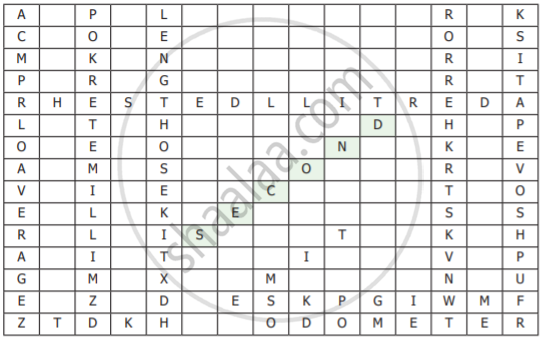
- 10-3 is one ______
- SI Unit of time is ______
- Cross view of reading a measurement leads to ______
- ______ is the one what a clock reads.
- ______ is the amount of substance present in an object.
- ______ can be taken to get the final reading of the recordings of different students for a single measurement.
- ______ is a fundamental quantity.
- ______ shows the distance covered by an automobile
- A tailor uses ______ to take measurements to stitch the cloth.
- Liquids are measured with this physical quantity.
Rulers, measuring tapes and metre scales are used to measure ______
What is the length of a 100 rupee note? Guess. Now measure it using a scale.
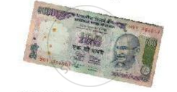
Measure the yellow rectangle. It is ________ cm long.
How many stamps can be placed along its length?
Now cut strips of equal sizes out of it. Using tape join the strips, end to end, to make a belt.
How long is your belt? _________
Can you think of how to cut a postcard so that you can pass through it?
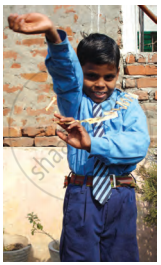
You can play this game on the ground. Make two squares of one square meter each. Divide your class into two teams. Ready to play!
- Which team could make more children stand in their square? How many?
You can play this game on the ground. Make two squares of one square meter each. Divide your class into two teams. Ready to play!
- Which team could make more children sit in their square? How many?
There are two beautiful lakes near a village. People come for boating and picnics in both the lakes. The village Panchayat is worried that with the noise of the boats the birds will stop coming. The Panchayat wants motorboats in only one lake. The other lake will be saved for the birds to make their nests.
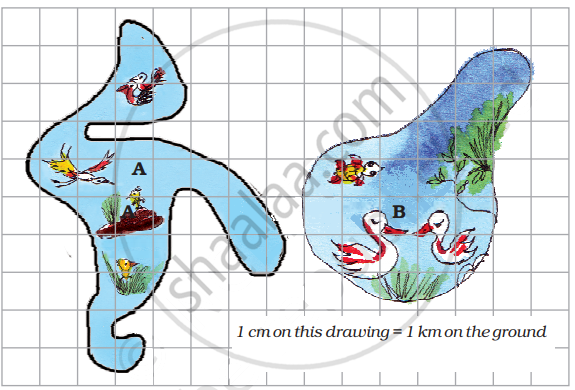
- How many kilometers long is the actual boundary of lake B?
There are two beautiful lakes near a village. People come for boating and picnics in both the lakes. The village Panchayat is worried that with the noise of the boats the birds will stop coming. The Panchayat wants motorboats in only one lake. The other lake will be saved for the birds to make their nests.
- A longer boundary around the lake will help more birds to lay their eggs. So which lake should be kept for birds? Which lake should be used for boats?
Match the following:
| Prefix | Symbol | ||
| a. | Centi | i. | k |
| b. | Nano | ii. | c |
| c. | Mili | iii. | n |
| d. | Kilo | iv. | m |
What is the unit of measurements of very small lengths?
What is the unit of measurements of very small lengths?
SI unit of electric current is ______.
Yard was used as the unit of length.
Why is Earth's orbit used instead of its diameter to measure distances to stars using the parallax method?
