Advertisements
Advertisements
Question
Answer the following question.
Star A is farther than star B. Which star will have a large parallax angle?
Advertisements
Solution

- 'b' is constant for the two stars
∴ θ ∝ `1/"D"` - As star A is farther i.e., DA > DB
⇒ θA < θB
Hence, star B will have a larger parallax angle than star A.
APPEARS IN
RELATED QUESTIONS
Length of one’s chest can be measured using metre scale.
A hand span is a reliable measure of length.
Match the following.
| 1. | Length of the fore arm | metre |
| 2. | SI unit of length | second |
| 3. | Nano | 103 |
| 4. | SI Unit of time | 10–9 |
| 5. | Kilo | Cubit |
Guess the lengths to draw these things. Ask your friend to draw the same. After you make the drawing use a scale to measure the length. Whose drawing showed a better guess?
| Guess its length and draw |
Measure of your drawing |
Measure of your friend’s drawing |
| An ant of length less than 1 cm |
||
| Pencil of length about 7 cm |
||
| A glass 11 cm high with water up to 5 cm |
||
| A bangle of perimeter 20 cm |
||
| A curly hair of length 16 cm |
Guess whose tail is the longest. Now measure the tails. How good is your guess?


Now guess the length and width of many other things. Measure and find the difference between your measure and your guess.
| Size of | Your guess in cm | Your measure in cm | ||
| Length | Width | Length | Width | |
| 100 Rupee note | ||||
| 10 Rupee note | ||||
| 20 Rupee note | ||||
| 5 Rupee note | ||||
| Post card | ||||
| Math-Magic book | ||||
How many stamps can be placed along its length?
How wide is the rectangle? ________ cm
How many stamps are needed to cover the rectangle?
You can play this game on the ground. Make two squares of one square meter each. Divide your class into two teams. Ready to play!
- How many of you can sit in one square meter?
You can play this game on the ground. Make two squares of one square meter each. Divide your class into two teams. Ready to play!
- How many of you can stand in it?
You can play this game on the ground. Make two squares of one square meter each. Divide your class into two teams. Ready to play!
- Which team could make more children sit in their square? How many?
Chumki, Jhumri, and Imran need wire to make a fence.
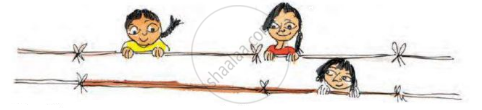
- How much wire in all will the three need?
There are two beautiful lakes near a village. People come for boating and picnics in both the lakes. The village Panchayat is worried that with the noise of the boats the birds will stop coming. The Panchayat wants motorboats in only one lake. The other lake will be saved for the birds to make their nests.
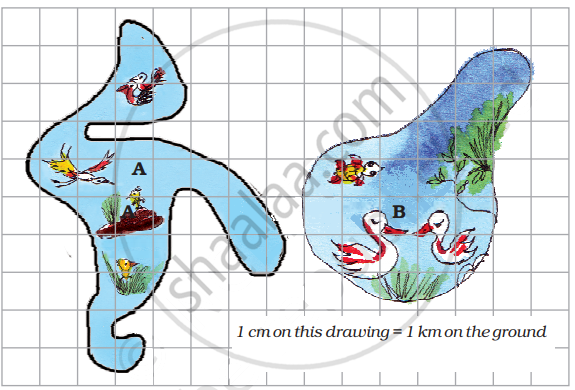
- Find the area of lake B on the drawing in square cm. What is its actual area in square km?
Length is a fundamental quantity.
Match the following:
| Prefix | Symbol | ||
| a. | Centi | i. | k |
| b. | Nano | ii. | c |
| c. | Mili | iii. | n |
| d. | Kilo | iv. | m |
What is the unit of measurements of very small lengths?
What is the unit of length?
The Unit used to measure length ______.
What unit will you use to measure the length of our classroom?
The SI unit of mass is kg.
To measure the distance of a planet from the earth, ______ method is used.
In an experiment to estimate the size of a molecule of oleic acid 1 mL of oleic acid is dissolved in 19 mL of alcohol. Then 1 mL of this solution is diluted to 20 mL by adding alcohol. Now 1 drop of this diluted solution is placed on water in a shallow trough. The solution spreads over the surface of water forming one molecule thick layer. Now, lycopodium powder is sprinkled evenly over the film and its diameter is measured. Knowing the volume of the drop and area of the film we can calculate the thickness of the film which will give us the size of oleic acid molecule.
Read the passage carefully and answer the following questions:
- Why do we dissolve oleic acid in alcohol?
- What is the role of lycopodium powder?
- What would be the volume of oleic acid in each mL of solution prepared?
- How will you calculate the volume of n drops of this solution of oleic acid?
- What will be the volume of oleic acid in one drop of this solution?
According to the modern definition, what fraction of a second does light travel to define one metre?
In the parallax formula D = b/θ, what must be true about the angle θ for the calculation to be correct?
The parallax method is used to measure astronomical distances because ______.
Which instruments are used to measure very small distances at the atomic scale?
