Advertisements
Advertisements
Question
The distance of a galaxy is of the order of 1025 m. Calculate the order of magnitude of time taken by light to reach us from the galaxy.
Advertisements
Solution
According to the problem, the distance of the galaxy = 1025 m.
Thus, the required time = `"Distance"/"Speed"`
⇒ `10^25/(3 xx 10^8)` sec
= `1/3 xx 10^17` seconds
Required time = `10/3 xx 10^16`
= 3.33 × 10¹⁶ seconds.
APPEARS IN
RELATED QUESTIONS
The farthest objects in our Universe discovered by modern astronomers are so distant that light emitted by them takes billions of years to reach the Earth. These objects (known as quasars) have many puzzling features, which have not yet been satisfactorily explained. What is the distance in km of a quasar from which light takes 3.0 billion years to reach us?
Just as precise measurements are necessary in science, it is equally important to be able to make rough estimates of quantities using rudimentary ideas and common observations. Think of ways by which you can estimate the following (where an estimate is difficult to obtain, try to get an upper bound on the quantity):
the number of strands of hair on your head
Write true or false.
Every measurement involves two things – a number and a unit.
While measuring the length of an object using a ruler, the position of your eye should be
Length of one’s chest can be measured using metre scale.
Complete the analogy.
Height of a person: cm :: Length of your sharpened pencil lead:______?
Match the following.
| 1. | Length | kelvin |
| 2. | Mass | metre |
| 3. | Time | kilogram |
| 4. | Temperature | second |
How wide is the rectangle? ________ cm
How close was your earlier guess? Discuss.
You can play this game on the ground. Make two squares of one square meter each. Divide your class into two teams. Ready to play!
- Which team could make more children stand in their square? How many?
So Anar also tried many different ways to make a boundary for 800 square meters of land.
He made rectangles A, B, and C of different sizes. Find out the length of the boundary of each. How much gold wire will he get for these rectangles?
- A
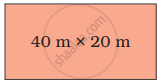
Gold wire for A = _________ metres - B

Gold wire for B = _________ metres - C

Gold wire for C = __________ metres
But then Anar made an even longer rectangle... See how long!
- D

So he will get __________ metres of gold wire!!
Length is a fundamental quantity.
What are the materials needed to find the length of a banana?
What is the unit of length?
The Unit used to measure length ______.
SI unit of electric current is ______.
To measure the distance of a planet from the earth, ______ method is used.
How many astronomical units (A.U.) make 1 parsec?
According to the modern definition, what fraction of a second does light travel to define one metre?
Which instruments are used to measure very small distances at the atomic scale?
