Advertisements
Advertisements
Question
The principle of ‘parallax’ in section 2.3.1 is used in the determination of distances of very distant stars. The baseline AB is the line joining the Earth’s two locations six months apart in its orbit around the Sun. That is, the baseline is about the diameter of the Earth’s orbit ≈ 3 × 10¹¹m. However, even the nearest stars are so distant that with such a long baseline, they show parallax only of the order of 1” (second) of arc or so. A parsec is a convenient unit of length on the astronomical scale. It is the distance of an object that will show a parallax of 1” (second) of arc from opposite ends of a baseline equal to the distance from the Earth to the Sun. How much is a parsec in terms of meters?
Advertisements
Solution 1
Diameter of Earth’s orbit = 3 × 10¹¹ m
Radius of Earth’s orbit, r = 1.5 × 10¹¹ m
Let the distance parallax angle be 1”= 4.847 × 10⁻⁶ rad.
Let the distance of the star be D.
Parsec is defined as the distance at which the average radius of the Earth’s orbit subtends an angle of 1.
:. We have `theta = r/D`
`D=r/theta = (1.5xx10^(11))/(4.847xx10^(-6))`
`=0.309 xx 10^(-6) ~~ 3.09xx10^(16)m`
Hence, 1 parsec ≈ 3.09 × 10¹⁶ m.
Solution 2
From parallax method we can say
θ=b/D,where b=baseline ,D = distance of distant object or star
Since, θ=1″ (s) and b=3 x 10¹¹ m
D=b/20=3 x 1011/2 x 4.85 x 10-6 m or D=3 x 10¹¹/9.7 x 10-6 m =30 x 1016/9.7 m
= 3.09 x 10¹⁶ m = 3 x 10¹⁶ m.
RELATED QUESTIONS
Match the following.
| Column A | Column B |
| (1) Length | a. kilogram |
| (2) Mass | b. cubic metre |
| (3) Area | c. metre |
| (4) Volume | d. square metre |
Solve the numerical example.
When the planet Jupiter is at a distance of 824.7 million kilometers from the Earth, its angular diameter is measured to be 35.72'' of arc. Calculate the diameter of Jupiter.
A hand span is a reliable measure of length.
Assertion (A): Distance between two celestial bodies is measured in terms of light year.
Reason (R): The distance travelled by the light in one year is one light year.
Numerical Problem.
Inian and Ezhilan argue about the light year. Inian tells that it is 9.46 × 10¹⁵ m and Ezhilan argues that it is 9.46 × 10 12 km. Who is right? Justify your answer.
Measure the yellow rectangle. It is ________ cm long.
Arbaz plans to tile his kitchen floor with green square tiles. Each side of the tile is 10 cm. His kitchen is 220 cm in length and 180 cm wide. How many tiles will he need?

Now cut strips of equal sizes out of it. Using tape join the strips, end to end, to make a belt.
How long is your belt? _________
You can play this game on the ground. Make two squares of one square meter each. Divide your class into two teams. Ready to play!
- How many of you can sit in one square meter?
You can play this game on the ground. Make two squares of one square meter each. Divide your class into two teams. Ready to play!
- How many of you can stand in it?
So Anar also tried many different ways to make a boundary for 800 square meters of land.
He made rectangles A, B, and C of different sizes. Find out the length of the boundary of each. How much gold wire will he get for these rectangles?
- A
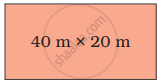
Gold wire for A = _________ metres - B

Gold wire for B = _________ metres - C

Gold wire for C = __________ metres
But then Anar made an even longer rectangle... See how long!
- D

So he will get __________ metres of gold wire!!
There are two beautiful lakes near a village. People come for boating and picnics in both the lakes. The village Panchayat is worried that with the noise of the boats the birds will stop coming. The Panchayat wants motorboats in only one lake. The other lake will be saved for the birds to make their nests.
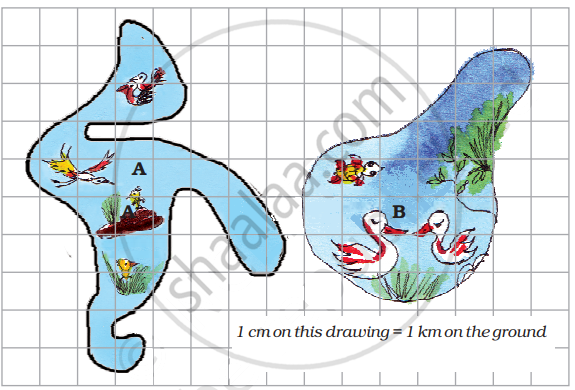
- How many kilometers long is the actual boundary of lake B?
There are two beautiful lakes near a village. People come for boating and picnics in both the lakes. The village Panchayat is worried that with the noise of the boats the birds will stop coming. The Panchayat wants motorboats in only one lake. The other lake will be saved for the birds to make their nests.
- A longer boundary around the lake will help more birds to lay their eggs. So which lake should be kept for birds? Which lake should be used for boats?
There are two beautiful lakes near a village. People come for boating and picnics in both the lakes. The village Panchayat is worried that with the noise of the boats the birds will stop coming. The Panchayat wants motorboats in only one lake. The other lake will be saved for the birds to make their nests.
- Find the area of lake B on the drawing in square cm. What is its actual area in square km?
Length is a fundamental quantity.
Larger unit for measuring time is ______.
The distance of a galaxy is of the order of 1025 m. Calculate the order of magnitude of time taken by light to reach us from the galaxy.
What is an Astronomical Unit (AU)?
