Advertisements
Advertisements
प्रश्न
The principle of ‘parallax’ in section 2.3.1 is used in the determination of distances of very distant stars. The baseline AB is the line joining the Earth’s two locations six months apart in its orbit around the Sun. That is, the baseline is about the diameter of the Earth’s orbit ≈ 3 × 10¹¹m. However, even the nearest stars are so distant that with such a long baseline, they show parallax only of the order of 1” (second) of arc or so. A parsec is a convenient unit of length on the astronomical scale. It is the distance of an object that will show a parallax of 1” (second) of arc from opposite ends of a baseline equal to the distance from the Earth to the Sun. How much is a parsec in terms of meters?
Advertisements
उत्तर १
Diameter of Earth’s orbit = 3 × 10¹¹ m
Radius of Earth’s orbit, r = 1.5 × 10¹¹ m
Let the distance parallax angle be 1”= 4.847 × 10⁻⁶ rad.
Let the distance of the star be D.
Parsec is defined as the distance at which the average radius of the Earth’s orbit subtends an angle of 1.
:. We have `theta = r/D`
`D=r/theta = (1.5xx10^(11))/(4.847xx10^(-6))`
`=0.309 xx 10^(-6) ~~ 3.09xx10^(16)m`
Hence, 1 parsec ≈ 3.09 × 10¹⁶ m.
उत्तर २
From parallax method we can say
θ=b/D,where b=baseline ,D = distance of distant object or star
Since, θ=1″ (s) and b=3 x 10¹¹ m
D=b/20=3 x 1011/2 x 4.85 x 10-6 m or D=3 x 10¹¹/9.7 x 10-6 m =30 x 1016/9.7 m
= 3.09 x 10¹⁶ m = 3 x 10¹⁶ m.
संबंधित प्रश्न
When the planet Jupiter is at a distance of 824.7 million kilometres from the Earth, its angular diameter is measured to be 35.72″ of arc. Calculate the diameter of Jupiter
What are the S.I. units of
- mass
- length
- time and
- temperature.
Write their names and symbols.
Match the following.
| Column A | Column B |
| (1) Length | a. kilogram |
| (2) Mass | b. cubic metre |
| (3) Area | c. metre |
| (4) Volume | d. square metre |
Exercise
Assertion (A): Distance between two celestial bodies is measured in terms of light year.
Reason (R): The distance travelled by the light in one year is one light year.
Can you find the diameter of a thin wire of length 2 m using the ruler from your instrument box?
Now guess the length and width of many other things. Measure and find the difference between your measure and your guess.
| Size of | Your guess in cm | Your measure in cm | ||
| Length | Width | Length | Width | |
| 100 Rupee note | ||||
| 10 Rupee note | ||||
| 20 Rupee note | ||||
| 5 Rupee note | ||||
| Post card | ||||
| Math-Magic book | ||||
How many stamps are needed to cover the rectangle?
Chumki, Jhumri, and Imran need wire to make a fence.
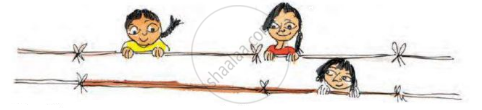
- How much wire in all will the three need?
So Anar also tried many different ways to make a boundary for 800 square meters of land.
He made rectangles A, B, and C of different sizes. Find out the length of the boundary of each. How much gold wire will he get for these rectangles?
- A
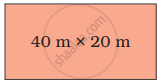
Gold wire for A = _________ metres - B

Gold wire for B = _________ metres - C

Gold wire for C = __________ metres
But then Anar made an even longer rectangle... See how long!
- D

So he will get __________ metres of gold wire!!
There are two beautiful lakes near a village. People come for boating and picnics in both the lakes. The village Panchayat is worried that with the noise of the boats the birds will stop coming. The Panchayat wants motorboats in only one lake. The other lake will be saved for the birds to make their nests.
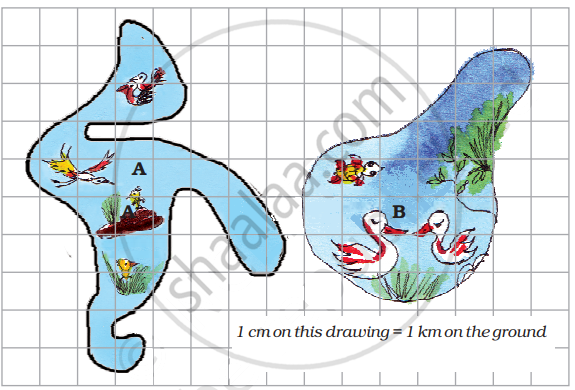
- A longer boundary around the lake will help more birds to lay their eggs. So which lake should be kept for birds? Which lake should be used for boats?
What formula is used to measure the area of your classroom?
Give some examples of larger length measures.
The distance between one end and the other end is called ______.
What is the unit of length?
According to the modern definition, what fraction of a second does light travel to define one metre?
The parallax method is used to measure astronomical distances because ______.
