Advertisements
Advertisements
प्रश्न
There are two beautiful lakes near a village. People come for boating and picnics in both the lakes. The village Panchayat is worried that with the noise of the boats the birds will stop coming. The Panchayat wants motorboats in only one lake. The other lake will be saved for the birds to make their nests.
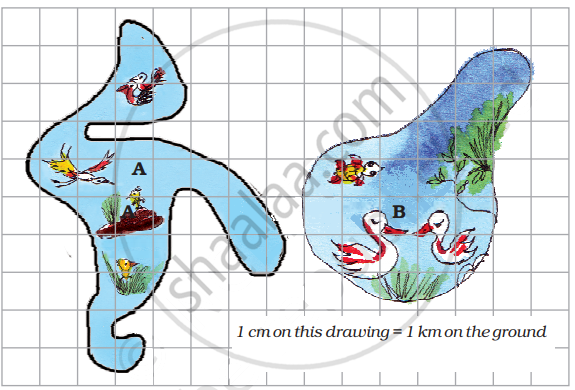
- Find the area of lake B on the drawing in square cm. What is its actual area in square km?
Advertisements
उत्तर
Lake B has 15 fully filled squares and 11 half-filled or more than half-filled squares.
- Area of 15 fully filled squares
= 15 × 15
= 225 square cm
We consider the area of every single half-filled or more than half-filled square as 1-centimetre square.
- Thus, the area of 11 such squares
= 11 × 11
= 121 square cm - So, the total area of lake B
= 225 + 121
= 346 square cm
We are given 1 cm on drawing = 1 km on the ground
Therefore, 346 square cm on drawing = 346 km
संबंधित प्रश्न
Write true or false.
Every measurement involves two things – a number and a unit.
A hand span is a reliable measure of length.
Complete the analogy.
Height of a person: cm :: Length of your sharpened pencil lead:______?
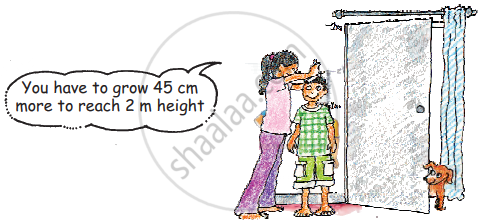
What is Dinesh’s height in metres? _____ m _____ cm.
How wide is the rectangle? ________ cm
How many stamps are needed to cover the rectangle?
How close was your earlier guess? Discuss.
Now cut strips of equal sizes out of it. Using tape join the strips, end to end, to make a belt.
How long is your belt? _________
So Anar also tried many different ways to make a boundary for 800 square meters of land.
He made rectangles A, B, and C of different sizes. Find out the length of the boundary of each. How much gold wire will he get for these rectangles?
- A
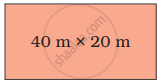
Gold wire for A = _________ metres - B

Gold wire for B = _________ metres - C

Gold wire for C = __________ metres
But then Anar made an even longer rectangle... See how long!
- D

So he will get __________ metres of gold wire!!
There are two beautiful lakes near a village. People come for boating and picnics in both the lakes. The village Panchayat is worried that with the noise of the boats the birds will stop coming. The Panchayat wants motorboats in only one lake. The other lake will be saved for the birds to make their nests.
- A longer boundary around the lake will help more birds to lay their eggs. So which lake should be kept for birds? Which lake should be used for boats?
In which SI unit, you can measure your height?
SI unit of electric current is ______.
The radius of atom is of the order of 1 Å and the radius of nucleus is of the order of fermi. How many magnitudes higher is the volume of atom as compared to the volume of nucleus?
Consider a sunlike star at a distance of 2 parsecs. When it is seen through a telescope with 100 magnification, what should be the angular size of the star? Sun appears to be (1/2)° from the earth. Due to atmospheric fluctuations, eye can’t resolve objects smaller than 1 arc minute.
According to the modern definition, what fraction of a second does light travel to define one metre?
Why is the speed of light used to define the metre?
One parsec is defined as ______.
The parallax method is used to measure astronomical distances because ______.
