Advertisements
Advertisements
Question
There are two beautiful lakes near a village. People come for boating and picnics in both the lakes. The village Panchayat is worried that with the noise of the boats the birds will stop coming. The Panchayat wants motorboats in only one lake. The other lake will be saved for the birds to make their nests.
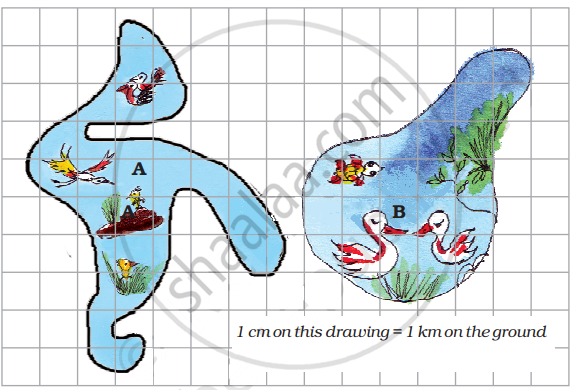
- Find the area of lake B on the drawing in square cm. What is its actual area in square km?
Advertisements
Solution
Lake B has 15 fully filled squares and 11 half-filled or more than half-filled squares.
- Area of 15 fully filled squares
= 15 × 15
= 225 square cm
We consider the area of every single half-filled or more than half-filled square as 1-centimetre square.
- Thus, the area of 11 such squares
= 11 × 11
= 121 square cm - So, the total area of lake B
= 225 + 121
= 346 square cm
We are given 1 cm on drawing = 1 km on the ground
Therefore, 346 square cm on drawing = 346 km
RELATED QUESTIONS
The principle of ‘parallax’ in section 2.3.1 is used in the determination of distances of very distant stars. The baseline AB is the line joining the Earth’s two locations six months apart in its orbit around the Sun. That is, the baseline is about the diameter of the Earth’s orbit ≈ 3 × 10¹¹m. However, even the nearest stars are so distant that with such a long baseline, they show parallax only of the order of 1” (second) of arc or so. A parsec is a convenient unit of length on the astronomical scale. It is the distance of an object that will show a parallax of 1” (second) of arc from opposite ends of a baseline equal to the distance from the Earth to the Sun. How much is a parsec in terms of meters?
The nearest star to our solar system is 4.29 light years away. How much is this distance in terms of parsecs? How much parallax would this star (named Alpha Centauri) show when viewed from two locations of the Earth six months apart in its orbit around the Sun?
Fill in the blank.
In the ............ system, length is measured in centimetres.
While measuring the length of an object using a ruler, the position of your eye should be
Complete the analogy.
Height of a person: cm :: Length of your sharpened pencil lead:______?
Fill in the following chart.
| Property | Definition | Basic Unit | Instrument used for measuring |
| Length | |||
| Mass | |||
| Volume | |||
| Time |
Match the following.
| 1. | Length | kelvin |
| 2. | Mass | metre |
| 3. | Time | kilogram |
| 4. | Temperature | second |
Guess whose tail is the longest. Now measure the tails. How good is your guess?


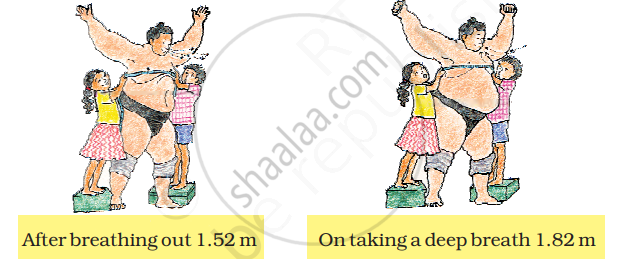
Difference in size 
Do this for yourself and find the difference.
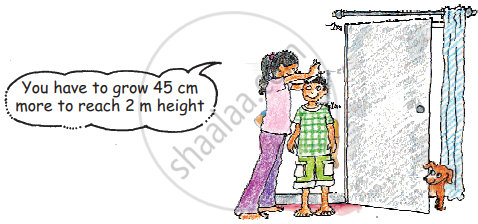
What is Dinesh’s height in metres? _____ m _____ cm.
How many stamps are needed to cover the rectangle?
How close was your earlier guess? Discuss.
The fencing of a square garden is 20 m in length. How long is one side of the garden?
Can you think of how to cut a postcard so that you can pass through it?
To measure the distance of a planet from the earth, ______ method is used.
Mars has approximately half of the earth’s diameter. When it is closest to the earth it is at about 1/2 A.U. from the earth. Calculate what size it will appear when seen through the same telescope.
According to the modern definition, what fraction of a second does light travel to define one metre?
Why is Earth's orbit used instead of its diameter to measure distances to stars using the parallax method?
Why is the speed of light used to define the metre?
