Advertisements
Advertisements
Question
Just as precise measurements are necessary in science, it is equally important to be able to make rough estimates of quantities using rudimentary ideas and common observations. Think of ways by which you can estimate the following (where an estimate is difficult to obtain, try to get an upper bound on the quantity):-
the number of air molecules in your classroom.
Advertisements
Solution 1
Let the volume of the room be V.
One mole of air at NTP occupies 22.4 l i.e., 22.4 × 10⁻³ m3 volume.
Number of molecules in one mole = 6.023 × 10²³
∴Number of molecules in room of volume V
=`(6.023xx10^(23))/(22.4xx10^(-3))xxV`
= 134.915 × 1026 V
= 1.35 × 1028 V
Solution 2
We can determine the volume of the class-room by measuring its length, breadth and height. Consider a class room of size 10 m x 8 m x 4 m.
Volume of this room is 320 m3.
We know that 22.4l or 22.4 x 10⁻³ m3 of air has 6.02 x 10²³ molecules (equal to Avogadro’s number).
Number of molecules of air in the class room =(6.02 x 10²³ /22.4 x 10-3 ) x 320 =8.6 x 1027
RELATED QUESTIONS
The principle of ‘parallax’ in section 2.3.1 is used in the determination of distances of very distant stars. The baseline AB is the line joining the Earth’s two locations six months apart in its orbit around the Sun. That is, the baseline is about the diameter of the Earth’s orbit ≈ 3 × 10¹¹m. However, even the nearest stars are so distant that with such a long baseline, they show parallax only of the order of 1” (second) of arc or so. A parsec is a convenient unit of length on the astronomical scale. It is the distance of an object that will show a parallax of 1” (second) of arc from opposite ends of a baseline equal to the distance from the Earth to the Sun. How much is a parsec in terms of meters?
What are the S.I. units of
- mass
- length
- time and
- temperature.
Write their names and symbols.
Fill in the blank.
In the ............ system, length is measured in centimetres.
While measuring the length of an object using a ruler, the position of your eye should be
A hand span is a reliable measure of length.
Match the following.
| 1. | Length of the fore arm | metre |
| 2. | SI unit of length | second |
| 3. | Nano | 103 |
| 4. | SI Unit of time | 10–9 |
| 5. | Kilo | Cubit |
Fill in the following chart.
| Property | Definition | Basic Unit | Instrument used for measuring |
| Length | |||
| Mass | |||
| Volume | |||
| Time |
Metre is the unit of ______.
Numerical Problem.
Inian and Ezhilan argue about the light year. Inian tells that it is 9.46 × 10¹⁵ m and Ezhilan argues that it is 9.46 × 10 12 km. Who is right? Justify your answer.
There are two beautiful lakes near a village. People come for boating and picnics in both the lakes. The village Panchayat is worried that with the noise of the boats the birds will stop coming. The Panchayat wants motorboats in only one lake. The other lake will be saved for the birds to make their nests.
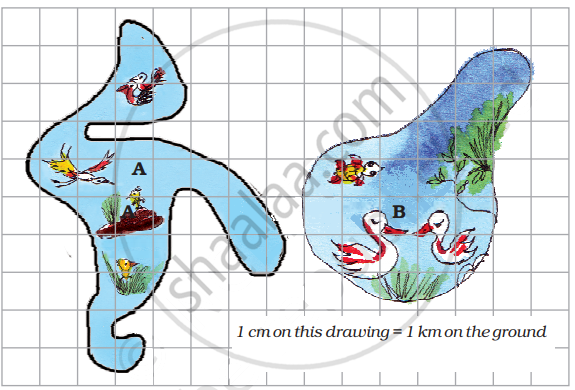
- How many kilometers long is the actual boundary of lake B?
There are two beautiful lakes near a village. People come for boating and picnics in both the lakes. The village Panchayat is worried that with the noise of the boats the birds will stop coming. The Panchayat wants motorboats in only one lake. The other lake will be saved for the birds to make their nests.
- A longer boundary around the lake will help more birds to lay their eggs. So which lake should be kept for birds? Which lake should be used for boats?
Length is a fundamental quantity.
What are the materials needed to find the length of a banana?
What unit will you use to measure the length of our classroom?
Yard was used as the unit of length.
The SI unit of mass is kg.
Consider a sunlike star at a distance of 2 parsecs. When it is seen through a telescope with 100 magnification, what should be the angular size of the star? Sun appears to be (1/2)° from the earth. Due to atmospheric fluctuations, eye can’t resolve objects smaller than 1 arc minute.
Why is the speed of light used to define the metre?
