Advertisements
Advertisements
Question
Match the following.
| 1. | Length of the fore arm | metre |
| 2. | SI unit of length | second |
| 3. | Nano | 103 |
| 4. | SI Unit of time | 10–9 |
| 5. | Kilo | Cubit |
Advertisements
Solution
| 1. | Length of the fore arm | Cubit |
| 2. | SI unit of length | metre |
| 3. | Nano | 10–9 |
| 4. | SI Unit of time | second |
| 5. | Kilo | 103 |
APPEARS IN
RELATED QUESTIONS
Write true or false.
Every measurement involves two things – a number and a unit.
Answer the following question.
Star A is farther than star B. Which star will have a large parallax angle?
Rulers, measuring tapes and metre scales are used to measure ______
Assertion (A): Distance between two celestial bodies is measured in terms of light year.
Reason (R): The distance travelled by the light in one year is one light year.
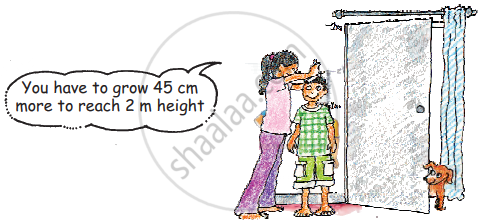
What is Dinesh’s height in metres? _____ m _____ cm.
You can play this game on the ground. Make two squares of one square meter each. Divide your class into two teams. Ready to play!
- How many of you can sit in one square meter?
You can play this game on the ground. Make two squares of one square meter each. Divide your class into two teams. Ready to play!
- Which team could make more children stand in their square? How many?
There are two beautiful lakes near a village. People come for boating and picnics in both the lakes. The village Panchayat is worried that with the noise of the boats the birds will stop coming. The Panchayat wants motorboats in only one lake. The other lake will be saved for the birds to make their nests.
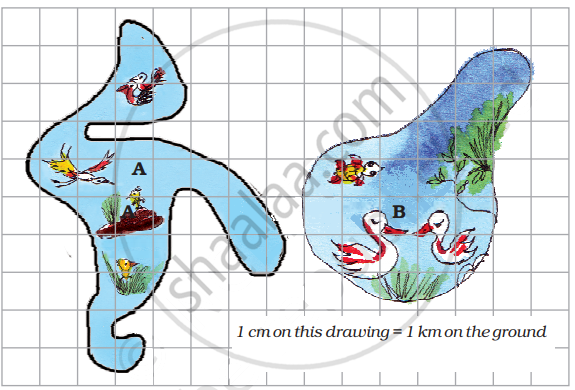
- What is the length of the boundary of lake B in the drawing?
Match the following:
| Prefix | Symbol | ||
| a. | Centi | i. | k |
| b. | Nano | ii. | c |
| c. | Mili | iii. | n |
| d. | Kilo | iv. | m |
Consider a sunlike star at a distance of 2 parsecs. When it is seen through a telescope with 100 magnification, what should be the angular size of the star? Sun appears to be (1/2)° from the earth. Due to atmospheric fluctuations, eye can’t resolve objects smaller than 1 arc minute.
