Advertisements
Advertisements
Question
- The earth-moon distance is about 60 earth radius. What will be the diameter of the earth (approximately in degrees) as seen from the moon?
- Moon is seen to be of (½)°diameter from the earth. What must be the relative size compared to the earth?
- From parallax measurement, the sun is found to be at a distance of about 400 times the earth-moon distance. Estimate the ratio of sun-earth diameters.
Advertisements
Solution

a. As the distance between moon and earth is greater than the radius of the earth, then radius of the earth can be treated as an arc.
According to the problem,
R, = length of arc
Distance between moon and earth = 60 RE
So, the angle subtended at distance r due to an arc of length `l` is
`θ_E = l/r = (2R_E)/(60 R_E) = 1/30` rad
= `1/30 xx 180^circ/pi` degree
= `6^circ/3.14` degree
= 1.9° ≈ 2°
Hence, the angle is subtended by the diameter of the earth 2θ = 2°.
b. According to the problem, the moon is seen as `(1/2)^circ` diameter from the earth and the earth is seen as 2° diameter from the moon.
As θ is proportional to diameter,
Hence, `"Diameter of earth"/"Diameter of moon" = 2/((1/2))` = 4
c. From parallax measurement given that the sun is at a distance of about 400 times the earth-moon distance, hence, `r_("sun")/r_("moon")` = 400
Sun and moon both appear to be of the same angular diameter as seen from the earth. (Suppose, here r stands for distance and D for diameter)
∴ `D_(sun)/r_(sun) = D_("moon")/r_("moon")`
⇒ `D_(sun)/D_("moon")` = 400
But `D_(earth)/D_("moon")` = 4
⇒ `D_(sun)/D_(earth)` = 100
APPEARS IN
RELATED QUESTIONS
What are the S.I. units of
- mass
- length
- time and
- temperature.
Write their names and symbols.
While measuring the length of an object using a ruler, the position of your eye should be
A hand span is a reliable measure of length.
Rulers, measuring tapes and metre scales are used to measure ______
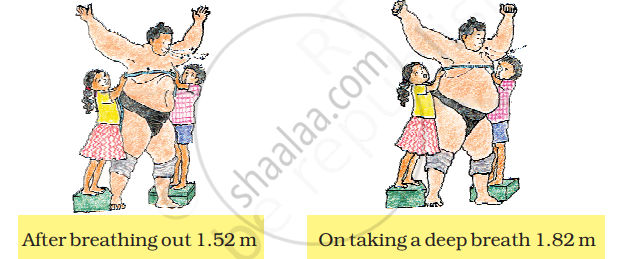
Difference in size 
Do this for yourself and find the difference.
How many stamps can be placed along its length?
You can play this game on the ground. Make two squares of one square meter each. Divide your class into two teams. Ready to play!
- How many of you can sit in one square meter?
You can play this game on the ground. Make two squares of one square meter each. Divide your class into two teams. Ready to play!
- Which team could make more children stand in their square? How many?
There are two beautiful lakes near a village. People come for boating and picnics in both the lakes. The village Panchayat is worried that with the noise of the boats the birds will stop coming. The Panchayat wants motorboats in only one lake. The other lake will be saved for the birds to make their nests.
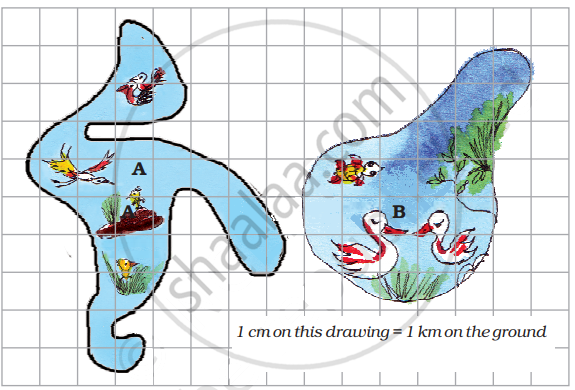
- How many cm is the length of the boundary of lake A in the drawing?(use thread to find out)
So Anar also tried many different ways to make a boundary for 800 square meters of land.
He made rectangles A, B, and C of different sizes. Find out the length of the boundary of each. How much gold wire will he get for these rectangles?
- A
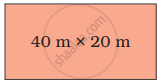
Gold wire for A = _________ metres - B

Gold wire for B = _________ metres - C

Gold wire for C = __________ metres
But then Anar made an even longer rectangle... See how long!
- D

So he will get __________ metres of gold wire!!
What are the materials needed to find the length of a banana?
Give some examples of larger length measures.
The distance between one end and the other end is called ______.
To measure the distance of a planet from the earth, ______ method is used.
How many astronomical units (A.U.) make 1 parsec?
Mars has approximately half of the earth’s diameter. When it is closest to the earth it is at about 1/2 A.U. from the earth. Calculate what size it will appear when seen through the same telescope.
Why is Earth's orbit used instead of its diameter to measure distances to stars using the parallax method?
What is an Astronomical Unit (AU)?
One parsec is defined as ______.
