Advertisements
Advertisements
Question
Now guess the length and width of many other things. Measure and find the difference between your measure and your guess.
| Size of | Your guess in cm | Your measure in cm | ||
| Length | Width | Length | Width | |
| 100 Rupee note | ||||
| 10 Rupee note | ||||
| 20 Rupee note | ||||
| 5 Rupee note | ||||
| Post card | ||||
| Math-Magic book | ||||
Advertisements
Solution
| Size of | Your guess in cm | Your measure in cm | ||
| Length | Width | Length | Width | |
| 100 Rupee note | 16.2 | 7.0 | 15.5 | 7.3 |
| 10 Rupee note | 13.0 | 6.0 | 13.7 | 6.3 |
| 20 Rupee note | 15.0 | 6.5 | 14.8 | 6.3 |
| 5 Rupee note | 11.5 | 6.5 | 11.7 | 6.3 |
| Post card | 14.0 | 9.0 | 14.5 | 9.5 |
| Math-Magic book | 28.0 | 22.0 | 28.5 | 21.5 |
Difference between my guess and measurement
| Size of | Difference in cm | |
| Length | Width | |
| 100 Rupee note | 0.5 cm | 0.3 cm |
| 10 Rupee note | 0.7 cm | 0.3 cm |
| 20 Rupee note | 0.2 cm | 0.2 cm |
| 5 Rupee note | 0.5 cm | 0.2 cm |
| Post card | 0.5 cm | 0.5 cm |
| Math-Magic book | 0.5 cm | 0.5 cm |
RELATED QUESTIONS
While measuring the length of a sharpened pencil, the reading of the scale at one end is 2.0 cm and at the other end is 12.1 cm. What is the length of the pencil?
Rulers, measuring tapes and metre scales are used to measure ______
Can you find the diameter of a thin wire of length 2 m using the ruler from your instrument box?
Arbaz plans to tile his kitchen floor with green square tiles. Each side of the tile is 10 cm. His kitchen is 220 cm in length and 180 cm wide. How many tiles will he need?

Can you think of how to cut a postcard so that you can pass through it?
Chumki, Jhumri, and Imran need wire to make a fence.
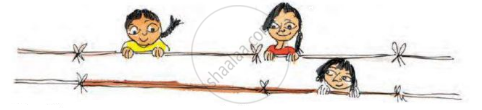
- How much wire in all will the three need?
So Anar also tried many different ways to make a boundary for 800 square meters of land.
He made rectangles A, B, and C of different sizes. Find out the length of the boundary of each. How much gold wire will he get for these rectangles?
- A
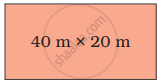
Gold wire for A = _________ metres - B

Gold wire for B = _________ metres - C

Gold wire for C = __________ metres
But then Anar made an even longer rectangle... See how long!
- D

So he will get __________ metres of gold wire!!
There are two beautiful lakes near a village. People come for boating and picnics in both the lakes. The village Panchayat is worried that with the noise of the boats the birds will stop coming. The Panchayat wants motorboats in only one lake. The other lake will be saved for the birds to make their nests.
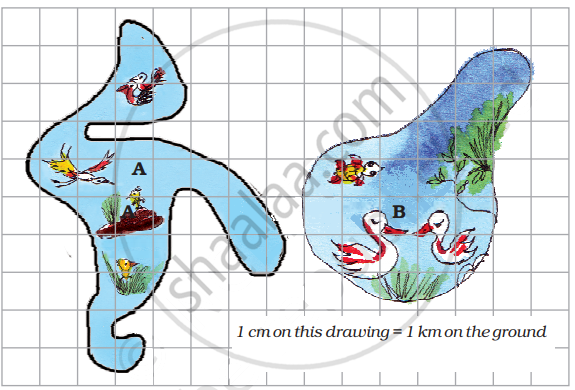
- How many kilometers long is the actual boundary of lake A?
What is the unit of measurements of very small lengths?
What is the unit of measurements of very small lengths?
Length is ______.
The SI unit of mass is kg.
To measure the distance of a planet from the earth, ______ method is used.
The radius of atom is of the order of 1 Å and the radius of nucleus is of the order of fermi. How many magnitudes higher is the volume of atom as compared to the volume of nucleus?
- The earth-moon distance is about 60 earth radius. What will be the diameter of the earth (approximately in degrees) as seen from the moon?
- Moon is seen to be of (½)°diameter from the earth. What must be the relative size compared to the earth?
- From parallax measurement, the sun is found to be at a distance of about 400 times the earth-moon distance. Estimate the ratio of sun-earth diameters.
How many astronomical units (A.U.) make 1 parsec?
Consider a sunlike star at a distance of 2 parsecs. When it is seen through a telescope with 100 magnification, what should be the angular size of the star? Sun appears to be (1/2)° from the earth. Due to atmospheric fluctuations, eye can’t resolve objects smaller than 1 arc minute.
Why is the speed of light used to define the metre?
The parallax method is used to measure astronomical distances because ______.
