Advertisements
Advertisements
प्रश्न
Just as precise measurements are necessary in science, it is equally important to be able to make rough estimates of quantities using rudimentary ideas and common observations. Think of ways by which you can estimate the following (where an estimate is difficult to obtain, try to get an upper bound on the quantity):
the number of strands of hair on your head
Advertisements
उत्तर १
Area of the head surface carrying hair = A
With the help of a screw gauge, the diameter and hence, the radius of a hair can be determined. Let it be r.
∴Area of one hair = πr2
Number of strands of hair `~~ "Total surface area"/("Area of one hair"pi) = A/r^2`
उत्तर २
Let us assume that the man is not partially bald. Let us further assume that the hair on the head are uniformly distributed. We can estimate the area of the head. The thickness of a hair can be measured by using a screw gauge. The number of hair on the head is clearly the ratio of the area of head to the cross-sectional area of a hair.
Assume that the human head is a circle of radius 0.08 m i.e., 8 cm. Let us further assume that the thickness of a human air is 5 x 10⁻⁵m.
Number of hair on the head =Area of the head/Area of cross – section of a hair
=π (0.08)2/π(5 x 10-5)=64 x 10-4/25 x 10-10=2.56 x 10⁶
The number of hair on the human head is of the order of one million.
संबंधित प्रश्न
Just as precise measurements are necessary in science, it is equally important to be able to make rough estimates of quantities using rudimentary ideas and common observations. Think of ways by which you can estimate the following (where an estimate is difficult to obtain, try to get an upper bound on the quantity):-
the number of air molecules in your classroom.
Match the following.
| Column A | Column B |
| (1) Length | a. kilogram |
| (2) Mass | b. cubic metre |
| (3) Area | c. metre |
| (4) Volume | d. square metre |
Answer the following question.
Star A is farther than star B. Which star will have a large parallax angle?
Solve the numerical example.
When the planet Jupiter is at a distance of 824.7 million kilometers from the Earth, its angular diameter is measured to be 35.72'' of arc. Calculate the diameter of Jupiter.
Match the following.
| 1. | Length | kelvin |
| 2. | Mass | metre |
| 3. | Time | kilogram |
| 4. | Temperature | second |
Measure the yellow rectangle. It is ________ cm long.
How close was your earlier guess? Discuss.
The fencing of a square garden is 20 m in length. How long is one side of the garden?
Now cut strips of equal sizes out of it. Using tape join the strips, end to end, to make a belt.
How long is your belt? _________
There are two beautiful lakes near a village. People come for boating and picnics in both the lakes. The village Panchayat is worried that with the noise of the boats the birds will stop coming. The Panchayat wants motorboats in only one lake. The other lake will be saved for the birds to make their nests.
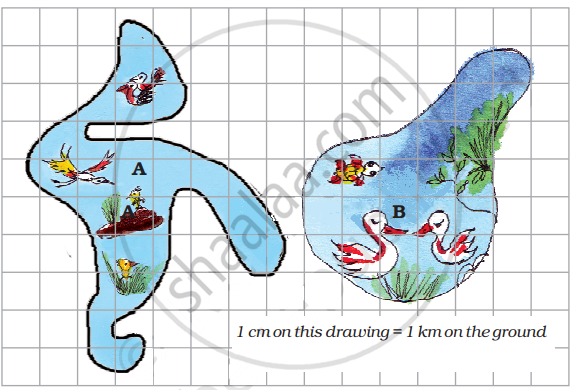
- How many kilometers long is the actual boundary of lake B?
In which SI unit, you can measure your height?
Give some examples of larger length measures.
What is the unit of measurements of very small lengths?
The Unit used to measure length ______.
Larger unit for measuring time is ______.
The radius of atom is of the order of 1 Å and the radius of nucleus is of the order of fermi. How many magnitudes higher is the volume of atom as compared to the volume of nucleus?
Consider a sunlike star at a distance of 2 parsecs. When it is seen through a telescope with 100 magnification, what should be the angular size of the star? Sun appears to be (1/2)° from the earth. Due to atmospheric fluctuations, eye can’t resolve objects smaller than 1 arc minute.
In the parallax formula D = b/θ, what must be true about the angle θ for the calculation to be correct?
What is an Astronomical Unit (AU)?
