Advertisements
Advertisements
प्रश्न
Guess the lengths to draw these things. Ask your friend to draw the same. After you make the drawing use a scale to measure the length. Whose drawing showed a better guess?
| Guess its length and draw |
Measure of your drawing |
Measure of your friend’s drawing |
| An ant of length less than 1 cm |
||
| Pencil of length about 7 cm |
||
| A glass 11 cm high with water up to 5 cm |
||
| A bangle of perimeter 20 cm |
||
| A curly hair of length 16 cm |
Advertisements
उत्तर
| Guess its length and draw |
Measure of your drawing |
Measure of your friend’s drawing |
| An ant of length less than 1 cm |
0.8 cm | 1.4 cm |
| Pencil of length about 7 cm |
6.4 cm | 7.2 cm |
| A glass 11 cm high with water up to 5 cm |
10.5 cm and 4.6 cm | 8 cm and 4.5 cm |
| A bangle of perimeter 20 cm |
18.9 cm | 20.2 cm |
| A curly hair of length 16 cm |
15 cm | 16.6 cm |
संबंधित प्रश्न
The farthest objects in our Universe discovered by modern astronomers are so distant that light emitted by them takes billions of years to reach the Earth. These objects (known as quasars) have many puzzling features, which have not yet been satisfactorily explained. What is the distance in km of a quasar from which light takes 3.0 billion years to reach us?
The principle of ‘parallax’ in section 2.3.1 is used in the determination of distances of very distant stars. The baseline AB is the line joining the Earth’s two locations six months apart in its orbit around the Sun. That is, the baseline is about the diameter of the Earth’s orbit ≈ 3 × 10¹¹m. However, even the nearest stars are so distant that with such a long baseline, they show parallax only of the order of 1” (second) of arc or so. A parsec is a convenient unit of length on the astronomical scale. It is the distance of an object that will show a parallax of 1” (second) of arc from opposite ends of a baseline equal to the distance from the Earth to the Sun. How much is a parsec in terms of meters?
500 gm = ______ kilogram.
Ten millimetre makes one centimetre.
Fill in the following chart.
| Property | Definition | Basic Unit | Instrument used for measuring |
| Length | |||
| Mass | |||
| Volume | |||
| Time |
Guess whose tail is the longest. Now measure the tails. How good is your guess?


How many stamps can be placed along its length?
How wide is the rectangle? ________ cm
There are two beautiful lakes near a village. People come for boating and picnics in both the lakes. The village Panchayat is worried that with the noise of the boats the birds will stop coming. The Panchayat wants motorboats in only one lake. The other lake will be saved for the birds to make their nests.
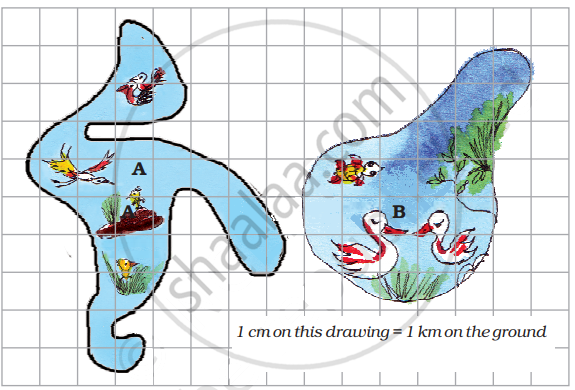
- How many cm is the length of the boundary of lake A in the drawing?(use thread to find out)
So Anar also tried many different ways to make a boundary for 800 square meters of land.
He made rectangles A, B, and C of different sizes. Find out the length of the boundary of each. How much gold wire will he get for these rectangles?
- A
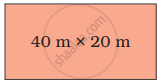
Gold wire for A = _________ metres - B

Gold wire for B = _________ metres - C

Gold wire for C = __________ metres
But then Anar made an even longer rectangle... See how long!
- D

So he will get __________ metres of gold wire!!
What formula is used to measure the area of your classroom?
Match the following:
| Prefix | Symbol | ||
| a. | Centi | i. | k |
| b. | Nano | ii. | c |
| c. | Mili | iii. | n |
| d. | Kilo | iv. | m |
Give some examples of larger length measures.
The Unit used to measure length ______.
SI unit of electric current is ______.
Larger unit for measuring time is ______.
The distance of a galaxy is of the order of 1025 m. Calculate the order of magnitude of time taken by light to reach us from the galaxy.
Consider a sunlike star at a distance of 2 parsecs. When it is seen through a telescope with 100 magnification, what should be the angular size of the star? Sun appears to be (1/2)° from the earth. Due to atmospheric fluctuations, eye can’t resolve objects smaller than 1 arc minute.
One parsec is defined as ______.
Which instruments are used to measure very small distances at the atomic scale?
