Advertisements
Advertisements
प्रश्न
So Anar also tried many different ways to make a boundary for 800 square meters of land.
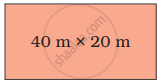
He made rectangles A, B, and C of different sizes. Find out the length of the boundary of each. How much gold wire will he get for these rectangles?
- A
Gold wire for A = _________ metres - B

Gold wire for B = _________ metres - C

Gold wire for C = __________ metres
But then Anar made an even longer rectangle... See how long!
- D

So he will get __________ metres of gold wire!!
Advertisements
उत्तर
Area of 30 m × 20 m rectangle = 600 square metres
Its area is larger than the area of the first rectangle.
The other rectangles that he can make with 100 metres of wire are
40 m × 10 m,
48 m × 2 m,
49 m × 1 m,
45 m × 5 m
- A
As the area of a rectangle, A is shown as 40 m × 20 m.
So, the length of rectangle = 40 m
Width of rectangle = 20 m
Gold wire for A
= 40 + 20 + 40 + 20
= 120 metres - B
As the area of rectangle B is shown as 80 m × 10 m.
So, the length of rectangle = 80 m
Width of rectangle = 10 m
Gold wire for B
= 80 + 10 + 80 + 10
= 180 metres - C
As the area of rectangle C is shown as 800 m × 1 m.
So, the length of rectangle = 800 m
Width of rectangle = 1 m
Gold wire for C
= 800 + 1 + 800 + 1
= 1602 metres - D
As the area of rectangle D is shown as 8000 m × 0.1 m.
So, the length of rectangle = 8000 m
Width of rectangle = 0.1 m
Gold wire for C
= 8000 + 0.1 + 8000 + 0.1
= 16000 + 0.2
= 16000.2 metres.
So, he will get 16000.2 metres of gold wire!!
संबंधित प्रश्न
The nearest star to our solar system is 4.29 light years away. How much is this distance in terms of parsecs? How much parallax would this star (named Alpha Centauri) show when viewed from two locations of the Earth six months apart in its orbit around the Sun?
Just as precise measurements are necessary in science, it is equally important to be able to make rough estimates of quantities using rudimentary ideas and common observations. Think of ways by which you can estimate the following (where an estimate is difficult to obtain, try to get an upper bound on the quantity):-
the number of air molecules in your classroom.
Fill in the blank.
In the ............ system, length is measured in centimetres.
While measuring the length of a sharpened pencil, the reading of the scale at one end is 2.0 cm and at the other end is 12.1 cm. What is the length of the pencil?
Rulers, measuring tapes and metre scales are used to measure ______
Difference in size 
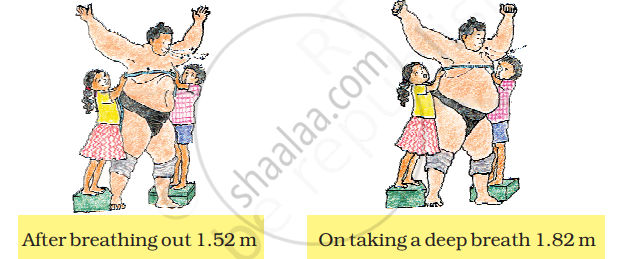
Do this for yourself and find the difference.
How close was your earlier guess? Discuss.
The fencing of a square garden is 20 m in length. How long is one side of the garden?
Now cut strips of equal sizes out of it. Using tape join the strips, end to end, to make a belt.
How long is your belt? _________
You can play this game on the ground. Make two squares of one square meter each. Divide your class into two teams. Ready to play!
- How many of you can sit in one square meter?
There are two beautiful lakes near a village. People come for boating and picnics in both the lakes. The village Panchayat is worried that with the noise of the boats the birds will stop coming. The Panchayat wants motorboats in only one lake. The other lake will be saved for the birds to make their nests.
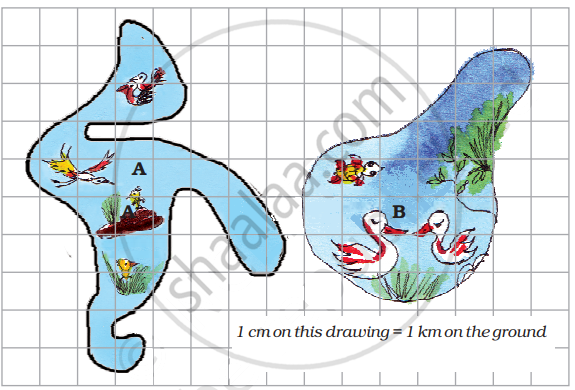
- How many kilometers long is the actual boundary of lake B?
There are two beautiful lakes near a village. People come for boating and picnics in both the lakes. The village Panchayat is worried that with the noise of the boats the birds will stop coming. The Panchayat wants motorboats in only one lake. The other lake will be saved for the birds to make their nests.
- A longer boundary around the lake will help more birds to lay their eggs. So which lake should be kept for birds? Which lake should be used for boats?
What are the materials needed to find the length of a banana?
What formula is used to measure the area of your classroom?
What unit will you use to measure the length of our classroom?
- The earth-moon distance is about 60 earth radius. What will be the diameter of the earth (approximately in degrees) as seen from the moon?
- Moon is seen to be of (½)°diameter from the earth. What must be the relative size compared to the earth?
- From parallax measurement, the sun is found to be at a distance of about 400 times the earth-moon distance. Estimate the ratio of sun-earth diameters.
Why is Earth's orbit used instead of its diameter to measure distances to stars using the parallax method?
