Advertisements
Advertisements
प्रश्न
When the planet Jupiter is at a distance of 824.7 million kilometres from the Earth, its angular diameter is measured to be 35.72″ of arc. Calculate the diameter of Jupiter
Advertisements
उत्तर १
Distance of Jupiter from the Earth, D = 824.7 × 10⁶ km = 824.7 × 10⁹ m
Angular diameter = 35.75" = 35.72 x 4.874 x 10-6 rad
Diameter of Jupiter = d
Using the relation,
`theta = d/D`
`d = thetaD = 824.7 xx 10^9 xx 35.72 xx 4.872 xx 20^(-6)`
=143520.76 x 103 = 1.435 x 10⁵ km
उत्तर २
Given angular diameter θ = 35.72= 35.72 x 4.85 x 10-6 rad
= 173.242 x 10-6 = 1.73 x 10⁻⁴ rad
Diameter of Jupiter D = θ x d = 1.73 x 10-4 x 824.7 x 109 m
=1426.731 x 103 = 1.43 x 10⁸ m
संबंधित प्रश्न
Just as precise measurements are necessary in science, it is equally important to be able to make rough estimates of quantities using rudimentary ideas and common observations. Think of ways by which you can estimate the following (where an estimate is difficult to obtain, try to get an upper bound on the quantity):-
the number of air molecules in your classroom.
Fill in the blank.
In the ............ system, length is measured in centimetres.
Solve the numerical example.
When the planet Jupiter is at a distance of 824.7 million kilometers from the Earth, its angular diameter is measured to be 35.72'' of arc. Calculate the diameter of Jupiter.
500 gm = ______ kilogram.
Length of one’s chest can be measured using metre scale.
Ten millimetre makes one centimetre.
While measuring the length of a sharpened pencil, the reading of the scale at one end is 2.0 cm and at the other end is 12.1 cm. What is the length of the pencil?
Find the answer for the following questions within the grid.
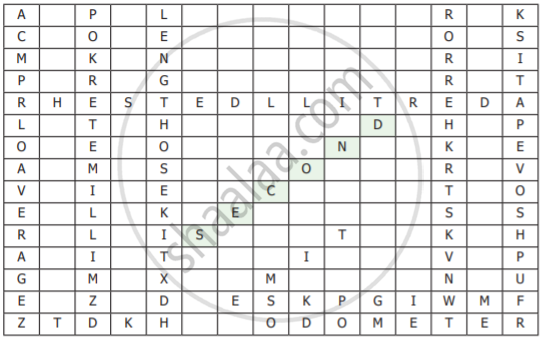
- 10-3 is one ______
- SI Unit of time is ______
- Cross view of reading a measurement leads to ______
- ______ is the one what a clock reads.
- ______ is the amount of substance present in an object.
- ______ can be taken to get the final reading of the recordings of different students for a single measurement.
- ______ is a fundamental quantity.
- ______ shows the distance covered by an automobile
- A tailor uses ______ to take measurements to stitch the cloth.
- Liquids are measured with this physical quantity.
Match the following.
| 1. | Length | kelvin |
| 2. | Mass | metre |
| 3. | Time | kilogram |
| 4. | Temperature | second |
Now guess the length and width of many other things. Measure and find the difference between your measure and your guess.
| Size of | Your guess in cm | Your measure in cm | ||
| Length | Width | Length | Width | |
| 100 Rupee note | ||||
| 10 Rupee note | ||||
| 20 Rupee note | ||||
| 5 Rupee note | ||||
| Post card | ||||
| Math-Magic book | ||||
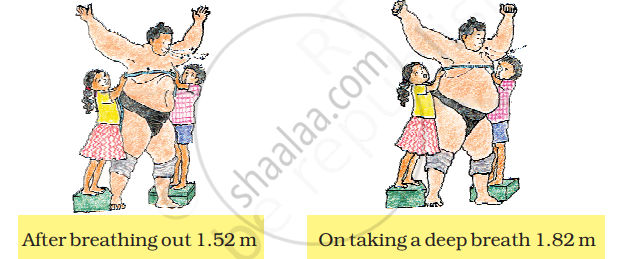
Difference in size 
Do this for yourself and find the difference.
So Anar also tried many different ways to make a boundary for 800 square meters of land.
He made rectangles A, B, and C of different sizes. Find out the length of the boundary of each. How much gold wire will he get for these rectangles?
- A
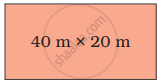
Gold wire for A = _________ metres - B

Gold wire for B = _________ metres - C

Gold wire for C = __________ metres
But then Anar made an even longer rectangle... See how long!
- D

So he will get __________ metres of gold wire!!
There are two beautiful lakes near a village. People come for boating and picnics in both the lakes. The village Panchayat is worried that with the noise of the boats the birds will stop coming. The Panchayat wants motorboats in only one lake. The other lake will be saved for the birds to make their nests.
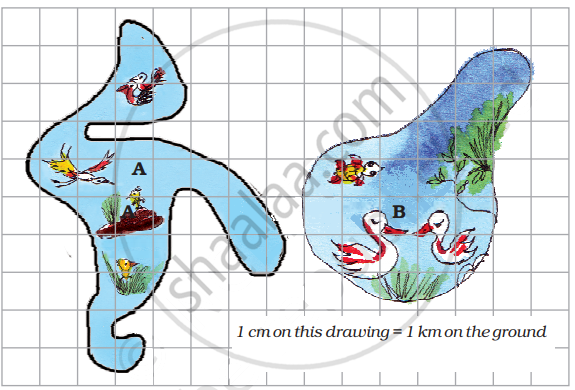
- How many kilometers long is the actual boundary of lake B?
There are two beautiful lakes near a village. People come for boating and picnics in both the lakes. The village Panchayat is worried that with the noise of the boats the birds will stop coming. The Panchayat wants motorboats in only one lake. The other lake will be saved for the birds to make their nests.
- Find the area of lake B on the drawing in square cm. What is its actual area in square km?
What are the materials needed to find the length of a banana?
What is the unit of measurements of very small lengths?
The distance of a galaxy is of the order of 1025 m. Calculate the order of magnitude of time taken by light to reach us from the galaxy.
Mars has approximately half of the earth’s diameter. When it is closest to the earth it is at about 1/2 A.U. from the earth. Calculate what size it will appear when seen through the same telescope.
According to the modern definition, what fraction of a second does light travel to define one metre?
