Advertisements
Advertisements
प्रश्न
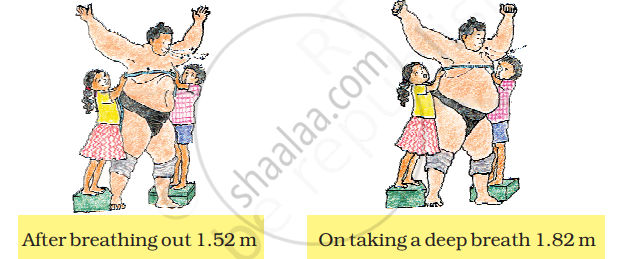
Difference in size 
Do this for yourself and find the difference.
Advertisements
उत्तर
Different in size: 1.82 m – 1.52 m
= 0.30 m
संबंधित प्रश्न
Just as precise measurements are necessary in science, it is equally important to be able to make rough estimates of quantities using rudimentary ideas and common observations. Think of ways by which you can estimate the following (where an estimate is difficult to obtain, try to get an upper bound on the quantity):-
the number of air molecules in your classroom.
Answer the following question.
Star A is farther than star B. Which star will have a large parallax angle?
500 gm = ______ kilogram.
A hand span is a reliable measure of length.
Can you find the diameter of a thin wire of length 2 m using the ruler from your instrument box?
Have you seen frogs? Where? How many different types of frogs have you seen? Are all the frogs of the same length? Here are two interesting examples.

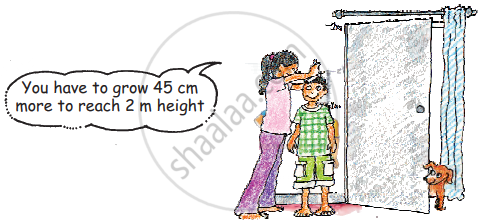
What is Dinesh’s height in metres? _____ m _____ cm.
How wide is the rectangle? ________ cm
Can you think of how to cut a postcard so that you can pass through it?

You can play this game on the ground. Make two squares of one square meter each. Divide your class into two teams. Ready to play!
- Which team could make more children sit in their square? How many?
Give some examples of larger length measures.
What is the unit of measurements of very small lengths?
The distance between one end and the other end is called ______.
The Unit used to measure length ______.
SI unit of electric current is ______.
How many astronomical units (A.U.) make 1 parsec?
According to the modern definition, what fraction of a second does light travel to define one metre?
What is the SI unit of length?
Which instruments are used to measure very small distances at the atomic scale?
