Advertisements
Advertisements
Question
Find the answer for the following questions within the grid.
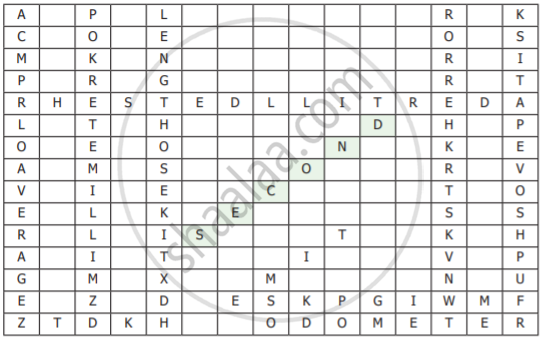
- 10-3 is one ______
- SI Unit of time is ______
- Cross view of reading a measurement leads to ______
- ______ is the one what a clock reads.
- ______ is the amount of substance present in an object.
- ______ can be taken to get the final reading of the recordings of different students for a single measurement.
- ______ is a fundamental quantity.
- ______ shows the distance covered by an automobile
- A tailor uses ______ to take measurements to stitch the cloth.
- Liquids are measured with this physical quantity.
Advertisements
Solution

- 10-3 is one millimetre
- SI Unit of time is second
- Cross view of reading a measurement leads to error
- Time is the one what a clock reads.
- Mass is the amount of substance present in an object.
- Average can be taken to get the final reading of the recordings of different students for a single measurement.
- Length is a fundamental quantity.
- Odometer shows the distance covered by an automobile
- A tailor uses tape to take measurements to stitch the cloth.
- Liquids are measured with this physical quantity- Litre
APPEARS IN
RELATED QUESTIONS
Just as precise measurements are necessary in science, it is equally important to be able to make rough estimates of quantities using rudimentary ideas and common observations. Think of ways by which you can estimate the following (where an estimate is difficult to obtain, try to get an upper bound on the quantity):
the number of strands of hair on your head
While measuring the length of an object using a ruler, the position of your eye should be
Length of one’s chest can be measured using metre scale.
Ten millimetre makes one centimetre.
Metre is the unit of ______.
In which SI unit, you can measure your height?
To measure the distance of a planet from the earth, ______ method is used.
How many astronomical units (A.U.) make 1 parsec?
Why is Earth's orbit used instead of its diameter to measure distances to stars using the parallax method?
If a planet subtends an angle α at distance D, what formula is used to find the planet's diameter?
