Advertisements
Advertisements
Question
The letter F is placed in front of a plane mirror:
How would its image look like when seen in a plane mirror?
Advertisements
Solution
The image of the letter F will appear laterally inverse, like this:
APPEARS IN
RELATED QUESTIONS
| Column I | Column II | Column III | |
| 1 | Dispersion | Long-sightedness | Twinkling of stars |
| 2 | Refraction | Splitting of white light into component colours | Convex lens |
| 3 | Hypermetropia | Change in the direction of the ray of light due to change in medium | Spectrum of seven colours |
A wall reflects light and a mirror also reflects light. What difference is three in the way they reflect light?
The image formed by a plane mirror is :
(a) virtual, behind the mirror and enlarged.
(b) virtual, behind the mirror and of the same size as the object.
(c) real, at the surface of the mirror and enlarged.
(d) real, behind the mirror and of the same size as the object.
An object is placed 20 cm in front of a plane mirror. The mirror is moved 2 cm towards the object. The distance between the positions of the positions of the original and final images seen in the mirror is ______.
A ray of light goes from water into air. Will it bend towards the normal or away from the normal?
When a light ray passes from air into glass, what happens to its speed? Draw a diagram to show which way the ray of light bends.
A ray of light passes from a medium X to another medium Y. No refraction of light occurs if the ray of light hits the boundary of medium Y at an angle of:
(a) 0°
(b) 45°
(c) 90°
(d) 120°
Air is optically .......... than glass.
When a ray of light travels from air to glass, it bends .......... the normal.
Match the Following
| Column A | Column B |
| (a) white Light | (1) Convex mirror |
| (b) Refraction | (2) Concave mirror |
| (c) Virtual images | (3) refraction |
| (d) Real images | (4) spectrum |
| (e) Prism | (5) ray of light from glass to air |
A ray of light A incident from air suffers partial reflection and refraction at the boundary of water.
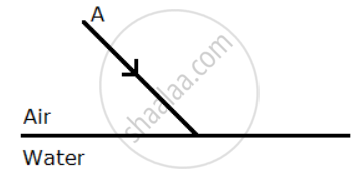
- Complete the diagram showing (i) the reflected ray B and (ii) the refracted ray C.
- How are the angles of incidence i and refraction r related?
Explain how the formation of a rainbow occurs.
The laws of reflection hold true for ______.
Explain the working of a periscope.
The angle of incidence for a ray of light having zero reflection angle is ______.
When light passes from one medium to another the ray gets bent. This property of light is called ______.
Twinkling of stars and Mirage are the two phenomena occurring due to refraction.
Assertion: The air bubble shines in water.
Reason: Air bubble shines due to the refraction of light.
Match the following:
| Column I | Column II | ||
| 1. | r > 90 | a. | Light gazes at the surface of separation between the two modes. |
| 2. | r = 90 | b. | No refraction. |
| 3. | r < 90 | c. | Refracted ray away from the normal |
The bottom of swimming pool appears to be less deep than the actual one because of
