Advertisements
Advertisements
Question
The farthest objects in our Universe discovered by modern astronomers are so distant that light emitted by them takes billions of years to reach the Earth. These objects (known as quasars) have many puzzling features, which have not yet been satisfactorily explained. What is the distance in km of a quasar from which light takes 3.0 billion years to reach us?
Advertisements
Solution 1
Time taken by quasar light to reach Earth = 3 billion years
= 3 × 10⁹ years
= 3 × 109 × 365 × 24 × 60 × 60 s
Speed of light = 3 × 10⁸ m/s
Distance between the Earth and quasar
= (3 × 108) × (3 × 109 × 365 × 24 × 60 × 60)
= 283824 × 1020 m
= 2.8 × 10²² km
Solution 2
The time taken by light from the quasar to the observer
t = 3.0 billion years = 3.0 x 10⁹ years As 1 ly = 9.46 x 10¹⁵ m
∴ Distance of quasar from the observer d = 3.0 x 109 x 9.46 x 1015 m
= 28.38 x 1024 m = 2.8 x 1025 m or 2.8 x 10²² km.
RELATED QUESTIONS
What are the S.I. units of
- mass
- length
- time and
- temperature.
Write their names and symbols.
Match the following.
| Column A | Column B |
| (1) Length | a. kilogram |
| (2) Mass | b. cubic metre |
| (3) Area | c. metre |
| (4) Volume | d. square metre |
Rulers, measuring tapes and metre scales are used to measure ______
Which line is longer? C or D? Measure each line. How good is your guess?

What is the length of a 100 rupee note? Guess. Now measure it using a scale.

The fencing of a square garden is 20 m in length. How long is one side of the garden?
You can play this game on the ground. Make two squares of one square meter each. Divide your class into two teams. Ready to play!
- How many of you can sit in one square meter?
You can play this game on the ground. Make two squares of one square meter each. Divide your class into two teams. Ready to play!
- How many of you can stand in it?
You can play this game on the ground. Make two squares of one square meter each. Divide your class into two teams. Ready to play!
- Which team could make more children stand in their square? How many?
You can play this game on the ground. Make two squares of one square meter each. Divide your class into two teams. Ready to play!
- Which team could make more children sit in their square? How many?
There are two beautiful lakes near a village. People come for boating and picnics in both the lakes. The village Panchayat is worried that with the noise of the boats the birds will stop coming. The Panchayat wants motorboats in only one lake. The other lake will be saved for the birds to make their nests.
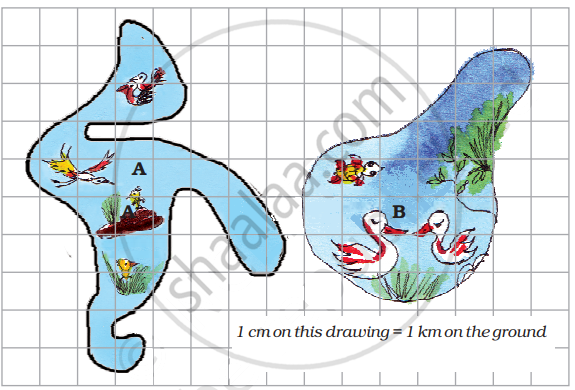
- How many cm is the length of the boundary of lake A in the drawing?(use thread to find out)
There are two beautiful lakes near a village. People come for boating and picnics in both the lakes. The village Panchayat is worried that with the noise of the boats the birds will stop coming. The Panchayat wants motorboats in only one lake. The other lake will be saved for the birds to make their nests.
- What is the length of the boundary of lake B in the drawing?
There are two beautiful lakes near a village. People come for boating and picnics in both the lakes. The village Panchayat is worried that with the noise of the boats the birds will stop coming. The Panchayat wants motorboats in only one lake. The other lake will be saved for the birds to make their nests.
- How many kilometers long is the actual boundary of lake B?
What formula is used to measure the area of your classroom?
Larger unit for measuring time is ______.
To measure the distance of a planet from the earth, ______ method is used.
How many astronomical units (A.U.) make 1 parsec?
According to the modern definition, what fraction of a second does light travel to define one metre?
What is an Astronomical Unit (AU)?
Why is the speed of light used to define the metre?
