Advertisements
Advertisements
Question
State whether the following statement is True or False:
Both Demetrius and Lysander fight for Hermia.
Options
True
False
Advertisements
Solution
Both Demetrius and Lysander fight for Hermia - False.
APPEARS IN
RELATED QUESTIONS
B1. Select
Fill in the blanks choosing the correct alternatives from those given in the bracket:
(i) The author was inspired and motivated to read ............................................ by the time she was eleven.
[Shakespeare, Chaucer, G.B. Shaw]
(ii) Every lesson .......................... ......... took was spiced with half a dozen or more anecdotes.
[Mrs. Rowlands, Sister Monica, Mr. A.N. Patil]
(iii) The teachers helped the narrator to become ..................................... . .
[confident, happy, independent]
(iv) Mrs. Cynthia Nesamani and Sister Monica gave .......................................... to the narrator.
[freedom to do what he wanted, advice to do something, instructions to produce better results]
In a way, one of the greatest gifts any teacher can give a student, I think, is to inculcate a curiosity to learn.
I've been incredibly lucky to have at least one such teacher at every stage in my life. The first was Mrs. Rowlands who taught me in primary school. She taught me to read without ever pushing me. She made me want to read more by giving 'me some of the most interesting children's books available. And although I still love to go back to those books from time to time, it was only because of her that I was able to read Shakespeare by the time I was ten, and Chaucer a year later.
In later years, it was Mr. A.N. Patil, my Marathi and Hindi Teacher who made a huge impression on me. Every lesson he took, was spiced with half a dozen or more anecdotes from a wide variety of subjects: among them history, politics, religion and sociology. I was, and still am in awe of his knowledge, which despite rather desperate attempts, I doubt I'll ever be able to match.
There have also been other teachers who helped me to try to become independent: to think and act for myself using my own judgement, which to my mind has been just as, if not more important, than actually learning anything.
After all, it's much too easy to become a completely useless repository of facts and little else.
Two teachers whom I remember in particular are Mrs. Cynthia Nesamani and Sister Monica, both taught me in school. The former, by and large, gave me a free rein to do what I wanted to do. I, being one of those people who dislike instructions, she helped me to produce much better results than I'd have otherwise done.
B2.Complete
Read the extract and complete the following:
The teacher can
(i) .............
(ii) ..............
(iii )..............
(iv).................
B3. Similar word
Look at the following sentences arid pick the word having similar meaning to the given word and rewrite:
(i) Spiced His conversation is always with a lot of humour. (made interesting, garnished, flavoured)
(ii) Repository
The library should not merely be a ................ of books. (store-house, reservoir, tank)
(iii) Inculcate
It is the responsibility of the parents and teachers to .......values in the child's formative years. (imbibe, give, show)
(iv) Incredibly
I have been .. lucky to have at least one such teacher at every stage in my life. (importantly, unbelievably, beautifully)
B4. Language study
(i) There have also been other teachers. They have helped me to try to become
independent. (Combine using 'who')
(ii) It was only because of her that I was able-to read Shakespeare.
(Rewrite beginning with: If it was not for her, ).
B.5 Out motivators
Look at the following table and complete it by presenting your own views
| Personalities | Influence on your life |
| (i) Teachers | |
| (ii) Parents | |
| (iii) Relatives | |
| (iv) Friends |
Maggu’s achievements are particularly noteworthy because – as is well known – academic institutions in India are less than sold on the idea of inclusive education. In fact, when Maggu lost her sight in class IV, her school (which she declines to name) expelled her while suggesting she attend a “blind school”. Though shocked, Maggu rejected the advice. “Attending a special school would have tarred me with a handicap forever, which was not how I saw my future. Therefore I did the rounds of other public schools with my father, a small – time merchant, explaining that my case was different Since I had vision till the age of ten,” she recalls.
Impressed by her persistence and ambition, Delhi’s Bluebells School not only admitted her but pulled out all the stops to support her in academics sporting events and also notched up a respectable 73 percent average in the class XII exam with the help of Braille, interactive textbooks and extra coaching.
The respectable average in her CBSE exam paved the way for admission into LSR where again she proved her mettle by winning medals in a slew of inter – collage events (100 200 and 400 metre sprints) high jump, long jump, javelin and discuss throw: resulting in her being declared ‘Athlete of the year’ 2003’ at a sports meet for 100 physically challenged athletes. And the cherry on the cake was the selection to the IBSA Games last year. “It was a tough regimen,” recalls Maggu. “I had to attend sports camps manage my studies and officiates as sports president. But I managed.”
Questions:
(1) What qualities of Maggu are highlighted in this passage?
(2) Why did Maggu refuse to attend a ‘blind school’?
(3) Quote the lines that show that Jyoti Maggu was good in academics as well as in sports.
(4) Use any two phrases in sentences of your own :
(a) To win laurels
(b) To pave the way
(c) To prove one’s mettle
(d) A tough regimen
(5)
(a) I did the rounds of other public schools with my father [Change the voice]
(b) though shocked Maggu rejected the advice [Rewrite as a simple sentence]
(6) Should the physically challenged be sent to special schools? Express your views.
How did the air raids disrupt the Dutch public life?
Answer any four of the following questions in 30 – 40 words each :
(a) After initial reluctance why did the lawyers tell Gandhiji that they were ready to follow him into jail?
(b) What is Mukesh's attitude towards the family business of making bangles?
(c) How does the poet show the futility of Aunt Jennifer's efforts?
(d) Stephen Spender in his poem, 'An Elementary School Classroom in a Slum' paints a dismal picture of poverty. Comment.
(e) Jackson went through the contents of Rev. McLeery's suitcase. Which object therein puzzled him sorely? What was his comment on that?
(f) How did the servants react when they realized that Dr. Sadao was going to save the life of an enemy?
Answer any four of the following questions in 30-40 words each:
(a) How could the peddler enter the forge without being noticed by the blacksmith?
(b) At Champaran what did the British landlords want from the sharecroppers?
(c) How does the poet show the futility of Aunt Jennifer's efforts?
(d) Stephen Spender in his poem, 'An elementary School Classroom in a Slum' paints a dismal picture of poverty. Comment.
(e) How did Evans have the last laugh at the Governor?
(f) How did the General plan to get rid of the American POW?
(i) The interest of Maharashtra and that of India should be one for the progress of Maharashtra state, because ................
Read the following passage and do the activities:
B1 Match:
Match the areas given in Column ‘A’ with the description of Mehendi design given in Column ‘B’:
| 'A' | 'B" | ||
| (i) | North African | (a) | A mix of Indo-Pakistani and Arabic design |
| (ii) | Indian | (b) | Delicate loops and curves, paisleys, teardrops |
| (iii) | Arabic | (c) | Geometrical images |
| (iv) | South Asian | (d) | Local textiles, paintings, and architecture |
Henna comes from the leaves of the plant Lawsonia inertias. The plant grows in hot and dry climes and is native to North Africa, the Indian subcontinent and the Middle East. The leaves of the plant are dried and crushed to powder. Various additives such as coffee decoction, tea, lime juice, Mehendi and eucalyptus oil are mixed with the henna powder to increase the potency of the dry, this also helps to bind the powder to a paste-like consistency. The mixture is applied through cones in intricate patterns depending on the region of use.
Album of Patterns
Four major styles can be found in the vast dictionary of Mehendi designs. Earlier the application was restricted to hand and feet, but the adoption of Mehendi by different cultures throughout the world has seen experimentation on different body parts including the neck naval and back.
North African patterns rely on geometrical images to trace the shape of hands and feet, Arabic designs borrow heavily from local textiles, paintings, and architecture. These are more spaced out, to allow the design to stand out boldly from the skin parts left untouched by henna. The Indian style comprises of delicate loops and curves, paisleys, teardrops and flowers that give a dainty filigreed glow-like effect. Though intricate patterning is the name of the game today, this trend took off in India only during the 20th century. The patterns preferred by the South Asian countries are mixed with Indo-Pakistani and Arabic design schemes. Chinese and Celtic symbols now find a place in the vast repertoire of Mehendi designs as well.
B2 Complete:
Complete the following and write:
(i) The procedure before applying henna _______
(ii) The reasons for using additives _______
(iii) The suitable climatic conditions for the henna plant _______
(iv) Mehendi is used on _______
B3 Find words:
Look at the following description and find out proper words from the passage and write:
(i) Existing naturally in the place : - n _______
(ii) Consist of something: - c _______
(iii) Delicate decoration made from gold, silver and copper wire: - f _______
(iv) Substance that is added in small quantity : - a _______
B4 Language study:
Fill in the blanks with suitable subordinators given in the box:
| as well as, so that, however, which |
(i) The mixture is applied through cones in intricate patterns _______ depend on the region of use.
(ii) The intricate pattern is the name of the game of today _______, this trend took off in India, recently.
(iii) North African pattern relies on geometrical images ______ they can trace the shape of hands and feet.
(iv) The patterns preferred by the South Asian countries are mixed with Indo-Pakistani _______ Arabic design schemes.
B5 Personal Response:
Which Mehendi design do you like? Why?
Discuss the following statement in groups of two pairs, each pair in a group taking opposite points of view.
The methods of inquiry of history, science, and philosophy are similar.
What do you think are the reasons for the references made to the English people and the British monarchy?
Examine the communication channels in the story between Paul and his uncle.
How does Shelley's attitude to science differ from that of Wordsworth and Keats?
Study each of the following sentences and notice the balance between its parts. Pick out other sentences in the text that reflect this kind of balance
a. It is right that a false Latin quantity should excite a smile in the House of Commons; but it is wrong that a false English meaning should not excite a frown there.
b. Let the accent of words be watched, by all means, but let the meaning be watched more closely still, and fewer will do the work.
Comment on the subtlety with which the poet captures the general pattern of communication within a family.
Distinguish between the following pairs of words
| Incredulous | - | Incredible |
| Suspicious | - | Susceptible |
| Sensitivity | - | Sentimentality |
| Successive | - | Successful |
Make sentence of your own using the following expression.
put up with:
Sue and Johnsy were very close friends.
Behrman was a hard-hearted person.
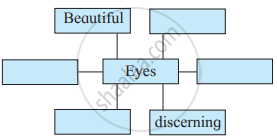
Complete the web with the help of adjectives used to describe eyes and nose in all respects. Two are done for you.

Have you ever given up on something good? Share your story with your friend.
Form pairs. Make a list of as many games as you can. (At least 25) Then classify the games using the following criteria:
- Indoor and outdoor games.
- Games played with and without any equipment.
- Games which have one-to-one matches and those in which teams play against each other (Single-player or team)
- Games played mostly by children and games played by adult players.
- Shape and size of the court or field.
Use the following figures to show your classification.
Go through the following web that highlights the essential qualities of a compere. Discuss with your partner the essential qualities and also the precautions that a compere should take while compering a program.

Precautions to be taken :
- __________________________
- __________________________
- __________________________
- __________________________
What did one of the fluttering creatures do?
Discuss the following question after you have seen a presentation of the ‘ad’.
How many times is the name Krispy Krunchy repeated in the ad? Why?
Form pairs. Discuss and prepare a list of things that can be and will be done in future. (5 things) Spot the modal verbs in your answer.
What two basic rules were followed in the Science Fair?
Choose a 'question' through your own observation. Try to follow the scientific method to find the answer to that question. Take the help of your teacher/parents to set up the experiment.
Who is the speaker in the poem?
Use the following expressions in your own sentences:
- We all agree that
- It is he/she who
- Don’t you see
- None of us
If you were to draw a landscape on the basis of this poem, what elements will you show in it? What colours will you use?
Prepare similar word chains using the following ideas.
sunshine - warm ________________.
Write in your own words.
Who does the poet invite to join him?
Write in your own words.
What message does the poem convey?
Why is Great January annoyed with Holena and her mother? Does he help them?
Mahatma Gandhi, Che Guevera, Guru Nanak, and Gauthama Buddha are some of the famous personalities and thinkers who made extensive journeys to understand life. Do you think journeys can be life-changing?
Complete the given tabular column with the suitable plural forms.
| chair | - | |
| box | - | |
| Eskimo | - | |
| lady | - | |
| radius | - | |
| formula | - | |
| child | - | |
| deer | - | |
| loaf | - | |
| hero | - |
Identify the speaker/character.
‘Come in, Zigzag, come in dear!’
Why did Shepherd-Barron reduce the PIN number from six digits to four?
What did the coach teach the child?
Tom lay thinking. Presently it occurred to him that he wished he was sick; then he could stay home from school. He examined himself. He found no symptoms or sickness, and he investigated again. This time he felt he had a stomach ache, but it soon grew feeble, and presently died wholly away. He reflected further.
What was the result of Tom’s self-examination?
When should we have courage?
Identify the speaker/character.
Wake up, child.
Read the incidents. Work in small groups to role play the situations in which they showed their presence of mind. Each group should perform the skit for the rest of the class. Share similar situations in the class.
Turtles are sea animals.
The hatchlings use a tiny egg-tooth to come out of the eggs.
Why did the girls snigger?
Geetha madam couldn’t stop the children running out of the train because they ______.
How should one react to adversity?
The poor farmer’s crop was______.
What were Anandhan and Yazhini watching in the television?
Vicky pleaded his father to buy a robot.
Why should we read?
The bird-catcher decided to sit under the ________.
Where did the bird catcher sit?
What did they use as net?
Look at the picture and tick choose the correct word.

Recite the poem with correct intonation.
How long did the competition take to reach the final?
One day Chris tried to draw a ______.
Write about the places where the poet wants us to run.
The garden Alice saw was
