Advertisements
Advertisements
Question
Show that the height of the cylinder of maximum volume, that can be inscribed in a sphere of radius R is `(2R)/sqrt3.` Also, find the maximum volume.
Advertisements
Solution 1
Given that the radius of the sphere is R,.
Let r and h be the radius and height of the inscribed cylinder, respectively.
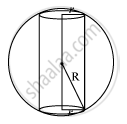
From the given figure, we have `h=2sqrt(R^2-r^2)`
The volume (V) of the cylinder is given by,
`V=pir^2h=2pir^2sqrt(R^2-r^2)`
`therefore (dV)/(dr)=4pirsqrt(R^2-r^2)+(2pir^2(-2r))/(2sqrt(R^2-r^2))`
`=(4pirR^2-6pir^3)/sqrt(R^2-r^2)`
for maxima or minima, `(dV)/(dr) =0 `
`(4pirR^2-6pir^3)=0`
`r^2=(2R^2)/3`
Now `,(d^2V)/(dr^2)=(sqrt(R^2-r^2)(4piR^2-18pir^2)-(4piR^2-6pir^3)(-2r)/(2sqrt(R^2-r^2)))/(R^2-r^2)`
`=((R^2-r^2)(4piR^2-18pir^2)-r(4piR^2-6pir^3))/(R^2-r^2)^(3/2)`
`=(4piR^4-22pir^2R^2+12pir^4+4pir^2R^2)/(R^2-r^2)^(3/2)`
Now, it can be observed that when `r^2=(2RR62)/3,(d^2V)/(dr^2)<0`
The volume is the maximum when `r^2=(2R^2)/3`
Maximum volume = V = `pih((4R^2 - h^2)/4)`
`h = 2R/sqrt3`
`V_(max) = pi xx 2R/sqrt3 ((4R^2 - 4R^2/3)/4)`
` = (2piR)/sqrt3 . (2R^2)/3 = (4piR^3)/(3sqrt3)` cubic units
Hence, the volume of the cylinder is at its maximum when the height of the cylinder is `(2R)/3`
Solution 2
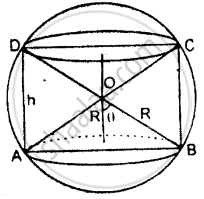
Let the radius of the sphere, OA = R
makes an angle θ with the axis of the cylinder.
Radius of cylinder = R sin θ
Height of cylinder = 2R cos θ
∴ Volume of cylinder = πr2h
V = π (R sin θ)2 × 2 R cos θ
= 2πR3 sin2 θ cos θ
On differentiating with respect to θ,
`(dV)/(d theta) = 2piR^2 [sin^2 theta (- sin theta) + cos theta * 2 sin theta cos theta]`
= 2πR3 [- sin3 θ + 2 cos2 θ sin θ]
= 2πR3 sin θ (2 cos2 θ - sin2 θ)
= 2πR3 sin θ (2 cos2 θ - 1 + cos2 θ)
= 2πR3 sin θ (3 cos2 θ - 1)
For maximum and minimum, `(dV)/(d theta) = 0`
⇒ 2πR3 sin θ (3 cos2 θ - 1) = 0
3 cos2 θ - 1 = 0 या `cos^2 theta = 1/3`
`therefore cos theta = 1/sqrt3`
At `cos theta = 1/sqrt3` the sign of `(dV)/(d theta)` changes from positive to negative when θ passes through cos θ = `1/sqrt3`.
V is maximum at `=> cos theta = 1/sqrt3`.
Height = 2 R cos θ = 2R `* 1/sqrt3 = (2R)/3`
∴ Maximum volume of cylinder = 2πR3 sin2 θ cos θ
`= 2piR^3 (sqrt2/sqrt3)^2 1/sqrt3 ...[because cos theta = 1/sqrt3, sin theta = sqrt2/sqrt3]`
`= 2piR^3 xx 2/3 * 1/sqrt3`
`= (4 piR^3)/(3 sqrt3)` square unit.
APPEARS IN
RELATED QUESTIONS
If `f'(x)=k(cosx-sinx), f'(0)=3 " and " f(pi/2)=15`, find f(x).
Find the maximum and minimum value, if any, of the following function given by g(x) = x3 + 1.
Find the maximum and minimum value, if any, of the following function given by h(x) = x + 1, x ∈ (−1, 1)
Find the local maxima and local minima, if any, of the following function. Find also the local maximum and the local minimum values, as the case may be:
f(x) = sinx − cos x, 0 < x < 2π
Prove that the following function do not have maxima or minima:
h(x) = x3 + x2 + x + 1
Find the maximum profit that a company can make, if the profit function is given by p(x) = 41 − 72x − 18x2.
What is the maximum value of the function sin x + cos x?
Find the maximum value of 2x3 − 24x + 107 in the interval [1, 3]. Find the maximum value of the same function in [−3, −1].
Find two numbers whose sum is 24 and whose product is as large as possible.
Show that the altitude of the right circular cone of maximum volume that can be inscribed in a sphere of radius r is `(4r)/3.`
Show that the cone of the greatest volume which can be inscribed in a given sphere has an altitude equal to \[ \frac{2}{3} \] of the diameter of the sphere.
Divide the number 20 into two parts such that their product is maximum.
The total cost of producing x units is ₹ (x2 + 60x + 50) and the price is ₹ (180 − x) per unit. For what units is the profit maximum?
If x + y = 3 show that the maximum value of x2y is 4.
Divide the number 20 into two parts such that their product is maximum
If z = ax + by; a, b > 0 subject to x ≤ 2, y ≤ 2, x + y ≥ 3, x ≥ 0, y ≥ 0 has minimum value at (2, 1) only, then ______.
The minimum value of the function f(x) = 13 - 14x + 9x2 is ______
The function f(x) = 2x3 – 3x2 – 12x + 4, has ______.
Find all the points of local maxima and local minima of the function f(x) = (x - 1)3 (x + 1)2
The coordinates of the point on the parabola y2 = 8x which is at minimum distance from the circle x2 + (y + 6)2 = 1 are ____________.
The combined resistance R of two resistors R1 and R2 (R1, R2 > 0) is given by `1/"R" = 1/"R"_1 + 1/"R"_2`. If R1 + R2 = C (a constant), then maximum resistance R is obtained if ____________.
The point on the curve `x^2 = 2y` which is nearest to the point (0, 5) is
Let A = [aij] be a 3 × 3 matrix, where
aij = `{{:(1, "," if "i" = "j"),(-x, "," if |"i" - "j"| = 1),(2x + 1, "," "otherwise"):}`
Let a function f: R→R be defined as f(x) = det(A). Then the sum of maximum and minimum values of f on R is equal to ______.
The set of values of p for which the points of extremum of the function f(x) = x3 – 3px2 + 3(p2 – 1)x + 1 lie in the interval (–2, 4), is ______.
Let f(x) = |(x – 1)(x2 – 2x – 3)| + x – 3, x ∈ R. If m and M are respectively the number of points of local minimum and local maximum of f in the interval (0, 4), then m + M is equal to ______.
The volume of the greatest cylinder which can be inscribed in a cone of height 30 cm and semi-vertical angle 30° is ______.
The point in the interval [0, 2π], where f(x) = ex sin x has maximum slope, is ______.
Find two numbers whose sum is 15 and when the square of one number multiplied by the cube of the other is maximum.
If f(x) = `1/(4x^2 + 2x + 1); x ∈ R`, then find the maximum value of f(x).
A running track of 440 m is to be laid out enclosing a football field. The football field is in the shape of a rectangle with a semi-circle at each end. If the area of the rectangular portion is to be maximum,then find the length of its sides. Also calculate the area of the football field.
Find the local maxima and local minima, if any, of the following function. Find also the local maximum and the local minimum values, as the case may be:
f(x) `= x sqrt(1 - x), 0 < x < 1`
For a function defined on an interval \[I\], which condition means that \[f\] has a minimum value at \[c\in I\]?
Which statement gives the meaning of a local minimum at \[c\]?
Let \[c\] be a critical point of a continuous function \[f\]. If \[f'(x)\] changes sign from negative to positive as \[x\] passes through \[c\], what is \[c\]?
For \[f(x)=3x^4+4x^3-12x^2+12\], which is the correct factorization of \[f'(x)\]?
