Advertisements
Advertisements
प्रश्न
Show that the height of the cylinder of maximum volume, that can be inscribed in a sphere of radius R is `(2R)/sqrt3.` Also, find the maximum volume.
Advertisements
उत्तर १
Given that the radius of the sphere is R,.
Let r and h be the radius and height of the inscribed cylinder, respectively.
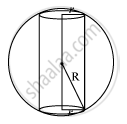
From the given figure, we have `h=2sqrt(R^2-r^2)`
The volume (V) of the cylinder is given by,
`V=pir^2h=2pir^2sqrt(R^2-r^2)`
`therefore (dV)/(dr)=4pirsqrt(R^2-r^2)+(2pir^2(-2r))/(2sqrt(R^2-r^2))`
`=(4pirR^2-6pir^3)/sqrt(R^2-r^2)`
for maxima or minima, `(dV)/(dr) =0 `
`(4pirR^2-6pir^3)=0`
`r^2=(2R^2)/3`
Now `,(d^2V)/(dr^2)=(sqrt(R^2-r^2)(4piR^2-18pir^2)-(4piR^2-6pir^3)(-2r)/(2sqrt(R^2-r^2)))/(R^2-r^2)`
`=((R^2-r^2)(4piR^2-18pir^2)-r(4piR^2-6pir^3))/(R^2-r^2)^(3/2)`
`=(4piR^4-22pir^2R^2+12pir^4+4pir^2R^2)/(R^2-r^2)^(3/2)`
Now, it can be observed that when `r^2=(2RR62)/3,(d^2V)/(dr^2)<0`
The volume is the maximum when `r^2=(2R^2)/3`
Maximum volume = V = `pih((4R^2 - h^2)/4)`
`h = 2R/sqrt3`
`V_(max) = pi xx 2R/sqrt3 ((4R^2 - 4R^2/3)/4)`
` = (2piR)/sqrt3 . (2R^2)/3 = (4piR^3)/(3sqrt3)` cubic units
Hence, the volume of the cylinder is at its maximum when the height of the cylinder is `(2R)/3`
उत्तर २
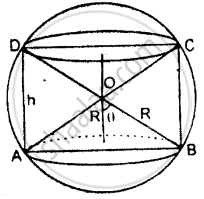
Let the radius of the sphere, OA = R
makes an angle θ with the axis of the cylinder.
Radius of cylinder = R sin θ
Height of cylinder = 2R cos θ
∴ Volume of cylinder = πr2h
V = π (R sin θ)2 × 2 R cos θ
= 2πR3 sin2 θ cos θ
On differentiating with respect to θ,
`(dV)/(d theta) = 2piR^2 [sin^2 theta (- sin theta) + cos theta * 2 sin theta cos theta]`
= 2πR3 [- sin3 θ + 2 cos2 θ sin θ]
= 2πR3 sin θ (2 cos2 θ - sin2 θ)
= 2πR3 sin θ (2 cos2 θ - 1 + cos2 θ)
= 2πR3 sin θ (3 cos2 θ - 1)
For maximum and minimum, `(dV)/(d theta) = 0`
⇒ 2πR3 sin θ (3 cos2 θ - 1) = 0
3 cos2 θ - 1 = 0 या `cos^2 theta = 1/3`
`therefore cos theta = 1/sqrt3`
At `cos theta = 1/sqrt3` the sign of `(dV)/(d theta)` changes from positive to negative when θ passes through cos θ = `1/sqrt3`.
V is maximum at `=> cos theta = 1/sqrt3`.
Height = 2 R cos θ = 2R `* 1/sqrt3 = (2R)/3`
∴ Maximum volume of cylinder = 2πR3 sin2 θ cos θ
`= 2piR^3 (sqrt2/sqrt3)^2 1/sqrt3 ...[because cos theta = 1/sqrt3, sin theta = sqrt2/sqrt3]`
`= 2piR^3 xx 2/3 * 1/sqrt3`
`= (4 piR^3)/(3 sqrt3)` square unit.
APPEARS IN
संबंधित प्रश्न
Find the maximum and minimum value, if any, of the following function given by f(x) = (2x − 1)2 + 3.
Find the maximum and minimum value, if any, of the following function given by f(x) = |sin 4x + 3|
Find the local maxima and local minima, if any, of the following function. Find also the local maximum and the local minimum values, as the case may be:
`g(x) = x/2 + 2/x, x > 0`
Prove that the following function do not have maxima or minima:
g(x) = logx
Find the absolute maximum value and the absolute minimum value of the following function in the given interval:
f (x) = sin x + cos x , x ∈ [0, π]
At what points in the interval [0, 2π], does the function sin 2x attain its maximum value?
A rectangular sheet of tin 45 cm by 24 cm is to be made into a box without top, by cutting off square from each corner and folding up the flaps. What should be the side of the square to be cut off so that the volume of the box is the maximum possible?
Show that semi-vertical angle of right circular cone of given surface area and maximum volume is `Sin^(-1) (1/3).`
Find the points at which the function f given by f (x) = (x – 2)4 (x + 1)3 has
- local maxima
- local minima
- point of inflexion
An open tank with a square base and vertical sides is to be constructed from a metal sheet so as to hold a given quantity of water. Show that the cost of material will be least when the depth of the tank is half of its width. If the cost is to be borne by nearby settled lower-income families, for whom water will be provided, what kind of value is hidden in this question?
Show that the cone of the greatest volume which can be inscribed in a given sphere has an altitude equal to \[ \frac{2}{3} \] of the diameter of the sphere.
Prove that the semi-vertical angle of the right circular cone of given volume and least curved surface is \[\cot^{- 1} \left( \sqrt{2} \right)\] .
Find the point on the straight line 2x+3y = 6, which is closest to the origin.
Find the maximum and minimum of the following functions : f(x) = 2x3 – 21x2 + 36x – 20
A metal wire of 36 cm length is bent to form a rectangle. Find its dimensions when its area is maximum.
Examine the function for maxima and minima f(x) = x3 - 9x2 + 24x
Divide the number 20 into two parts such that their product is maximum
By completing the following activity, examine the function f(x) = x3 – 9x2 + 24x for maxima and minima
Solution: f(x) = x3 – 9x2 + 24x
∴ f'(x) = `square`
∴ f''(x) = `square`
For extreme values, f'(x) = 0, we get
x = `square` or `square`
∴ f''`(square)` = – 6 < 0
∴ f(x) is maximum at x = 2.
∴ Maximum value = `square`
∴ f''`(square)` = 6 > 0
∴ f(x) is maximum at x = 4.
∴ Minimum value = `square`
The maximum value of function x3 - 15x2 + 72x + 19 in the interval [1, 10] is ______.
The maximum and minimum values for the function f(x) = 4x3 - 6x2 on [-1, 2] are ______
The maximum value of `(1/x)^x` is ______.
Find the points of local maxima and local minima respectively for the function f(x) = sin 2x - x, where `-pi/2 le "x" le pi/2`
Find the maximum profit that a company can make, if the profit function is given by P(x) = 41 + 24x – 18x2.
The function f(x) = x5 - 5x4 + 5x3 - 1 has ____________.
Find the volume of the largest cylinder that can be inscribed in a sphere of radius r cm.
The area of a right-angled triangle of the given hypotenuse is maximum when the triangle is ____________.
The function `"f"("x") = "x" + 4/"x"` has ____________.
Divide 20 into two ports, so that their product is maximum.
Let P(h, k) be a point on the curve y = x2 + 7x + 2, nearest to the line, y = 3x – 3. Then the equation of the normal to the curve at P is ______.
The maximum distance from origin of a point on the curve x = `a sin t - b sin((at)/b)`, y = `a cos t - b cos((at)/b)`, both a, b > 0 is ______.
The maximum value of z = 6x + 8y subject to constraints 2x + y ≤ 30, x + 2y ≤ 24 and x ≥ 0, y ≥ 0 is ______.
Sum of two numbers is 5. If the sum of the cubes of these numbers is least, then find the sum of the squares of these numbers.
Mrs. Roy designs a window in her son’s study room so that the room gets maximum sunlight. She designs the window in the shape of a rectangle surmounted by an equilateral triangle. If the perimeter of the window is 12 m, find the dimensions of the window that will admit maximum sunlight into the room.

20 is divided into two parts so that the product of the cube of one part and the square of the other part is maximum, then these two parts are
Which statement gives the meaning of a local minimum at \[c\]?
Why must the left endpoint \[a\] and right endpoint \[b\] be checked for absolute extrema on \[[a,b]\]?
For \[f(x)=3x^4+4x^3-12x^2+12\], which is the correct factorization of \[f'(x)\]?
