Advertisements
Advertisements
Question
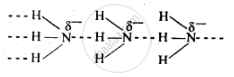
Why does NH3 form hydrogen bond but PH3 does not?
Advertisements
Solution 1
Nitrogen is highly electronegative as compared to phosphorus. This causes a greater attraction of electrons towards nitrogen in NH3 than towards phosphorus in PH3. Hence, the extent of hydrogen bonding in PH3 is very less as compared to NH3.
Solution 2
Nitrogen has an electronegativity value of 3.0, which is much higher than that of H (2.1). As a result, N-H bond is quite polar and hence NH3 undergoes intermolecular H-bonding.
Phosphorus has an electronegativity value of 2.1. Thus, the P–H bond is not polar, and hence PH3 does not undergo H-bonding.
RELATED QUESTIONS
Account for the following: Oxygen shows catenation behavior less than sulphur.
a. Explain the trends in the following properties with reference to group 16:
1 Atomic radii and ionic radii
2 Density
3 ionisation enthalpy
4 Electronegativity
b. In the electolysis of AgNO3 solution 0.7g of Ag is deposited after a certain period of time. Calulate the quantity of electricity required in coulomb. (Molar mass of Ag is 107.9g mol-1)
Give reasons for the following : Oxygen has less electron gain enthalpy with negative sign than sulphur.
List the important sources of sulphur.
Why is H2O a liquid and H2S a gas?
Knowing the electron gain enthalpy values for \[\ce{O -> O-}\] and \[\ce{O -> O^{2-}}\] as −141 and 702 kJ mol−1 respectively, how can you account for the formation of a large number of oxides having O2− species and not O−?
(Hint: Consider lattice energy factor in the formation of compounds).
Explain why inspite of nearly the same electronegativity, oxygen forms hydrogen bonding while chlorine does not.
Draw the structures of `H_3PO_2`
Explain the following properties of group 16 elements :
1) Electro negativity
2) Melting and boiling points
3) Metallic character
4) Allotropy
Arrange the following in order of the property indicated set.
HF, HCl, HBr, HI - decreasing bond enthalpy.
The formation of \[\ce{O^+_2[PtF6]^-}\] is the basis for the formation of first xenon compound. This is because ____________.
Which of the following statement is incorrect?
Strong reducing behaviour of \[\ce{H3PO2}\] is due to ______.
Write a balanced chemical equation for the reaction showing catalytic oxidation of NH3 by atmospheric oxygen.
Out of \[\ce{H2O}\] and \[\ce{H2S}\], which one has higher bond angle and why?
The correct order of ΔiHs among the following elements is
These are physical properties of an elements.
- Sublimation enthalpy
- Ionisation enthalpy
- Hydration enthalpy
- Electron gain enthalpy
The total number of above properties that affect the reduction potential is ______. (Integer answer)
