Advertisements
Advertisements
Question
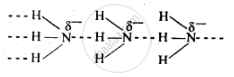
Why does NH3 form hydrogen bond but PH3 does not?
Advertisements
Solution 1
Nitrogen is highly electronegative as compared to phosphorus. This causes a greater attraction of electrons towards nitrogen in NH3 than towards phosphorus in PH3. Hence, the extent of hydrogen bonding in PH3 is very less as compared to NH3.
Solution 2
Nitrogen has an electronegativity value of 3.0, which is much higher than that of H (2.1). As a result, N-H bond is quite polar and hence NH3 undergoes intermolecular H-bonding.
Phosphorus has an electronegativity value of 2.1. Thus, the P–H bond is not polar, and hence PH3 does not undergo H-bonding.
RELATED QUESTIONS
Account for the following: Oxygen shows catenation behavior less than sulphur.
a. Explain the trends in the following properties with reference to group 16:
1 Atomic radii and ionic radii
2 Density
3 ionisation enthalpy
4 Electronegativity
b. In the electolysis of AgNO3 solution 0.7g of Ag is deposited after a certain period of time. Calulate the quantity of electricity required in coulomb. (Molar mass of Ag is 107.9g mol-1)
List the important sources of sulphur.
Write the order of thermal stability of the hydrides of Group 16 elements.
Why is H2O a liquid and H2S a gas?
Justify the placement of O, S, Se, Te and Po in the same group of the periodic table in terms of electronic configuration, oxidation state and hydride formation.
Why are halogens strong oxidising agents?
Give reasons Thermal stability decreases from H2O to H2Te.
Draw the structures of `H_3PO_2`
Arrange the following in the order of the property indicated against set :
H2O, H2S, H2Se, H2Te − increasing acidic character.
Explain the following properties of group 16 elements :
1) Electro negativity
2) Melting and boiling points
3) Metallic character
4) Allotropy
Give reactions for the following:
O – O single bond is weaker than S – S single bond.
Arrange the following in order of the property indicated set.
HF, HCl, HBr, HI - decreasing bond enthalpy.
Given below are two statements labelled as Assertion (A) and Reason (R).
Assertion (A): Electron gain enthalpy of oxygen is less than that of Flourine but greater than Nitrogen.
Reason (R): Ionisation enthalpies of the elements follow the order Nitrogen > Oxygen > Fluorine.
Select the most appropriate answer from the options given below:
Write a balanced chemical equation for the reaction showing catalytic oxidation of NH3 by atmospheric oxygen.
In forming (i) \[\ce{N2 -> N^{+}2}\] and (ii) \[\ce{O2 -> O^{+}2}\]; the electrons respectively are removed from:
These are physical properties of an elements.
- Sublimation enthalpy
- Ionisation enthalpy
- Hydration enthalpy
- Electron gain enthalpy
The total number of above properties that affect the reduction potential is ______. (Integer answer)
______ is a radioactive element in group 16 elements.
