Advertisements
Advertisements
Question
List the four elements of drama.
Advertisements
Solution
The elements of drama are plot, characters, characterization, dialogue, stage directions, conflict, and theme.
APPEARS IN
RELATED QUESTIONS
Describe Miss Stapleton's first encounter with Sir Henry in about 125 words
Attempt in 120‒150 words a character sketch of Miss Sullivan.
Read the passage given below :
(ii) he added a lot of grandeur to Mewar.
(iii) of his valour, sacrifice and patriotism.
(iv) both (ii) and (iii)
(b) Difficulties in the way of Mewar were :
(ii) ancient traditions of the kingdom.
(iii) its small area and small population.
(iv) the poverty of the subjects.
(ii) the flag of Mewar was hoisted high.
(iii) the people of Mewar showed gallantry.
(iv) most of the rulers heaved a sigh of relief.
(d) Mewar was lucky because :
(ii) most of its people were competent.
(iii) most of its rulers were competent.
(iv) only a few of its people were incompetent.
Answer the following questions briefly:
(h) How could art and literature flourish in Mewar?
(i) How did the rulers show that they cared for their subjects?
(j) What does the erection of Vijaya Stambha and Kirti Stambha in the same fort signify?
(k) Find words from the passage which mean the same as each of the following:
(ii) evidence (para 4)
Answer any four of the following questions in 30-40 words each:
(a) How could the peddler enter the forge without being noticed by the blacksmith?
(b) At Champaran what did the British landlords want from the sharecroppers?
(c) How does the poet show the futility of Aunt Jennifer's efforts?
(d) Stephen Spender in his poem, 'An elementary School Classroom in a Slum' paints a dismal picture of poverty. Comment.
(e) How did Evans have the last laugh at the Governor?
(f) How did the General plan to get rid of the American POW?
Read the following passage and do the activities:
A1 True or False:
Rewrite the following statements and state whether they are ‘true’ or ‘false’.
(i) Mashelkar’s mother did menial work to bring him up.
(ii) Mashelkar’s father died when he was twelve.
(iii) Mashelkar was born in a very rich family.
(iv) Tatas added much value to Mashelkar’s life.
I start with my greatest guru-my mother. I was born in a very poor family and my father died when I was six. We moved to Mumbai and my mother did menial work to bring me up. Two meals a day was a tough challenge. I studied under street lights and I walked barefoot until, I think, I was twelve. I remember when I passed the seventh standard and I wanted to go into the eighth standard, our poverty was such that even to secure 21 rupees for secondary school admission became a big challenge. We had to borrow from a lady, who was a housemaid in Chaupati in Mumbai. That was the tough life I had.
In fact, I remember, my passing the SSC Examination-i.e. 11th standard. Those days it used to be not 10th standard or 12th standard but 11th standard. I stood 11th among 1,35,000 but I was about to leave higher education and find a job. What helped me was the scholarship by Sir Dorab Tata Trust. It was just 60 rupees per month and would you believe that 60 rupees per month from Tatas added so much value to my life that I have been able to stand here today before you to speak to you.
I am on the Board of Tatas now and it is very interesting that the same Bombay House where I used to go to collect that 60 rupees per month now one goes and sits there like a Director on the Board of Tata Motors. The turn that these 40 years have taken is very interesting. It has all been possible because of the chance I got to do higher studies at the insistence of my mother. She gave me the values of my life. She was one of the noblest parents I have met in my life.
So, my greatest guru was my mother. My second guru was Principal Bhave, about whom I made a mention earlier. He taught us Physics. Because it was a poor school, I remember, it had to innovate to convey to the young students the message of Science.
A2 Complete:
Complete the following sentences and write:
(i) Mashelkar was inspired by his greatest guru _______
(ii) Mashelkar studied under _______
(iii) Principal Bhave taught _______
(iv) The scholarship by _______ Trust helped him in higher education.
A3 Find the meaning:
Choose the appropriate meaning of the underlined words from the given alternatives:
(i) We moved to Mumbai and my mother did menial work.
(a) skilled
(b) hard
(c) unskilled
(d) of low status
(ii) Because it was a poor school, it had to innovate to convey to the young students the message of science.
(a) do a cheap experiment
(b) introduce new things
(c) avoid
(d) try hard
(iii) I got to do higher studies at the insistence of my mother.
(a) firm saying
(b) being inspired
(c) being inspected
(d) being instigated
(iv) That was the tough life I had.
(a) difficult
(b) soft
(c) cheap
(d) simple
A4 Match:
Match the following sentences with their tags:
| 'A' | 'B' | ||
| (i) | I stood 11th among 1,35,000 |
(a) | aren’t I? |
| (ii) | I am on the Board of Tatas | (b) | didn’t we? |
| (iii) | It was a poor school | (c) | didn’t I? |
| (iv) | We moved to Mumbai | (d) | wasn’t it? |
A5 Personal Response:
“Mother is the greatest Guru.” Discuss.
How is the father’s helplessness brought out in the poem?
What does the word ‘cardboard’ denote in the poem? Why has this word been used?
How does the horse serve as a true friend and companion to Iona?
‘The Tale of Melon City’ has been narrated in a verse form. This is a unique style which lends extra charm to an ancient tale. Find similar examples in your language. Share them in the class.
Notice these words in the poem and guess their meaning from the context
| turquoise | darts |
Comment on the subtlety with which the poet captures the general pattern of communication within a family.
Read the extract and state whether the following statement is true or false. Correct the false statement.
Growing in abundance is more important than the quality of the crop.
The mother was working, when the Swallow brought the yellow jewel.
Think of one of your favourite stories. Fill in the following facts about the story.
- Name of the story:
- Type of story:
- Setting (time and place):
- Important characters:
- Theme/Plot:
- Conflict/Dilemma:
- Solution:
- End:
Make a list of words related to agriculture.
Rearrange the following in the proper order and insert them into a flow chart as per the poem.
- The plate turned to lead when it was gifted to false-hearted claimants.
- Many claimants donated their wealth to receive the plate of gold.
- For almost two years, no claimants received the plate of gold.
- A plate of gold fell in a temple from Heaven.
- The peasant offered comfort and courage to a blind miserable beggar, whom all had ignored.
- The priests announced that the one who loved God most of all would receive the gift from Heaven.
- When the priest gave the plate of gold to that peasant, it shone with thrice its luster.
- A simple peasant, who had nothing to offer, came to that temple.
Out of all names of birds and animals given in the poem, pick out 4 names that are similar in English as well as in Hindi/Marathi or your Mother's tongue.
Imagine that one of your family members/friends/classmates has recently undergone surgery. You were curious and wanted to learn about his/her experience.
Match the questions you asked with their answers.
| 1. | What health problem did you suffer from? | a. | I was given a bath and I wore a surgical gown. |
| 2. | Whom did you inform about it first? | b. | I was given an injection of anesthesia. |
| 3. | What type of doctor did you consult? | c. | I consulted an orthopedic surgeon. |
| 4 | How did he/she find out that you needed a surgery? | d. | I was relieved and happy that the operation was over. |
| 5. | What preparation was done before the surgery? | e. | I had fractured my ankle while playing hockey. |
| 6. | What did you feel when you were taken to the operation theatre? | f | No, I did not feel anything. I was fast asleep. |
| 7. | What was the first step before the actual surgery? | g. | I recovered and I could walk normally after 3 weeks. |
| 8. | Did you feel any pain during the surgery? | h. | Our school hockey coach. |
| 9. | What did you feel when you opened your eyes after the operation? | i. | The doctor took an X-ray of my ankle, and he found a fracture in my ankle. |
| 10. | How soon did you recover? | j. | I was very nervous. |
Read the following word and use it in a sentence of your own.
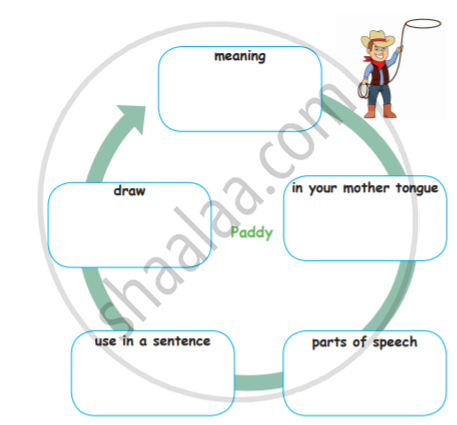
Renown
Fill in the gap, choosing a word from the bracket to make an appropriate comparison.
(tall / quiet / humble / merry / busy / slippery / fast / sly / slow / big)
as ______ as a bee
Complete the following statements with the help of the text.
To learn about meditation, you have to see ____________________________________________________________ Watch your thinking. Do not ________________________ Do not ____________________________________ Begin to learn ______________________________ Just watch thought. Do not ____________________________________________________.
Read aloud/Enact the play.
Write a conversation between a donkey and a school boy.
Write a review of your favorite book. Use the following points:
- Title of the book
- Author/Authors
- The central idea or story
- The important characters
- Some special features of the book
- Why it is your favourite book.
Read the passage. Underline the new words. Guess their meaning from the context. Verify it from a good dictionary.
Using your imagination, write more sentences in the same pattern:
- But the more the lion had, the more he wanted.
- Whenever he took a walk, they followed him.
- To be king is good. But to be kind is better.
How does the following character in the story live up to their name? Provide points from the story.
Teshumai Tewindrow
Guess the meaning of the following word.
novel
Form a group of 4 or 5. Make a ‘storyboard’ for the story ‘Three Sacks of Rice’.
Arrange the story in the form of a sequence of pictures.
Decide what you will show in each picture; what words/lines you will write with each picture to explain what happens in it.
You can also add ‘speech balloons’ for the people in the pictures.
Enact the play.
The second human being that Miranda saw on the island was __________________.
What did the narrator think the unusual sound was?
What made the reporter gaze at the author?
Based on your reading, rearrange the following sentences in the correct sequence.
- Since all her methods failed, finally she gave him a pain-killer.
- He told his aunt that Peter had no aunt, so he gave him the medicine.
- The pain-killer triggered adverse reactions on Peter.
- It jumped out of the open window.
- Tom was dull and depressed.
- This incident upset Aunt Polly and she questioned him.
- But, Tom gave that painkiller to the cat Peter.
- So, Aunt Polly tried different types of remedies on him.
In what ways are we doing injustice to nature?
How can we make our life worth living?
What challenges does Alice face and how does she overcome them?
The teacher asked the children to take their seat because______.
Read the lines and answer the question given below.
And ever again, in the wink of an eye,
Painted stations whistle by
- ‘In the wink of an eye’ means very quickly. Explain ‘painted stations whistle by’.
Complete the sentence given below with word/phrase.
The buffalo ______ in the hole.
In the Earth, we get water from ______.
What is the setting of the story?
How did Santhosh spend his time in the river?
Try your own.
The battle of Nauranang lasted for three days.
Choose the correct option from the given homophones.
I saw a ______ on the flower.
Some words sound the same but their spelling and meaning are different. Such words are called homophones. There are many homophones.
The old man put _____ on the mouth of the gourd.
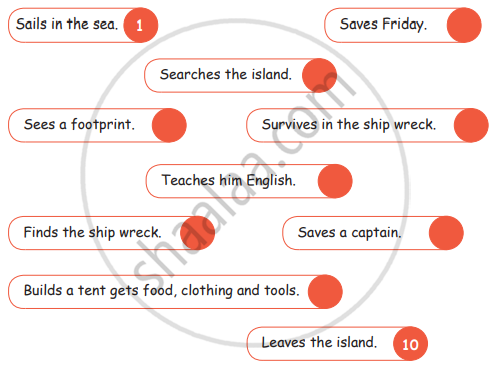
Arrange the actions of Robinson by numbering from 1 to 10.
Fill in the blank
He has bat ______ ball.
______are the real wealth.
Name the character or speaker.
"Do you have a fever?"
Fill in the blank with rhyming word.
larder- ______
Why did Jana have a nightmare?
Divya loved solving _______.
What did the grandfather announce?
The king looked for a______.
The brush ______ to her will.
Write the correct word.
| rooster, king, hen, tiger, queen, tigress. |
What did he make out of it?
