Advertisements
Advertisements
Question
Let P(11, 7), Q(13.5, 4) and R(9.5, 4) be the midpoints of the sides AB, BC and AC respectively of ∆ABC. Find the coordinates of the vertices A, B and C. Hence find the area of ∆ABC and compare this with area of ∆PQR.
Advertisements
Solution
Let the vertices of the ∆ABC be A(x1, y1), B(x2, y2), C(x3, y3)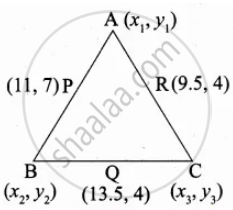
Mid point of AB = `((x_1 + x_2)/2, (y_1 + y_2)/2)`
(11, 7) = `((x_1 + x_2)/2, (y_1 + y_2)/2)`
|
`(x_1 + x_2)/2` = 11 x1 + x2 = 22 ...(1) |
`(y_1 + y_2)/2` = 7 y1 + y2 = 14 ...(2) |
Mid point of BC = `((x_2 + x_3)/2, (y_2 + y_3)/2)`
⇒ (13.5, 4) = `((x_2 + x_3)/2, (y_2 + y_3)/2)`
|
`(x_2 + x_3)/2` = 13.5 x2 + x3 = 27 ...(3) |
`(y_2 + y_3)/2` = 4 y2 + y3 = 8 ...(4) |
Mid point of AC = `((x_1 + x_3)/2, (y_1 + y_3)/2)`
(9.5, 4) = `((x_1 + x_2)/2, (y_1 + y_3)/2)`
|
`(x_1 + x_3)/2` = 9.5 x1 + x3 = 19 ...(5) |
`(y_1 + y_3)/2` = 4 y1 + y3 = 8 ...(6) |
Add (1), (3) and (5)
2x1 + 2x2 + 2x3 = 22 + 27 + 19
2(x1 + x2 + x3) = 68
x1 + x2 + x3 = 34
From (1) ⇒ x1 + x2 = 22
x3 = 34 – 22 = 12
From (3) ⇒ x2 + x3 = 27
x1 = 34 – 27 = 7
From (5) ⇒ x1 + x3 = 19
x2 = 34 – 19 = 15
Add (2), (4) and (6)
2y1 + 2y2 + 2y3 = 14 + 8 + 8
2(y1 + y2 + y3) = 30
y1 + y2 + y3 = 15
From (2) ⇒ y1 + y2 = 14
y3 = 15 – 14 = 1
From (4) ⇒ y2 + y3 = 18
y1 = 15 – 8 = 7
From (6) ⇒ y1 + y3 = 8
y2 = 15 – 8 = 7
The vertices of a ΔABC are A(7, 7), B(15, 7) and C(12, 1)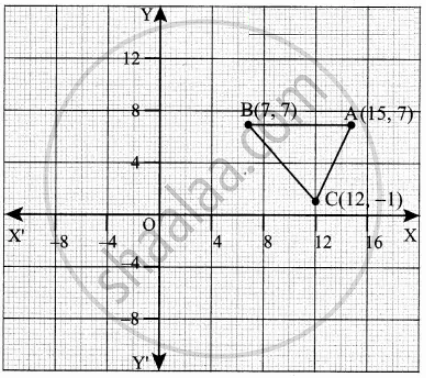
Area of ΔABC = `1/2[(x_1y_2 + x_2y_3 + x_3y_1) - (x_2y_1 + x_3y_2 + x_1y_3)]`
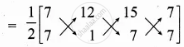
= `1/2[(7 + 84 + 105) - (84 + 15 + 49)]`
= `1/2[196 - 148]`
= `1/2 xx 48`
= 24 sq. units
Area of ΔPRQ = `1/2[(44 + 8 + 94.5) - (66.5 + 54 + 44)]`
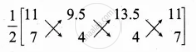
= `1/2[176.5 - 164.5]`
= `1/2 xx 12`
= 6 sq. units
APPEARS IN
RELATED QUESTIONS
The diagonal of a quadrilateral shaped field is 24 m and the perpendiculars dropped on it from the remaining opposite vertices are 8 m and 13 m. Find the area of the field.
A wire when bent in the form of a square encloses an area = 576 cm2. Find the largest area enclosed by the same wire when bent to form;
(i) an equilateral triangle.
(ii) A rectangle whose adjacent sides differ by 4 cm.
A rectangular plot of land measures 45 m x 30 m. A boundary wall of height 2.4 m is built all around the plot at a distance of 1 m from the plot. Find the area of the inner surface of the boundary wall.
Two adjacent sides of a parallelogram are 28 cm and 26 cm. If one diagonal of it is 30 cm long; find the area of the parallelogram. Also, find the distance between its shorter sides.
The rate for a 1.20 m wide carpet is Rs. 40 per meter; find the cost of covering a hall 45 m long and 32 m wide with this carpet. Also, find the cost of carpeting the same hall if the carpet, 80 wide, is at Rs. 25. Per meter.
Find the area and perimeter of a square plot of land, the length of whose diagonal is 15 meters. Given your answer correct to 2 places of decimals.
The perimeter of a semicircular plate is 108 cm. find its area.
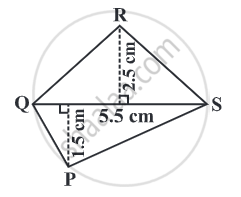
Find the area of quadrilateral PQRS.
Find the area of the quadrilateral whose vertices are at (– 9, 0), (– 8, 6), (– 1, – 2) and (– 6, – 3)
When proving that a quadrilateral is a trapezium, it is necessary to show
