Advertisements
Advertisements
Question
PQRS is a rectangle formed by joining the points P(– 1, – 1), Q(– 1, 4), R(5, 4) and S(5, – 1). A, B, C and D are the mid-points of PQ, QR, RS and SP respectively. Is the quadrilateral ABCD a square, a rectangle or a rhombus? Justify your answer.
Advertisements
Solution
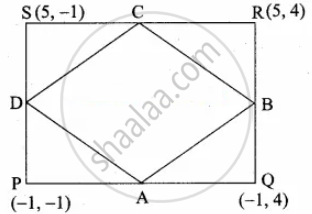
Mid point of a line = `((x_1 + x_2)/2, (y_1 + y_2)/2)`
Mid point of PQ (A) = `((-1 - 1)/2, (-1 + 4)/2)`
= `((-2)/2, 3/2)`
= `(-1, 3/2)`
Mid point of QR (B) = `((-1 + 5)/2, (4 + 4)/2) = (4/2, 8/2)` = (2, 4)
Mid point of RS (C) =`((5 + 5)/2, (4 - 1)/2) = (10/2, 3/2) = (5, 3/2)`
Mid point of PS (D) = `((5 - 1)/2, (-1 - 1)/2) = (4/2, (-2)/2)` = (2, − 1)
Distance = `sqrt((x_2 - x_1)^2 + (y_2 - y_1)^2`
AB = `sqrt((2 + 1)^2 + (4 - 3/2)^2`
= `sqrt(3^2 + (5/2)^2`
= `sqrt(9 + 25/4)`
= `sqrt((36 + 25)/4`
= `sqrt(61/4)`
BC = `sqrt((5 - 2)^2 + (3/2 - 4)^2`
= `sqrt(9 + 25/4)`
= `sqrt((36 + 25)/4`
= `sqrt(61/4)`
CD = `sqrt((5 - 2)^2 + (3/2 + 1)^2`
= `sqrt(3^2 + (5/2)^2`
= `sqrt(9 + 25/4)`
= `sqrt((36 + 25)/4)`
= `sqrt(61/4)`
AD = `sqrt((2 + 1)^2 + (-1 - 3/2)^2`
= `sqrt(3^2 + (- 5/2)^2`
= `sqrt(9 + 25/4)`
= `sqrt(61/4)`
AB = BC = CD = AD = `sqrt(61/4)`
Since all the four sides are equal,
∴ ABCD is a rhombus.
APPEARS IN
RELATED QUESTIONS
A rectangular plot of land measures 45 m x 30 m. A boundary wall of height 2.4 m is built all around the plot at a distance of 1 m from the plot. Find the area of the inner surface of the boundary wall.
The area of a rectangular is 640 m2. Taking its length as x cm; find in terms of x, the width of the rectangle. If the perimeter of the rectangle is 104 m; find its dimensions.
The perimeter of a rectangular board is 70 cm. Taking its length as x cm, find its width in terms of x.
If the area of the rectangular board is 300 cm2; find its dimensions.
Trapezium given below; find its area.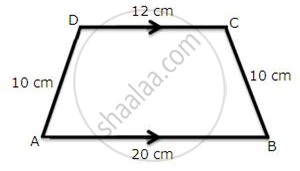
A rectangular plot 85 m long and 60 m broad is to be covered with grass leaving 5 m all around. Find the area to be laid with grass.
A footpath of uniform width runs all around the outside of a rectangular field 30 m long and 24 m wide. If the path occupies an area of 360 m2, find its width.
Find the area and perimeter of a square plot of land, the length of whose diagonal is 15 meters. Given your answer correct to 2 places of decimals.
The floor of a room is of size 6 m x 5 m. Find the cost of covering the floor of the room with 50 cm wide carpet at the rate of Rs.24.50 per metre. Also, find the cost of carpeting the same hall if the carpet, 60 cm, wide, is at the rate of Rs.26 per metre.
Find the diagonal of a quadrilateral whose area is 756cm2 and the perpendicular from the opposite vertices are 17cm and 19cm.
When proving that a quadrilateral is a trapezium, it is necessary to show
