Advertisements
Advertisements
प्रश्न
PQRS is a rectangle formed by joining the points P(– 1, – 1), Q(– 1, 4), R(5, 4) and S(5, – 1). A, B, C and D are the mid-points of PQ, QR, RS and SP respectively. Is the quadrilateral ABCD a square, a rectangle or a rhombus? Justify your answer.
Advertisements
उत्तर
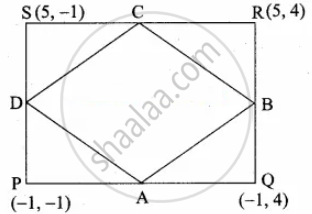
Mid point of a line = `((x_1 + x_2)/2, (y_1 + y_2)/2)`
Mid point of PQ (A) = `((-1 - 1)/2, (-1 + 4)/2)`
= `((-2)/2, 3/2)`
= `(-1, 3/2)`
Mid point of QR (B) = `((-1 + 5)/2, (4 + 4)/2) = (4/2, 8/2)` = (2, 4)
Mid point of RS (C) =`((5 + 5)/2, (4 - 1)/2) = (10/2, 3/2) = (5, 3/2)`
Mid point of PS (D) = `((5 - 1)/2, (-1 - 1)/2) = (4/2, (-2)/2)` = (2, − 1)
Distance = `sqrt((x_2 - x_1)^2 + (y_2 - y_1)^2`
AB = `sqrt((2 + 1)^2 + (4 - 3/2)^2`
= `sqrt(3^2 + (5/2)^2`
= `sqrt(9 + 25/4)`
= `sqrt((36 + 25)/4`
= `sqrt(61/4)`
BC = `sqrt((5 - 2)^2 + (3/2 - 4)^2`
= `sqrt(9 + 25/4)`
= `sqrt((36 + 25)/4`
= `sqrt(61/4)`
CD = `sqrt((5 - 2)^2 + (3/2 + 1)^2`
= `sqrt(3^2 + (5/2)^2`
= `sqrt(9 + 25/4)`
= `sqrt((36 + 25)/4)`
= `sqrt(61/4)`
AD = `sqrt((2 + 1)^2 + (-1 - 3/2)^2`
= `sqrt(3^2 + (- 5/2)^2`
= `sqrt(9 + 25/4)`
= `sqrt(61/4)`
AB = BC = CD = AD = `sqrt(61/4)`
Since all the four sides are equal,
∴ ABCD is a rhombus.
APPEARS IN
संबंधित प्रश्न
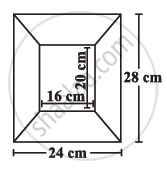
Diagram of the adjacent picture frame has outer dimensions = 24 cm × 28 cm and inner dimensions 16 cm × 20 cm. Find the area of each section of the frame, if the width of each section is same.
The diagonal of a quadrilateral shaped field is 24 m and the perpendiculars dropped on it from the remaining opposite vertices are 8 m and 13 m. Find the area of the field.
A wire when bent in the form of a square encloses an area = 576 cm2. Find the largest area enclosed by the same wire when bent to form;
(i) an equilateral triangle.
(ii) A rectangle whose adjacent sides differ by 4 cm.
The diagonals of a quadrilateral are 16 cm and 13 cm. If they intersect each other at right angles; find the area of the quadrilateral.
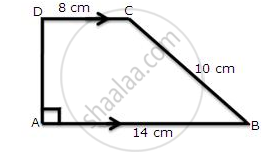
Trapezium given below; find its area.
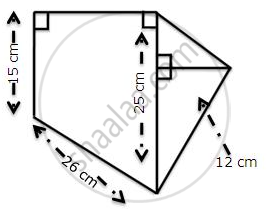
Calculate the area of the figure given below:
Which is not drawn scale.
Find the area and the perimeter of a square with diagonal 24 cm. [Take √2 = 1.41 ]
In the following, find the value of ‘a’ for which the given points are collinear
(a, 2 – 2a), (– a + 1, 2a) and (– 4 – a, 6 – 2a)
When proving that a quadrilateral is a parallelogram by using slopes you must find
If the diagonal d of a quadrilateral is doubled and the heights h1 and h2 falling on d are halved, then the area of quadrilateral is ______.
