Advertisements
Advertisements
प्रश्न
Calculate the area of quadrilateral ABCD, in which ∠ABD = 90°, triangle BCD is an equilateral triangle of side 24 cm and AD = 26 cm.
Advertisements
उत्तर
Consider the figure:
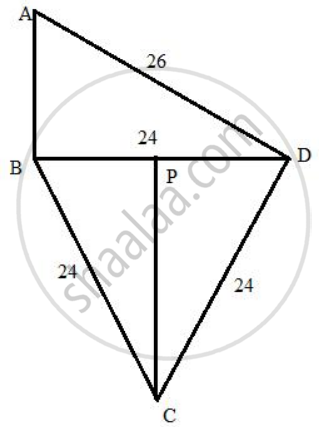
From the right triangle ABD we have
AB = `sqrt(26^2 - 24^2)`
= `2sqrt(13^2 - 12^2)`
= 2 × 5
= 10
The area of right triangle ABC will be
ΔABD = `1/2("AB")("BD")`
= `1/2``(10) (24)`
= 120
Again from the equilateral triangle BCD, we have CP ⊥ BD
PC = `sqrt(24^2 - 12^2)`
= `12sqrt(2^2 - 1^2)`
= `12sqrt(3)`
Therefore, the area of the triangle BCD will be
ΔBCD = `1/2 ("BD")( "PC" )`
= `1/2 (24) (12sqrt3)`
= `144sqrt3`
Hence, the area of the quadrilateral will be
ΔABD + ΔBCD
= 120 + `144sqrt3`
= 369.41 cm2
APPEARS IN
संबंधित प्रश्न
A wire when bent in the form of a square encloses an area = 576 cm2. Find the largest area enclosed by the same wire when bent to form;
(i) an equilateral triangle.
(ii) A rectangle whose adjacent sides differ by 4 cm.
The perimeter of a rectangular board is 70 cm. Taking its length as x cm, find its width in terms of x.
If the area of the rectangular board is 300 cm2; find its dimensions.
Trapezium given below; find its area.

Trapezium given below; find its area.
A rectangular plot 85 m long and 60 m broad is to be covered with grass leaving 5 m all around. Find the area to be laid with grass.
A quadrilateral field of unequal has a longer diagonal with 140m. The perpendiculars from opposite vertives upon this diagonal are 20m and 14m. Find the area of the field.
Vertices of given triangles are taken in order and their areas are provided aside. Find the value of ‘p’.
| Vertices | Area (sq.units) |
| (0, 0), (p, 8), (6, 2) | 20 |
Vertices of given triangles are taken in order and their areas are provided aside. Find the value of ‘p’.
| Vertices | Area (sq.units) |
| (p, p), (5, 6), (5, –2) | 32 |
Let P(11, 7), Q(13.5, 4) and R(9.5, 4) be the midpoints of the sides AB, BC and AC respectively of ∆ABC. Find the coordinates of the vertices A, B and C. Hence find the area of ∆ABC and compare this with area of ∆PQR.
If the diagonal d of a quadrilateral is doubled and the heights h1 and h2 falling on d are halved, then the area of quadrilateral is ______.
