Advertisements
Advertisements
Question
Calculate the area of quadrilateral ABCD, in which ∠ABD = 90°, triangle BCD is an equilateral triangle of side 24 cm and AD = 26 cm.
Advertisements
Solution
Consider the figure:
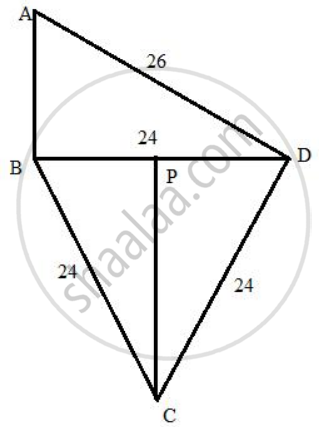
From the right triangle ABD we have
AB = `sqrt(26^2 - 24^2)`
= `2sqrt(13^2 - 12^2)`
= 2 × 5
= 10
The area of right triangle ABC will be
ΔABD = `1/2("AB")("BD")`
= `1/2``(10) (24)`
= 120
Again from the equilateral triangle BCD, we have CP ⊥ BD
PC = `sqrt(24^2 - 12^2)`
= `12sqrt(2^2 - 1^2)`
= `12sqrt(3)`
Therefore, the area of the triangle BCD will be
ΔBCD = `1/2 ("BD")( "PC" )`
= `1/2 (24) (12sqrt3)`
= `144sqrt3`
Hence, the area of the quadrilateral will be
ΔABD + ΔBCD
= 120 + `144sqrt3`
= 369.41 cm2
APPEARS IN
RELATED QUESTIONS
The diagonal of a rectangular plot is 34 m and its perimeter is 92 m. Find its area.
The area of a parallelogram is y cm2 and its height is h cm. The base of another parallelogram is x cm more than the base of the first parallelogram and its area is twice the area of the first. Find, in terms of y, h, and x, the expression for the height of the second parallelogram.
Find the area of a quadrilateral one of whose diagonals is 30 cm long and the perpendiculars from the other two vertices are 19 cm and 11 cm respectively.
The area of a rectangular is 640 m2. Taking its length as x cm; find in terms of x, the width of the rectangle. If the perimeter of the rectangle is 104 m; find its dimensions.
The perimeter of a rectangular field is `3/5`km. If the length of the field is twice its width; find the area of the rectangle in sq. meters.
Calculate the area of the figure given below:
Which is not drawn scale.

The perimeter of a rhombus is 52 cm. If one diagonal is 24 cm; find:
(i) The length of its other diagonal,
(ii) Its area.
A triangle and a parallelogram have the same base and the same area. If the side of the triangle is 26 cm, 28 cm, and 30 cm and the parallelogram stands on the base 28 cm, find the height of the parallelogram.
Using the information in the following figure, find its area.
Sum of the areas of two squares is 400 cm2. If the difference of their perimeters is 16 cm, find the sides of the two squares.
