Advertisements
Advertisements
प्रश्न
Calculate the area of quadrilateral ABCD, in which ∠ABD = 90°, triangle BCD is an equilateral triangle of side 24 cm and AD = 26 cm.
Advertisements
उत्तर
Consider the figure:
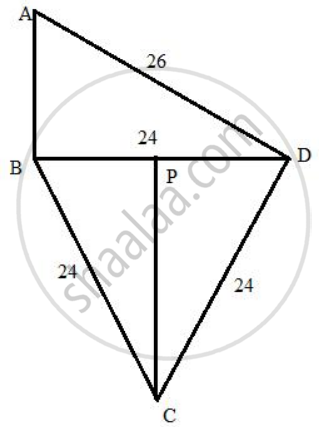
From the right triangle ABD we have
AB = `sqrt(26^2 - 24^2)`
= `2sqrt(13^2 - 12^2)`
= 2 × 5
= 10
The area of right triangle ABC will be
ΔABD = `1/2("AB")("BD")`
= `1/2``(10) (24)`
= 120
Again from the equilateral triangle BCD, we have CP ⊥ BD
PC = `sqrt(24^2 - 12^2)`
= `12sqrt(2^2 - 1^2)`
= `12sqrt(3)`
Therefore, the area of the triangle BCD will be
ΔBCD = `1/2 ("BD")( "PC" )`
= `1/2 (24) (12sqrt3)`
= `144sqrt3`
Hence, the area of the quadrilateral will be
ΔABD + ΔBCD
= 120 + `144sqrt3`
= 369.41 cm2
APPEARS IN
संबंधित प्रश्न
The distance between parallel sides of a trapezium is 15 cm and the length of the line segment joining the mid-points of its non-parallel sides is 26 cm. Find the area of the trapezium.
Trapezium given below; find its area.
The cost of enclosing a rectangular garden with a fence all around, at the rate of 75 paise per metre, is Rs. 300. If the length of the garden is 120 metres, find the area of the field in square metres.
The figure given below shows the cross-section of a concrete structure. Calculate the area of cross-section if AB = 1.8 cm, CD = 0.6 m, DE = 0.8 m, EF = 0.3 m and AF = 1.2 m.

Two adjacent sides of a parallelogram are 28 cm and 26 cm. If one diagonal of it is 30 cm long; find the area of the parallelogram. Also, find the distance between its shorter sides.
Find the area and perimeter of a square plot of land, the length of whose diagonal is 15 meters. Given your answer correct to 2 places of decimals.
In the following, find the value of ‘a’ for which the given points are collinear
(a, 2 – 2a), (– a + 1, 2a) and (– 4 – a, 6 – 2a)
The quadrilateral swimming pool shown is surrounded by concrete patio. Find the area of the patio
If vertices of a quadrilateral are at A(– 5, 7), B(– 4, k), C(– 1, – 6) and D(4, 5) and its area is 72 sq. units. Find the value of k.
If the diagonal d of a quadrilateral is doubled and the heights h1 and h2 falling on d are halved, then the area of quadrilateral is ______.
