English

Trapezium Given Below; Find Its Area.

Advertisements
Advertisements

Question

Trapezium given below; find its area.
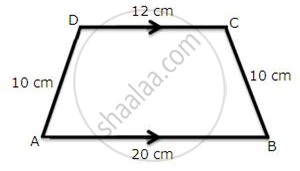
Sum
Advertisements

Solution
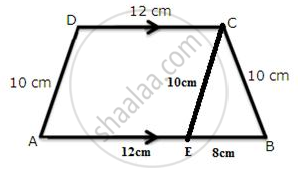

Area of ΔEBC = `1/4 xx 8 xx sqrt( 4 xx 10^2 - 8^2 )`

= `1/4 xx 8 xx 18.3`
= 36.6 cm2

Again
Area of ΔEBC = `1/2` x 8 x h

              36.6 = 4h
                  h = 9.15

Area of ABCD = `1/2 xx ( 12 + 20 ) xx 9.15`

                       = `1/2` x 32 x 9.15

                       = 146.64 sq.cm

shaalaa.com
  Is there an error in this question or solution?
Chapter 19: Area and Perimeter of Plane Figures - Exercise 20 (B) [Page 256]

APPEARS IN

Selina Concise Mathematics [English] Class 9 ICSE
Chapter 19 Area and Perimeter of Plane Figures
Exercise 20 (B) | Q 27.1 | Page 256

RELATED QUESTIONS

The area of a parallelogram is y cm2 and its height is h cm. The base of another parallelogram is x cm more than the base of the first parallelogram and its area is twice the area of the first. Find, in terms of y, h, and x, the expression for the height of the second parallelogram.


A wire when bent in the form of a square encloses an area = 576 cm2. Find the largest area enclosed by the same wire when bent to form;
(i) an equilateral triangle.
(ii) A rectangle whose adjacent sides differ by 4 cm.


The perimeter of a rectangular field is `3/5`km. If the length of the field is twice its width; find the area of the rectangle in sq. meters.


How many tiles, each of area 400 cm2, will be needed to pave a footpath which is 2 m wide and surrounds a grass plot 25 m long and 13 m wide? 


Calculate the area of the figure given below:

Which is not drawn scale.


A floor that measures 15 m x 8 m is to be laid with tiles measuring 50 cm x 25 cm. Find the number of tiles required.
Further, if a carpet is laid on the floor so that a space of 1 m exists between its edges and the edges of the floor, what fraction of the floor is left uncovered?


Using the information in the following figure, find its area.


In the following, find the value of ‘a’ for which the given points are collinear

(2, 3), (4, a) and (6, – 3)


Find the value of k, if the area of a quadrilateral is 28 sq. units, whose vertices are (– 4, – 2), (– 3, k), (3, – 2) and (2, 3)


If vertices of a quadrilateral are at A(– 5, 7), B(– 4, k), C(– 1, – 6) and D(4, 5) and its area is 72 sq. units. Find the value of k.


Share
Notifications

Englishहिंदीमराठी


      Forgot password?
Use app×