Advertisements
Advertisements
प्रश्न
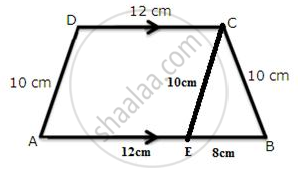
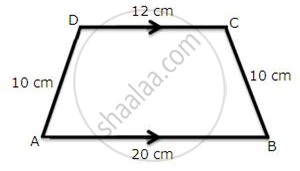
Trapezium given below; find its area.
Advertisements
उत्तर

Area of ΔEBC = `1/4 xx 8 xx sqrt( 4 xx 10^2 - 8^2 )`
= `1/4 xx 8 xx 18.3`
= 36.6 cm2
Again
Area of ΔEBC = `1/2` x 8 x h
36.6 = 4h
h = 9.15
Area of ABCD = `1/2 xx ( 12 + 20 ) xx 9.15`
= `1/2` x 32 x 9.15
= 146.64 sq.cm
APPEARS IN
संबंधित प्रश्न
The diagonal of a quadrilateral shaped field is 24 m and the perpendiculars dropped on it from the remaining opposite vertices are 8 m and 13 m. Find the area of the field.

The diagonal of a quadrilateral shaped field is 24 m and the perpendiculars dropped on it from the remaining opposite vertices are 8 m and 13 m. Find the area of the field.
The length of a rectangle is twice the side of a square and its width is 6 cm greater than the side of the square. If the area of the rectangle is three times the area of the square; find the dimensions of each.
Calculate the area of quadrilateral ABCD, in which ∠ABD = 90°, triangle BCD is an equilateral triangle of side 24 cm and AD = 26 cm.
The perimeter of a rhombus is 46 cm. If the height of the rhombus is 8 cm; find its area.
Sum of the areas of two squares is 400 cm2. If the difference of their perimeters is 16 cm, find the sides of the two squares.
Find the area and the perimeter of a square with diagonal 24 cm. [Take √2 = 1.41 ]
Find the area of the quadrilateral whose vertices are at (– 9, 0), (– 8, 6), (– 1, – 2) and (– 6, – 3)
PQRS is a rectangle formed by joining the points P(– 1, – 1), Q(– 1, 4), R(5, 4) and S(5, – 1). A, B, C and D are the mid-points of PQ, QR, RS and SP respectively. Is the quadrilateral ABCD a square, a rectangle or a rhombus? Justify your answer.
If vertices of a quadrilateral are at A(– 5, 7), B(– 4, k), C(– 1, – 6) and D(4, 5) and its area is 72 sq. units. Find the value of k.