Advertisements
Advertisements
Question
In the following, find the value of ‘a’ for which the given points are collinear
(a, 2 – 2a), (– a + 1, 2a) and (– 4 – a, 6 – 2a)
Advertisements
Solution
Let the points be A(a, 2 – 2a), B(– a + 1, 2a) C(– 4 – a, 6 – 2a).
Since the given points are collinear.
Area of a ∆ = 0
`1/2[(x_1y_2 + x_2y_3 + x_3y_1) - (x_2y_1 + x_3y_2 + x_1y_3)]` = 0

`1/2[((2"a"^2 + (- "a" + 1)(6 - 2"a") + (-4 - "a")(2 - 2"a"))), (-((- "a" + 1)(2 - 2"a") + 2"a"(-4 - "a") + (6 - 2"a")"a"))]` = 0
`1/2[((2"a"^2 - 6"a" + 2"a"^2 + 6 - 2"a" - 8 + 8"a" - 2"a" + 2"a"^2)-), ((-2"a" + 2"a"^2 + 2 - 2"a" - 8"a" - 2"a"^2 + 6"a" - 2"a"^2))]` = 0
`1/2[6"a"^2 - 10"a" + 8"a" - 2 - (2"a"^2 - 4"a"^2 - 12"a" + 6"a" + 2)]` = 0
6a2 – 2a – 2 – (– 2a2 – 6a + 2) = 0
6a2 – 2a – 2 + 2a2 + 6a – 2 = 0
8a2 + 4a – 4 = 0 ...(Divided by 4)
2a2 + a – 1 = 0
2a2 + 2a – a – 1 = 0
2a (a + 1) – 1 (a + 1) = 0
(a + 1) (2a – 1) = 0
a + 1 = 0 or 2a – 1 = 0
a = – 1 or 2a = 1 ⇒ a = `1/2`
The value of a = – 1 or `1/2`
APPEARS IN
RELATED QUESTIONS
The distance between parallel sides of a trapezium is 15 cm and the length of the line segment joining the mid-points of its non-parallel sides is 26 cm. Find the area of the trapezium.
Find the area of a quadrilateral one of whose diagonals is 30 cm long and the perpendiculars from the other two vertices are 19 cm and 11 cm respectively.
Trapezium given below; find its area.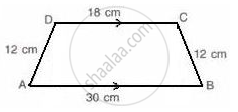
The length and the breadth of a rectangle are 6 cm and 4 cm respectively. Find the height of a triangle whose base is 6 cm and the area is 3 times that of the rectangle.
How many tiles, each of area 400 cm2, will be needed to pave a footpath which is 2 m wide and surrounds a grass plot 25 m long and 13 m wide?
Two adjacent sides of a parallelogram are 28 cm and 26 cm. If one diagonal of it is 30 cm long; find the area of the parallelogram. Also, find the distance between its shorter sides.
Find the area and perimeter of a square plot of land, the length of whose diagonal is 15 meters. Given your answer correct to 2 places of decimals.
The perimeter of a semicircular plate is 108 cm. find its area.
Vertices of given triangles are taken in order and their areas are provided aside. Find the value of ‘p’.
| Vertices | Area (sq.units) |
| (p, p), (5, 6), (5, –2) | 32 |
PQRS is a rectangle formed by joining the points P(– 1, – 1), Q(– 1, 4), R(5, 4) and S(5, – 1). A, B, C and D are the mid-points of PQ, QR, RS and SP respectively. Is the quadrilateral ABCD a square, a rectangle or a rhombus? Justify your answer.
