Advertisements
Advertisements
Question
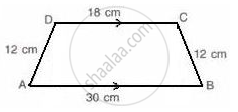
Trapezium given below; find its area.
Advertisements
Solution
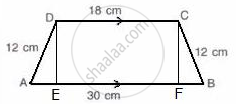
In the given figure, we can observe that the non-parallel sides are equal and hence it is an isosceles trapezium.
Therefore, let us draw DE and CF perpendiculars to AB.
Thus, the area of the parallelogram is given by
AB = AE + EF + FB and CD = EF = 18 cm, we have
30 = AE + 18 + FB
⇒ 30 = AE + 18 + AE
⇒ 2AE + 18 = 30
⇒ 2AE = 30 - 18
⇒ 2AE = 12
⇒ AE = 6 cm
Now, consider the right angled triangle ADE.
AD2 = AE2 + DE2
⇒ 122 = 62 + DE2
⇒ 144 = 36 + DE2
⇒ DE2 = 144 - 36
⇒ DE2 = 108
⇒ DE = `sqrt( 36 xx 3 )`
⇒ DE = `6sqrt3`
Area( `square"ABCD" ) = "Area"( Δ"ADE" ) + "Area"( square "DEFC") + "Area"( Δ"CFB" )`
⇒ Area( `square"ABCD" ) = 1/2 xx 6 xx 6sqrt3 + 18 xx 6sqrt3 + 1/2 xx 6 xx 6sqrt3`
⇒ Area( `square"ABCD" ) = 6 xx 6sqrt3 + 18 xx 6sqrt3`
⇒ Area( `square"ABCD") = 144sqrt3`= 249.41 cm2
APPEARS IN
RELATED QUESTIONS
The distance between parallel sides of a trapezium is 15 cm and the length of the line segment joining the mid-points of its non-parallel sides is 26 cm. Find the area of the trapezium.
Trapezium given below; find its area.
The width of a rectangular room is `4/7`of its length, x, and its perimeter is y. Write an equation connecting x and y. Find the length of the room when the perimeter is 4400 cm.
The perimeter of a rhombus is 52 cm. If one diagonal is 24 cm; find:
(i) The length of its other diagonal,
(ii) Its area.
The length of a rectangular verandah is 3 m more than its breadth. The numerical value of its area is equal to the numerical value of its perimeter.
(i) Taking x as the breadth of the verandah, write an equation in x that represents the above statement
(ii) Solve the equation obtained in (i) above and hence find the dimensions of the verandah.
Find the area and perimeter of a square plot of land, the length of whose diagonal is 15 meters. Given your answer correct to 2 places of decimals.
Find the area and the perimeter of a square with diagonal 24 cm. [Take √2 = 1.41 ]
Find the area of quadrilateral PQRS.

In the following, find the value of ‘a’ for which the given points are collinear
(2, 3), (4, a) and (6, – 3)
In the following, find the value of ‘a’ for which the given points are collinear
(a, 2 – 2a), (– a + 1, 2a) and (– 4 – a, 6 – 2a)
