मराठी

Trapezium Given Below; Find Its Area. - Mathematics

Advertisements
Advertisements

प्रश्न

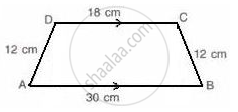
Trapezium given below; find its area.
बेरीज
Advertisements

उत्तर

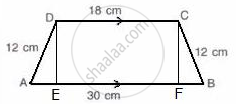
In the given figure, we can observe that the non-parallel sides are equal and hence it is an isosceles trapezium.

Therefore, let us draw DE and CF perpendiculars to AB.

Thus, the area of the parallelogram is given by
AB = AE + EF + FB and CD = EF = 18 cm, we have
30 = AE + 18 + FB
⇒ 30 = AE + 18 + AE
⇒  2AE + 18 = 30
⇒ 2AE = 30 - 18
⇒ 2AE = 12
⇒ AE = 6 cm

Now, consider the right angled triangle ADE.
AD2 = AE2 + DE2
⇒ 122 = 62 + DE2
⇒  144 = 36 + DE2
⇒ DE2 = 144 - 36
⇒ DE2 = 108
⇒ DE = `sqrt( 36 xx 3 )`
⇒ DE = `6sqrt3`

Area( `square"ABCD" ) = "Area"( Δ"ADE" ) + "Area"( square "DEFC") + "Area"( Δ"CFB" )`

⇒ Area( `square"ABCD" ) = 1/2 xx 6 xx 6sqrt3 + 18 xx 6sqrt3 + 1/2 xx 6 xx 6sqrt3`

⇒ Area( `square"ABCD" ) = 6 xx 6sqrt3 + 18 xx 6sqrt3`

⇒ Area( `square"ABCD") = 144sqrt3`= 249.41 cm2

shaalaa.com
  या प्रश्नात किंवा उत्तरात काही त्रुटी आहे का?
पाठ 20: Area and Perimeter of Plane Figures - Exercise 20 (B) [पृष्ठ २५६]

APPEARS IN

सेलिना Concise Mathematics [English] Class 9 ICSE
पाठ 20 Area and Perimeter of Plane Figures
Exercise 20 (B) | Q 27.4 | पृष्ठ २५६

संबंधित प्रश्‍न

Diagram of the adjacent picture frame has outer dimensions = 24 cm × 28 cm and inner dimensions 16 cm × 20 cm. Find the area of each section of the frame, if the width of each section is same.


A wire when bent in the form of a square encloses an area = 576 cm2. Find the largest area enclosed by the same wire when bent to form;
(i) an equilateral triangle.
(ii) A rectangle whose adjacent sides differ by 4 cm.


Calculate the area of quadrilateral ABCD, in which ∠ABD = 90°, triangle BCD is an equilateral triangle of side 24 cm and AD = 26 cm.


Trapezium given below; find its area.


The perimeter of a rectangular field is `3/5`km. If the length of the field is twice its width; find the area of the rectangle in sq. meters.


The following diagram shows a pentagonal field ABCDE in which the lengths of AF, FG, GH, and HD are 50 m, 40 m, 15 m and 25 m, respectively, and the lengths of perpendiculars BF, CH and EG are 50 m, 25 m and 60 m respectively. Determine the area of the field.


The area of a rhombus is 216 sq. cm. If it's one diagonal is 24 cm; find:
(i) Length of its other diagonal,
(ii) Length of its side,
(iii) The perimeter of the rhombus.


Sum of the areas of two squares is 400 cm2. If the difference of their perimeters is 16 cm, find the sides of the two squares. 


Find the value of k, if the area of a quadrilateral is 28 sq. units, whose vertices are (– 4, – 2), (– 3, k), (3, – 2) and (2, 3)


If vertices of a quadrilateral are at A(– 5, 7), B(– 4, k), C(– 1, – 6) and D(4, 5) and its area is 72 sq. units. Find the value of k.


Share
Notifications

Englishहिंदीमराठी


      Forgot password?
Use app×