Advertisements
Advertisements
प्रश्न
Find the value of k, if the area of a quadrilateral is 28 sq. units, whose vertices are (– 4, – 2), (– 3, k), (3, – 2) and (2, 3)
Advertisements
उत्तर
Let the vertices A(– 4, – 2), B(– 3, k), C(3, – 2) and D(2, 3)
Area of the Quadrilateral = 28 sq. units
`1/2[(x_1y_2 + x_2y_3 + x_3y_4 + x_4y_1) - (x_2y_1 + x_3y_2 + x_4y_3 + x_1y_4)]` = 28

`1/2[(-4"k" + 6 + 9 - 4) - (6 + 3"k" - 4 - 12)]` = 28
`1/2[(-4"k" + 11) - (3"k" - 10)]` = 28
– 4k + 11 – 3k + 10 = 56
– 7k + 21 = 56
– 7k = 56 – 21
– 7k = 35
⇒ 7k = – 35
k = `35/7`
= – 5
The value of k = – 5
APPEARS IN
संबंधित प्रश्न
Find the area of a quadrilateral one of whose diagonals is 30 cm long and the perpendiculars from the other two vertices are 19 cm and 11 cm respectively.
Calculate the area of quadrilateral ABCD, in which ∠ABD = 90°, triangle BCD is an equilateral triangle of side 24 cm and AD = 26 cm.
Trapezium given below; find its area.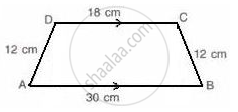
A rectangular plot 85 m long and 60 m broad is to be covered with grass leaving 5 m all around. Find the area to be laid with grass.
The length and the breadth of a rectangle are 6 cm and 4 cm respectively. Find the height of a triangle whose base is 6 cm and the area is 3 times that of the rectangle.
How many tiles, each of area 400 cm2, will be needed to pave a footpath which is 2 m wide and surrounds a grass plot 25 m long and 13 m wide?
The perimeter of a rhombus is 46 cm. If the height of the rhombus is 8 cm; find its area.
Two adjacent sides of a parallelogram are 28 cm and 26 cm. If one diagonal of it is 30 cm long; find the area of the parallelogram. Also, find the distance between its shorter sides.
The rate for a 1.20 m wide carpet is Rs. 40 per meter; find the cost of covering a hall 45 m long and 32 m wide with this carpet. Also, find the cost of carpeting the same hall if the carpet, 80 wide, is at Rs. 25. Per meter.
A triangle and a parallelogram have the same base and the same area. If the side of the triangle is 26 cm, 28 cm, and 30 cm and the parallelogram stands on the base 28 cm, find the height of the parallelogram.
