Advertisements
Advertisements
प्रश्न
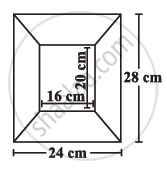
Diagram of the adjacent picture frame has outer dimensions = 24 cm × 28 cm and inner dimensions 16 cm × 20 cm. Find the area of each section of the frame, if the width of each section is same.
Advertisements
उत्तर
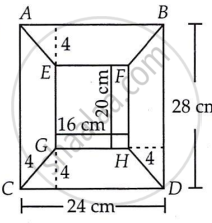
Area of ABFE
= `1/2` (AB + EF) × 4 cm2
= `1/2` (24 + 16) × 4 cm2
= `1/2` × 40 × 4 cm2
= 80 cm2
Also, Area of GHDC = Area of ABFE
= 80 cm2
Area of AEGC = `1/2` (EG + AC) × 4cm2
= `1/2 (20 + 28)` × 4cm2
= 96 cm2
Also, Area of AEGC = BFHD = 96 cm2 Area of EFHG
= HG × HF
= 16 × 20 cm2
= 320 cm2
संबंधित प्रश्न
The distance between parallel sides of a trapezium is 15 cm and the length of the line segment joining the mid-points of its non-parallel sides is 26 cm. Find the area of the trapezium.
A footpath of uniform width runs all around the outside of a rectangular field 30 m long and 24 m wide. If the path occupies an area of 360 m2, find its width.
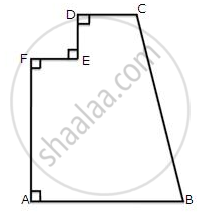
The figure given below shows the cross-section of a concrete structure. Calculate the area of cross-section if AB = 1.8 cm, CD = 0.6 m, DE = 0.8 m, EF = 0.3 m and AF = 1.2 m.
The rate for a 1.20 m wide carpet is Rs. 40 per meter; find the cost of covering a hall 45 m long and 32 m wide with this carpet. Also, find the cost of carpeting the same hall if the carpet, 80 wide, is at Rs. 25. Per meter.
Find the area and perimeter of a square plot of land, the length of whose diagonal is 15 meters. Given your answer correct to 2 places of decimals.
Using the information in the following figure, find its area.
A quadrilateral field of unequal has a longer diagonal with 140m. The perpendiculars from opposite vertives upon this diagonal are 20m and 14m. Find the area of the field.
Find the diagonal of a quadrilateral whose area is 756cm2 and the perpendicular from the opposite vertices are 17cm and 19cm.
Find the area of the quadrilateral whose vertices are at (– 9, 0), (– 8, 6), (– 1, – 2) and (– 6, – 3)
When proving that a quadrilateral is a trapezium, it is necessary to show
