Advertisements
Advertisements
प्रश्न
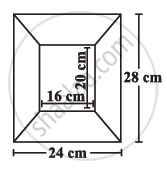
Diagram of the adjacent picture frame has outer dimensions = 24 cm × 28 cm and inner dimensions 16 cm × 20 cm. Find the area of each section of the frame, if the width of each section is same.
Advertisements
उत्तर
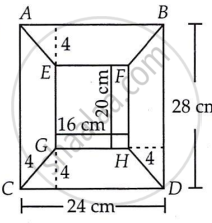
Area of ABFE
= `1/2` (AB + EF) × 4 cm2
= `1/2` (24 + 16) × 4 cm2
= `1/2` × 40 × 4 cm2
= 80 cm2
Also, Area of GHDC = Area of ABFE
= 80 cm2
Area of AEGC = `1/2` (EG + AC) × 4cm2
= `1/2 (20 + 28)` × 4cm2
= 96 cm2
Also, Area of AEGC = BFHD = 96 cm2 Area of EFHG
= HG × HF
= 16 × 20 cm2
= 320 cm2
संबंधित प्रश्न
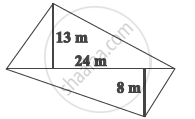
The diagonal of a quadrilateral shaped field is 24 m and the perpendiculars dropped on it from the remaining opposite vertices are 8 m and 13 m. Find the area of the field.
The distance between parallel sides of a trapezium is 15 cm and the length of the line segment joining the mid-points of its non-parallel sides is 26 cm. Find the area of the trapezium.
A rectangular plot of land measures 45 m x 30 m. A boundary wall of height 2.4 m is built all around the plot at a distance of 1 m from the plot. Find the area of the inner surface of the boundary wall.
Trapezium given below; find its area.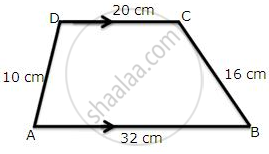
A wire when bent in the form of a square encloses an area of 484 m2. Find the largest area enclosed by the same wire when bent to from:
- An equilateral triangle.
- A rectangle of breadth 16 m.
The following diagram shows a pentagonal field ABCDE in which the lengths of AF, FG, GH, and HD are 50 m, 40 m, 15 m and 25 m, respectively, and the lengths of perpendiculars BF, CH and EG are 50 m, 25 m and 60 m respectively. Determine the area of the field.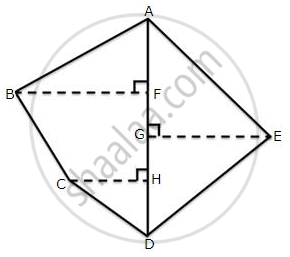
The perimeter of a rhombus is 46 cm. If the height of the rhombus is 8 cm; find its area.
A quadrilateral field of unequal has a longer diagonal with 140m. The perpendiculars from opposite vertives upon this diagonal are 20m and 14m. Find the area of the field.
Find the area of the quadrilateral whose vertices are at (– 9, 0), (– 8, 6), (– 1, – 2) and (– 6, – 3)
Find the area of quadrilateral BCEG