Advertisements
Advertisements
प्रश्न
A wire when bent in the form of a square encloses an area of 484 m2. Find the largest area enclosed by the same wire when bent to from:
- An equilateral triangle.
- A rectangle of length 16 m.
Advertisements
उत्तर
The area of the square is 484.
Let a be the length of each side of the square.
Now
a2 = 484
a = 22 m
Hence, the length of the wire is = 4 × 22 = 88 m.
(i) Now, this 88 m wire is bent in the form of an equilateral triangle.
Side of the triangle = `88/3`
= 29.3 m
Area of the triangle = `sqrt3/4` × (Side)2
= `sqrt3/4` × (29.3)2
= 372.58 m2
(ii) Let x be the breadth of the rectangle.
Now,
2(l + b) = 88
16 + x = 44
x = 28 m
Hence, area = 16 × 28 = 448 m2.
APPEARS IN
संबंधित प्रश्न
Find the area of a quadrilateral one of whose diagonals is 30 cm long and the perpendiculars from the other two vertices are 19 cm and 11 cm respectively.
A wire when bent in the form of a square encloses an area = 576 cm2. Find the largest area enclosed by the same wire when bent to form;
(i) an equilateral triangle.
(ii) A rectangle whose adjacent sides differ by 4 cm.
The diagonals of a quadrilateral are 16 cm and 13 cm. If they intersect each other at right angles; find the area of the quadrilateral.
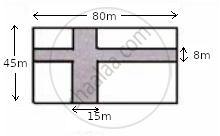
The diagram, given below, shows two paths drawn inside a rectangular field 80 m long and 45 m wide. The widths of the two paths are 8 m and 15 m as shown. Find the area of the shaded portion.
Two adjacent sides of a parallelogram are 28 cm and 26 cm. If one diagonal of it is 30 cm long; find the area of the parallelogram. Also, find the distance between its shorter sides.
The shaded region of the given diagram represents the lawn in the form of a house. On the three sides of the lawn, there are flowerbeds having a uniform width of 2 m.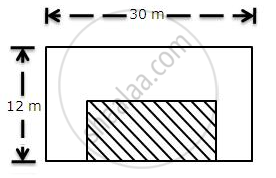
(i) Find the length and the breadth of the lawn.
(ii) Hence, or otherwise, find the area of the flower-beds.
A triangle and a parallelogram have the same base and the same area. If the side of the triangle is 26 cm, 28 cm, and 30 cm and the parallelogram stands on the base 28 cm, find the height of the parallelogram.
The perimeter of a semicircular plate is 108 cm. find its area.
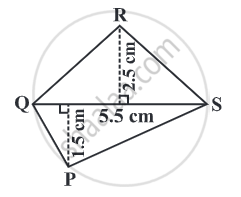
Find the area of quadrilateral PQRS.
In the following, find the value of ‘a’ for which the given points are collinear
(a, 2 – 2a), (– a + 1, 2a) and (– 4 – a, 6 – 2a)
