Advertisements
Advertisements
प्रश्न
Let P(11, 7), Q(13.5, 4) and R(9.5, 4) be the midpoints of the sides AB, BC and AC respectively of ∆ABC. Find the coordinates of the vertices A, B and C. Hence find the area of ∆ABC and compare this with area of ∆PQR.
Advertisements
उत्तर
Let the vertices of the ∆ABC be A(x1, y1), B(x2, y2), C(x3, y3)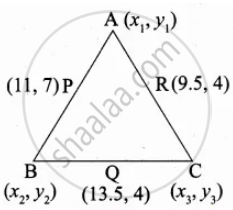
Mid point of AB = `((x_1 + x_2)/2, (y_1 + y_2)/2)`
(11, 7) = `((x_1 + x_2)/2, (y_1 + y_2)/2)`
|
`(x_1 + x_2)/2` = 11 x1 + x2 = 22 ...(1) |
`(y_1 + y_2)/2` = 7 y1 + y2 = 14 ...(2) |
Mid point of BC = `((x_2 + x_3)/2, (y_2 + y_3)/2)`
⇒ (13.5, 4) = `((x_2 + x_3)/2, (y_2 + y_3)/2)`
|
`(x_2 + x_3)/2` = 13.5 x2 + x3 = 27 ...(3) |
`(y_2 + y_3)/2` = 4 y2 + y3 = 8 ...(4) |
Mid point of AC = `((x_1 + x_3)/2, (y_1 + y_3)/2)`
(9.5, 4) = `((x_1 + x_2)/2, (y_1 + y_3)/2)`
|
`(x_1 + x_3)/2` = 9.5 x1 + x3 = 19 ...(5) |
`(y_1 + y_3)/2` = 4 y1 + y3 = 8 ...(6) |
Add (1), (3) and (5)
2x1 + 2x2 + 2x3 = 22 + 27 + 19
2(x1 + x2 + x3) = 68
x1 + x2 + x3 = 34
From (1) ⇒ x1 + x2 = 22
x3 = 34 – 22 = 12
From (3) ⇒ x2 + x3 = 27
x1 = 34 – 27 = 7
From (5) ⇒ x1 + x3 = 19
x2 = 34 – 19 = 15
Add (2), (4) and (6)
2y1 + 2y2 + 2y3 = 14 + 8 + 8
2(y1 + y2 + y3) = 30
y1 + y2 + y3 = 15
From (2) ⇒ y1 + y2 = 14
y3 = 15 – 14 = 1
From (4) ⇒ y2 + y3 = 18
y1 = 15 – 8 = 7
From (6) ⇒ y1 + y3 = 8
y2 = 15 – 8 = 7
The vertices of a ΔABC are A(7, 7), B(15, 7) and C(12, 1)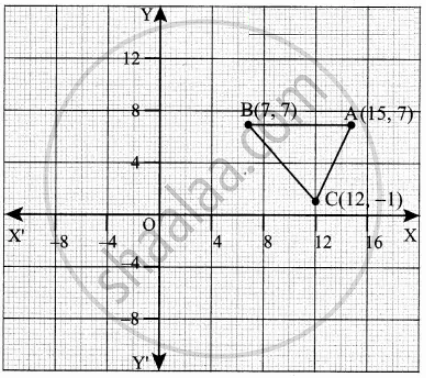
Area of ΔABC = `1/2[(x_1y_2 + x_2y_3 + x_3y_1) - (x_2y_1 + x_3y_2 + x_1y_3)]`
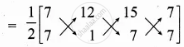
= `1/2[(7 + 84 + 105) - (84 + 15 + 49)]`
= `1/2[196 - 148]`
= `1/2 xx 48`
= 24 sq. units
Area of ΔPRQ = `1/2[(44 + 8 + 94.5) - (66.5 + 54 + 44)]`
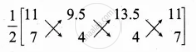
= `1/2[176.5 - 164.5]`
= `1/2 xx 12`
= 6 sq. units
APPEARS IN
संबंधित प्रश्न
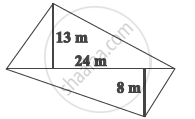
The diagonal of a quadrilateral shaped field is 24 m and the perpendiculars dropped on it from the remaining opposite vertices are 8 m and 13 m. Find the area of the field.
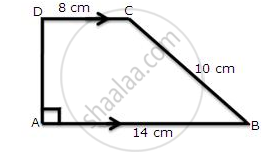
Trapezium given below; find its area.
The length and the breadth of a rectangle are 6 cm and 4 cm respectively. Find the height of a triangle whose base is 6 cm and the area is 3 times that of the rectangle.
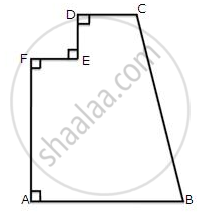
The figure given below shows the cross-section of a concrete structure. Calculate the area of cross-section if AB = 1.8 cm, CD = 0.6 m, DE = 0.8 m, EF = 0.3 m and AF = 1.2 m.
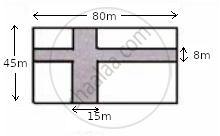
The diagram, given below, shows two paths drawn inside a rectangular field 80 m long and 45 m wide. The widths of the two paths are 8 m and 15 m as shown. Find the area of the shaded portion.
The rate for a 1.20 m wide carpet is Rs. 40 per meter; find the cost of covering a hall 45 m long and 32 m wide with this carpet. Also, find the cost of carpeting the same hall if the carpet, 80 wide, is at Rs. 25. Per meter.
A quadrilateral field of unequal has a longer diagonal with 140m. The perpendiculars from opposite vertives upon this diagonal are 20m and 14m. Find the area of the field.
Find the value of k, if the area of a quadrilateral is 28 sq. units, whose vertices are (– 4, – 2), (– 3, k), (3, – 2) and (2, 3)
The quadrilateral swimming pool shown is surrounded by concrete patio. Find the area of the patio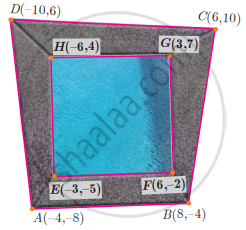
PQRS is a rectangle formed by joining the points P(– 1, – 1), Q(– 1, 4), R(5, 4) and S(5, – 1). A, B, C and D are the mid-points of PQ, QR, RS and SP respectively. Is the quadrilateral ABCD a square, a rectangle or a rhombus? Justify your answer.
