Advertisements
Advertisements
प्रश्न
The quadrilateral swimming pool shown is surrounded by concrete patio. Find the area of the patio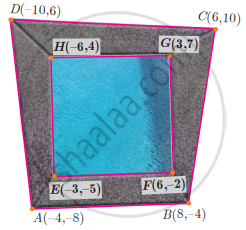
Advertisements
उत्तर
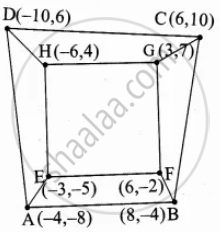
Area of the Quadrilateral ABCD = `1/2[(x_1y_2 + x_2y_3 + x_3y_4 + x_4y_1) - (x_2y_1 + x_3y_2 + x_4y_3 + x_1y_4)]`
= `1/2[(16 + 80 + 36 + 80) - (-64 - 24 - 100 - 24)]`
= `1/2[212 - (-212)]`
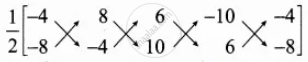
= `1/2[212 + 212]`
= `1/2[424]`
= 212 sq. units
Area of the Quadrilatera swimming pool EFGH = `1/2[(6 + 42 + 12 + 30) - (- 30 - 6 - 42 - 12)]`
= `1/2[90 - (- 90)]`
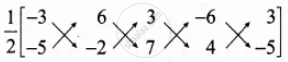
= `1/2[90 + 90]`
= `1/2 xx 180`
= 90 sq. units
Area of the patio = Area of the Quadrilateral ABCD – Area of the Quadrilateral EFGH
= (212 – 90) sq. units
Area of the patio = 122 sq. units
APPEARS IN
संबंधित प्रश्न
The area of a parallelogram is y cm2 and its height is h cm. The base of another parallelogram is x cm more than the base of the first parallelogram and its area is twice the area of the first. Find, in terms of y, h, and x, the expression for the height of the second parallelogram.
Calculate the area of quadrilateral ABCD, in which ∠ABD = 90°, triangle BCD is an equilateral triangle of side 24 cm and AD = 26 cm.
How many tiles, each of area 400 cm2, will be needed to pave a footpath which is 2 m wide and surrounds a grass plot 25 m long and 13 m wide?
Using the information in the following figure, find its area.
A quadrilateral field of unequal has a longer diagonal with 140m. The perpendiculars from opposite vertives upon this diagonal are 20m and 14m. Find the area of the field.
Find the area of a quadrilateral field whose sides are 12m, 9m, 18m and 21m respectively and the angle between the first two sides is a right angle. Take the value of `sqrt(6)` as 2.5.
Find the diagonal of a quadrilateral whose area is 756cm2 and the perpendicular from the opposite vertices are 17cm and 19cm.
In the following, find the value of ‘a’ for which the given points are collinear
(2, 3), (4, a) and (6, – 3)
Let P(11, 7), Q(13.5, 4) and R(9.5, 4) be the midpoints of the sides AB, BC and AC respectively of ∆ABC. Find the coordinates of the vertices A, B and C. Hence find the area of ∆ABC and compare this with area of ∆PQR.
When proving that a quadrilateral is a trapezium, it is necessary to show
