Advertisements
Advertisements
प्रश्न
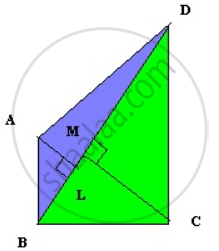
A quadrilateral field of unequal has a longer diagonal with 140m. The perpendiculars from opposite vertives upon this diagonal are 20m and 14m. Find the area of the field.
Advertisements
उत्तर

In quadrilateral ABCD, the sides AB, BC, CD and AD are unequal.
The longer diagonal BD = 140m
AM ⊥ BD, CL ⊥ BD
AM = 20m and CL = 14m.
We split a quadrilateral into triangles and find its area.
We know that,
Area of a Triangle = `(1)/(2)"b.h" "i.e" (1)/(2)("Base" xx "Height")`
Ar(ΔABD) = `(1)/(2)"BD" xx "AL";(Δ"CBD") = (1)/(2)"BD" xx "CM"`
Ar(QuadABCD) = Ar(ΔABD) + Ar(ΔCBD)
= `(1)/(2)"BD" xx "AL" + (1)/(2)"BD" xx "CM"`
= `(1)/(2)"BD" xx ("AL" + "CM")`
= `(1)/(2) xx 140 xx (20 + 14)`
= 70 x 34
= 2380m2.
APPEARS IN
संबंधित प्रश्न
The diagonal of a rectangular plot is 34 m and its perimeter is 92 m. Find its area.
The diagonals of a quadrilateral are 16 cm and 13 cm. If they intersect each other at right angles; find the area of the quadrilateral.
A rectangular plot 85 m long and 60 m broad is to be covered with grass leaving 5 m all around. Find the area to be laid with grass.
A floor that measures 15 m x 8 m is to be laid with tiles measuring 50 cm x 25 cm. Find the number of tiles required.
Further, if a carpet is laid on the floor so that a space of 1 m exists between its edges and the edges of the floor, what fraction of the floor is left uncovered?
The shaded region of the given diagram represents the lawn in the form of a house. On the three sides of the lawn, there are flowerbeds having a uniform width of 2 m.
(i) Find the length and the breadth of the lawn.
(ii) Hence, or otherwise, find the area of the flower-beds.
A triangle and a parallelogram have the same base and the same area. If the side of the triangle is 26 cm, 28 cm, and 30 cm and the parallelogram stands on the base 28 cm, find the height of the parallelogram.
Using the information in the following figure, find its area.
Find the diagonal of a quadrilateral whose area is 756cm2 and the perpendicular from the opposite vertices are 17cm and 19cm.
Vertices of given triangles are taken in order and their areas are provided aside. Find the value of ‘p’.
| Vertices | Area (sq.units) |
| (p, p), (5, 6), (5, –2) | 32 |
When proving that a quadrilateral is a trapezium, it is necessary to show